US December Retail Sales Preview: Can dollar capitalize on upbeat data?
- Retail Sales in the US are forecast to remain unchanged in December.
- Dollar has been having a difficult time finding demand this week.
- Market participants will pay close attention to Retail Sales Control Group print.

Retail Sales data for the month of December will be released by the US Census Bureau on Friday, January 14. Investors expect sales to remain unchanged at $639.8 billion in December following a 0.3% increase in November.
Whilst the market reaction to this data point is usually pretty muted, the Retail Sales Control Group, which represents the total industry sales that are used to prepare the estimates of the Personal Consumption Expenditures (PCE) for most goods, may elicit a response.
In November, the Retail Sales Control Group contracted by 0.1%; in contrast, it is forecast to rise by 0.1% in December. A stronger-than-expected increase could help the greenback show some resilience against its rivals ahead of the weekend but it is unlikely to trigger a convincing recovery in the US Dollar Index (DXY). On the other hand, a negative print should open the door for an extended DXY decline.
Earlier in the week, the dollar sold off after FOMC Chairman Jerome Powell said they will need up to four policy meetings to come up with a plan to reduce the balance sheet. This contradicted the view held by many policymakers in the minutes of the December policy meeting that it was appropriate to start the balance sheet runoff after the first rate hike.
On Wednesday, the US Bureau of Labor Statistics reported that the annual Consumer Price Index (CPI) rose to 7% in December from 6.8% in November. With this print matching the market consensus, investors seem to be reassessing the odds of the Fed hiking the policy rate four times in 2022.
To summarize, the dollar is struggling to find demand as this week's developments suggest that the Fed could afford to stay patient when it comes to policy tightening and the Retail Sales report by itself is unlikely to change that.
DXY technical outlook
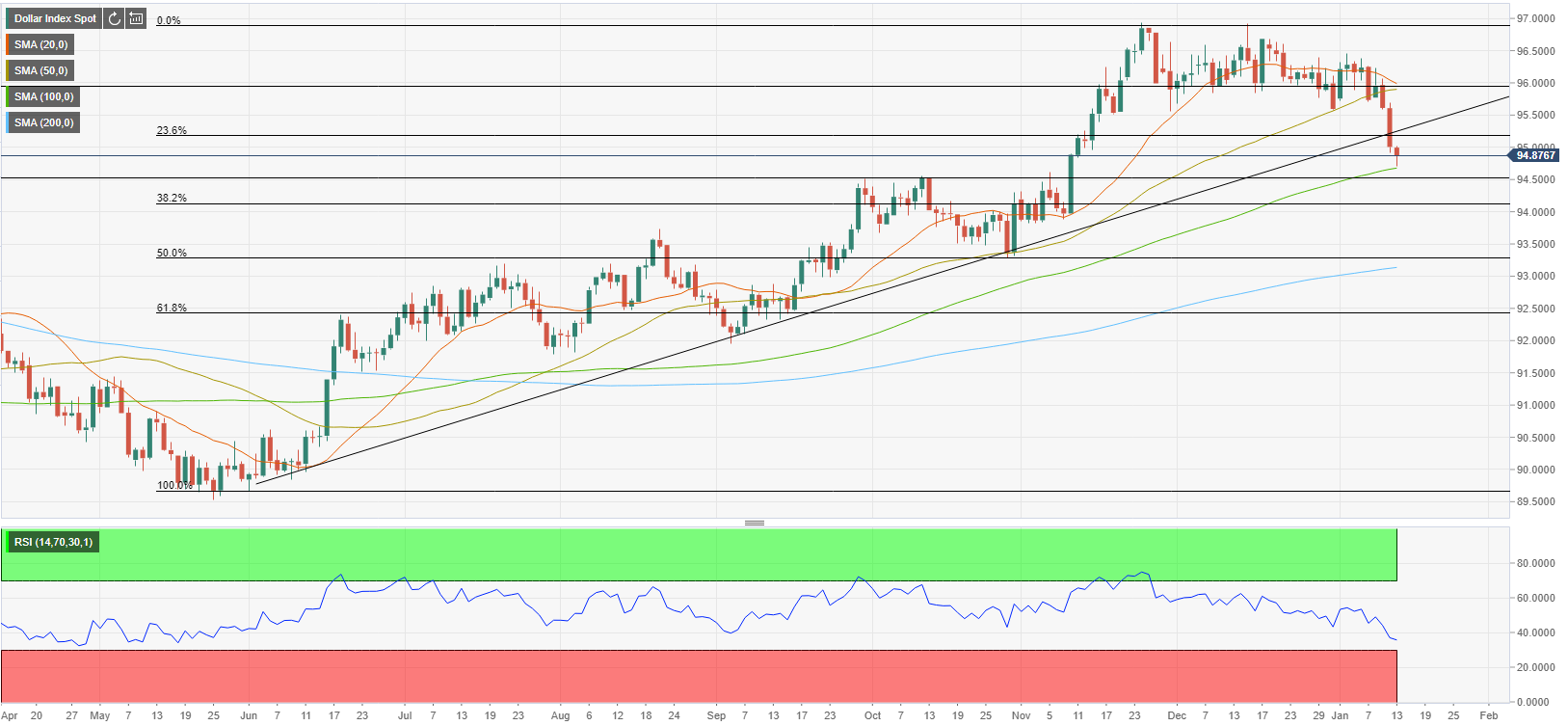
DXY could fall further before becoming technically oversold, according to the Relative Strength Index (RSI) indicator which is holding above 30 on the daily chart. The index is staying below the six-month-old ascending trendline, confirming the bearish bias.
A strong support area seems to have formed at 94.60/50 (100-day SMA, former resistance). A daily close below that support could see DXY target 94.00, where the Fibonacci 38.2% retracement of the June-December uptrend is located.
In case the index stages a technical correction, it could meet first resistance at 95.20 (Fibonacci 23.6% retracement, ascending trendline) before returning to 96.00 (50-day SMA, psychological level).
Author

Eren Sengezer
FXStreet
As an economist at heart, Eren Sengezer specializes in the assessment of the short-term and long-term impacts of macroeconomic data, central bank policies and political developments on financial assets.
















