US CPI preview: Moderation on the horizon, but underlying pressures linger


The US Consumer Price Index for October will be released on Tuesday, November 10, at a time when financial markets are receiving rather different signals from inflation, employment and credit conditions.
September's inflation report showed headline consumer prices rising by 0.6% month over month, while core inflation increased by 0.3%. It was a significant acceleration in the headline figure, largely driven by energy prices.
For October, the market expects headline inflation to slow to 0.3%, with core inflation easing to 0.2%.
Our forecast is slightly below consensus for the headline figure. We expect headline CPI to increase by 0.2% month over month, while core CPI should also rise by approximately 0.2%.
The distinction matters because the latest economic indicators suggest that inflationary pressure has not disappeared. It may simply be moving through different parts of the economy at different speeds.
What the Cleveland Fed is telling us
The Federal Reserve Bank of Cleveland's inflation nowcasting model provides a useful starting point.
Its latest estimates place October headline CPI at 0.24% month over month and core CPI at 0.21%.
Both figures would round to approximately 0.2% if the underlying estimates were realized. However, headline inflation is particularly close to the threshold separating a reported 0.2% from 0.3%, leaving little room for forecasting error.
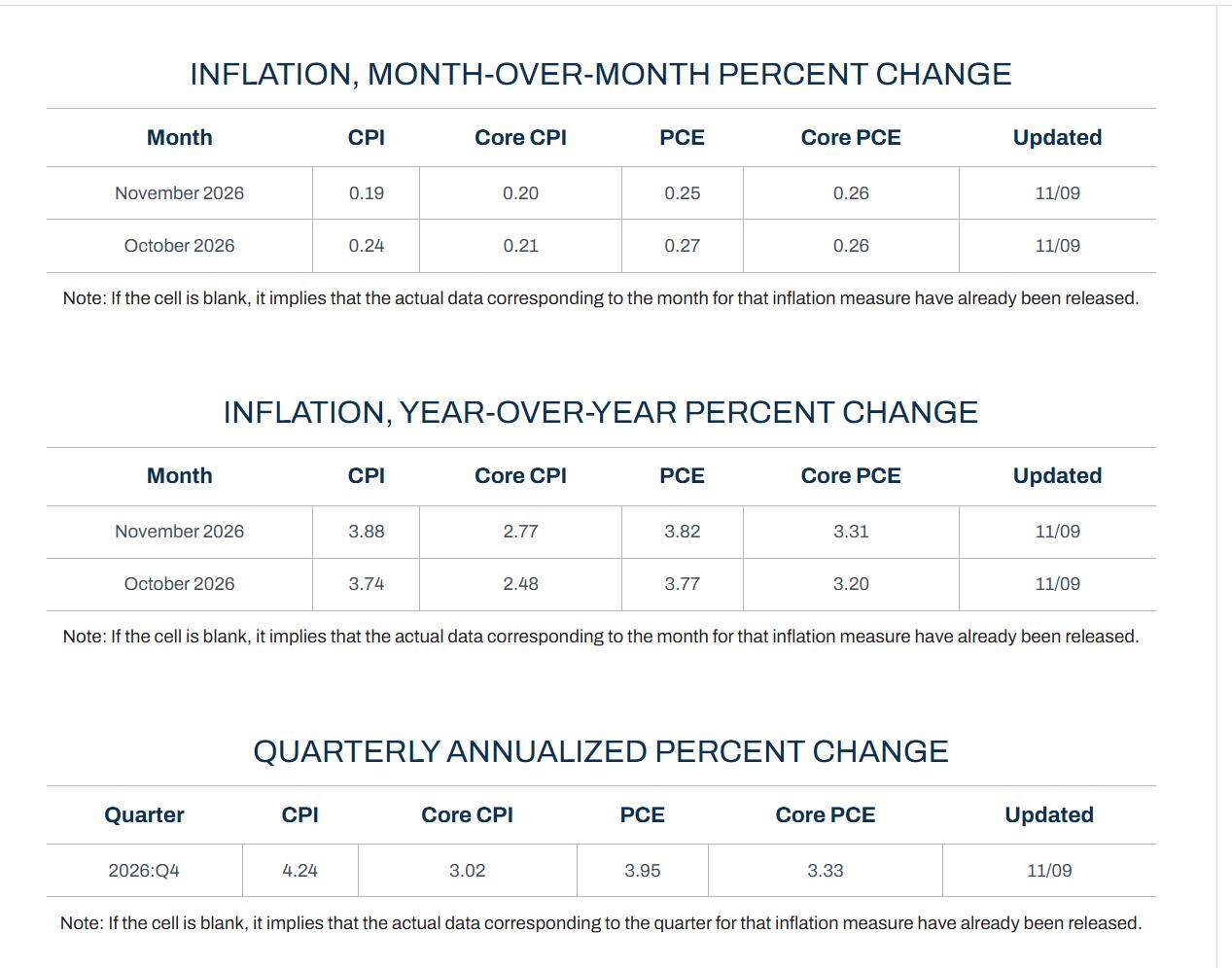
The Cleveland model therefore supports a relatively moderate inflation reading, but it does not eliminate the possibility of an upside surprise.
Looking at the previous releases, the headline CPI increased by 0.4% in August and 0.6% in September. Core inflation, meanwhile, increased by 0.3% in both months.
This suggests that the recent acceleration was not entirely limited to energy, although energy clearly played a major role in September.
The question is whether October's underlying price developments were strong enough to maintain that momentum.
Producer prices remain a concern
September's Producer Price Index was considerably stronger than expected.
Headline producer prices increased by 1.3% month over month and 6.3% year over year. Final-demand energy prices rose by 10.8%, while transportation and warehousing costs increased by 3.4%.
These figures suggest that companies were experiencing substantial cost pressure well before the latest CPI release.
The problem is that higher producer prices do not automatically translate into higher consumer prices in the following month.
Some businesses pass additional costs directly to consumers. Others absorb them through lower margins, while certain industries adjust prices only after several months.
This distinction is particularly relevant when analyzing energy-related inflation.
Higher diesel prices, for example, can increase transportation expenses for manufacturers, agricultural producers and retailers. Those costs may eventually appear in consumer goods prices, even after the original increase in crude oil prices has reversed.
The September PPI therefore remains an inflationary warning signal, but it does not provide sufficient evidence on its own to justify an October CPI forecast above the Cleveland Fed's estimate.
October's ISM data show a more complicated picture
The October ISM surveys provide additional information because they reflect economic conditions during the actual CPI reporting month.
Manufacturing Prices Paid declined from 77.9 in September to 75.2 in October.
Services Prices Paid also decreased, moving from 74.0 to 73.0.
Both indicators remain exceptionally elevated, suggesting that price increases continue to affect a substantial portion of surveyed businesses.
However, the decline in both indexes indicates that the breadth of reported price increases has eased slightly.
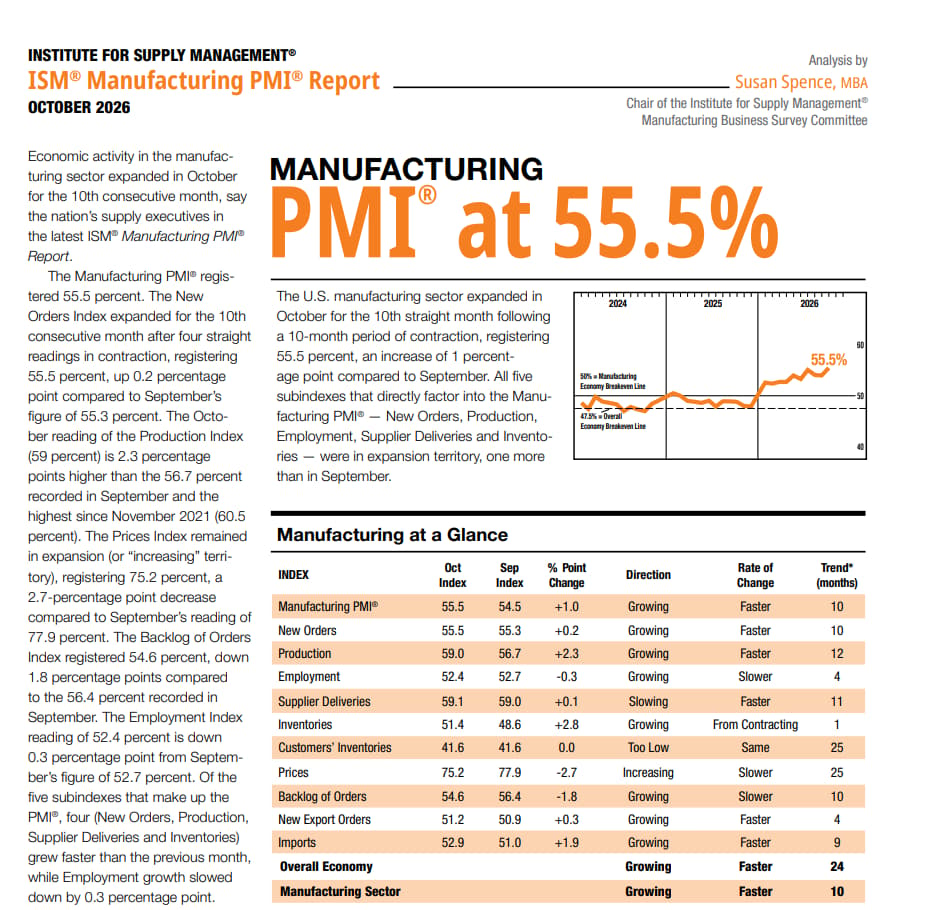
This is not necessarily the same as falling prices. The ISM price indexes measure how widespread price increases are, rather than their precise magnitude.
There are also signs of softer demand in the service sector.
The Services New Orders Index declined from 59.8 to 55.9, while Business Activity fell from 56.5 to 53.8.
This combination is interesting because businesses continue to report higher input costs while demand growth appears less dynamic.
Over time, weaker demand could make it more difficult for companies to pass additional costs on to customers.
For the October CPI, however, these developments provide only a modest disinflationary signal. They are not evidence that underlying inflation has already returned to a comfortable level.
Energy may be the main reason headline inflation slows
Energy remains one of the most important components of our forecast.
In an earlier analysis, we examined how rising crude oil, diesel, LNG and aviation fuel prices could create inflationary pressure extending beyond the energy sector.
That concern remains relevant.
However, the October price data suggest that we should distinguish between elevated energy costs and continued price acceleration.
US regular gasoline prices declined during October. According to weekly Energy Information Administration observations, the national average fell from approximately $4.35 per gallon in the first week of October to $4.27 in the final week.
Our calculations also suggest that the average of the October weekly observations was slightly below September's average.
This matters because gasoline prices were a major contributor to September's strong headline CPI reading.
A moderation in gasoline prices during October could therefore reduce the energy contribution to headline inflation.
Nevertheless, the relationship is not exact. The official CPI uses seasonally adjusted price changes, while the weekly gasoline figures are not seasonally adjusted.
There is also an important difference between crude oil and refined petroleum products.
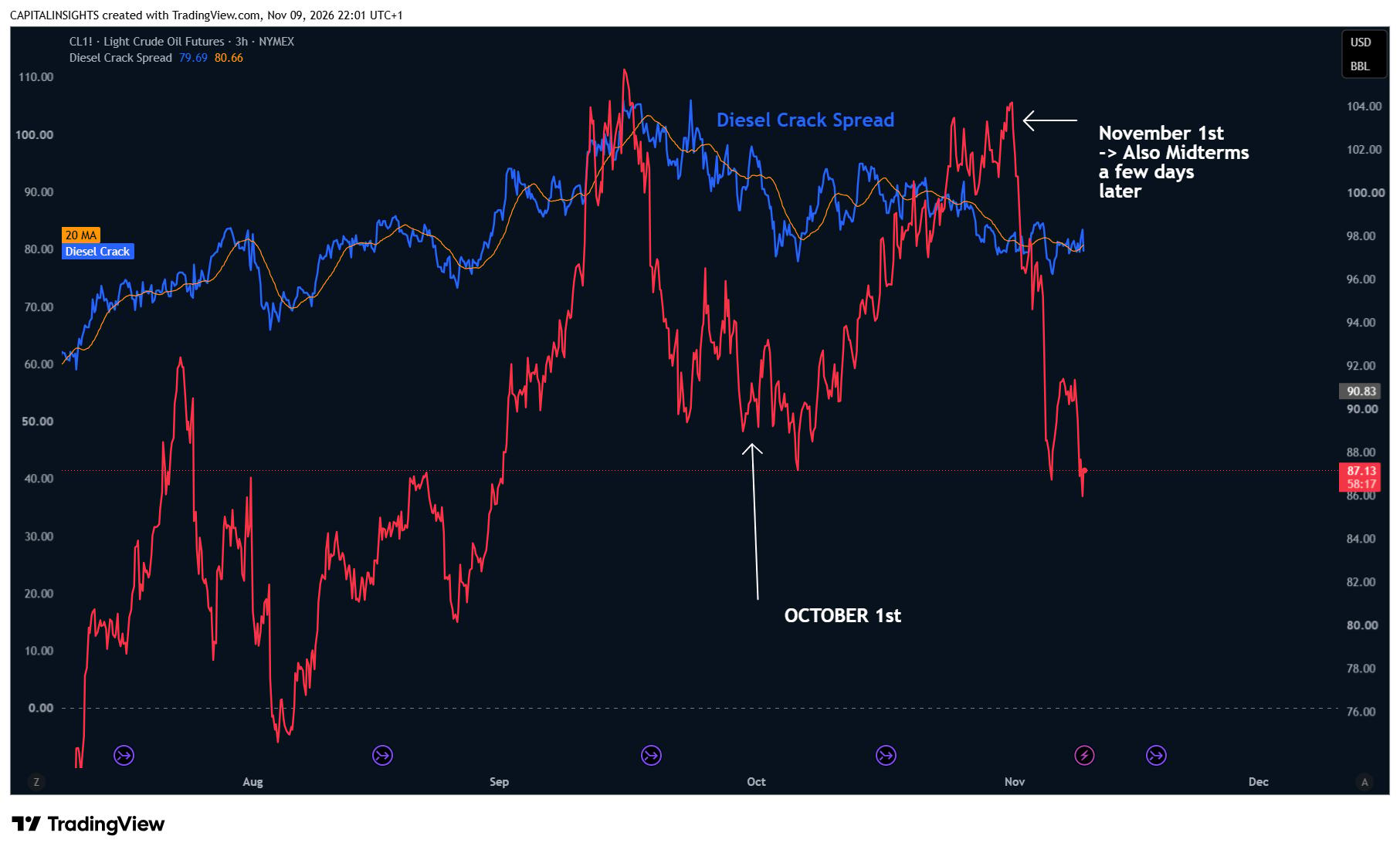
Our recent market observations showed significant volatility in WTI crude oil and continued pressure in the diesel refining market.
Even where crude oil prices decline, refining costs and transportation constraints can prevent fuel prices from adjusting immediately.
For now, the energy data support our expectation of slower headline inflation, while leaving open the possibility that earlier cost increases continue feeding through to other consumer prices.
Housing remains a risk for core inflation
The latest Zillow Observed Rent Index also deserves attention.
Based on the national seasonally adjusted data through September, asking rents increased by approximately 0.35% month over month and 2.88% year over year.
The monthly pace of rent growth accelerated considerably throughout much of 2026.
A broader examination of metropolitan rental markets also suggests that the increase has not been limited to a small group of major cities.
This creates a potential risk for future shelter inflation.
However, Zillow measures asking rents for properties entering the rental market. The official CPI shelter component also includes rents paid under existing leases and owners' equivalent rent.
These measures respond to changes in market rents with a delay.
As a result, stronger Zillow rental growth in September does not necessarily mean that October's official shelter inflation will accelerate immediately.
For our forecast, the data argue against assuming that housing-related inflation has permanently weakened.
At the same time, they do not justify a significant upward adjustment to the October core CPI estimate.
Inflation expectations and the Federal Reserve
Longer-term inflation expectations provide another perspective.
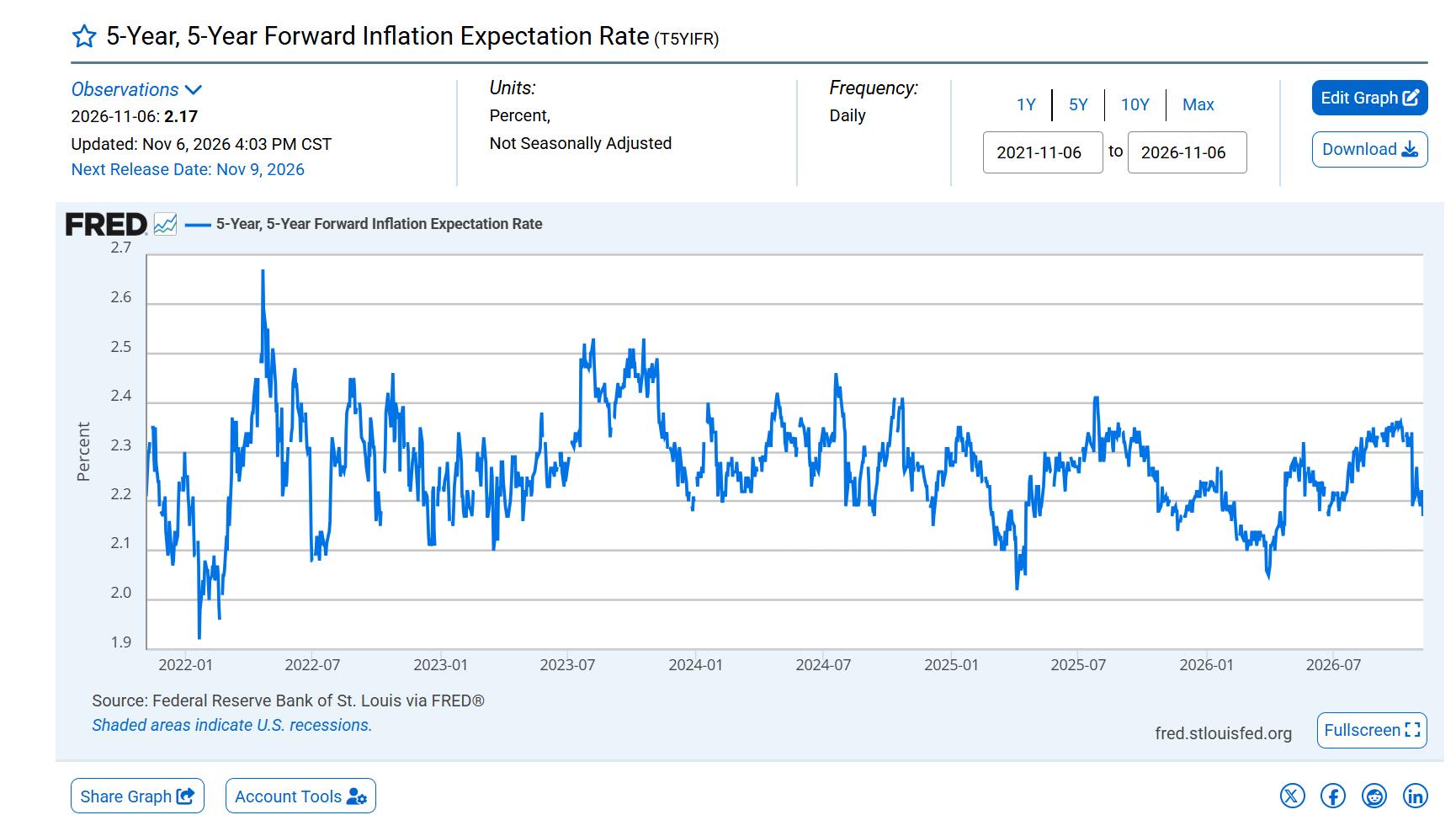
The five-year, five-year forward inflation expectation rate stood at 2.17% on November 6.
That is below its average level during October and suggests that the recent increase in producer prices has not produced a comparable increase in long-term market-based inflation compensation.
However, the indicator also reflects inflation risk and liquidity premiums, and should not be interpreted as a direct forecast of next month's consumer prices.
The Federal Reserve is facing an additional challenge.
At its October meeting, the Fed maintained its target range at 3.75%–4.00%, while two policymakers preferred another 25-basis-point increase.
The latest employment report has also complicated the inflation outlook.
The US economy added 165,000 jobs in October, while the unemployment rate remained at 4.1%. Average hourly earnings increased by 0.4% month over month.
These figures suggest that the labor market remains resilient despite the recent pressure in financial markets.
If inflation remains elevated while employment continues to hold up, the Fed may see little reason to abandon its restrictive policy stance.
A softer CPI report could reduce the urgency of additional tightening, but one moderate inflation reading would not necessarily be sufficient to change the broader monetary policy outlook.
Why the Nasdaq reaction may be different this time
The October CPI report arrives during a difficult period for technology stocks.
The Nasdaq 100 has experienced a substantial correction, while corporate credit spreads have widened and investors have become more cautious about the financing requirements of the artificial intelligence industry.
In previous analyses, we discussed why falling Treasury yields should not always be interpreted as a positive signal for equities.
Lower government bond yields can improve the valuation of long-duration assets such as technology stocks.
However, the reason yields are falling is equally important.
If Treasury yields decline because inflation expectations are easing without a significant deterioration in economic growth, that would generally be supportive for the Nasdaq.
But if yields fall because investors are seeking safety while corporate credit spreads continue widening, the improvement in government borrowing costs may provide little relief to companies facing higher financing risk premiums.
This distinction is particularly relevant for businesses with substantial capital expenditure requirements.
A softer CPI release could initially support technology stocks through lower interest rate expectations.
Whether that develops into a sustained recovery would depend partly on the reaction in credit markets, the dollar and the broader Treasury curve.
Our October CPI forecast
Our baseline expectation is for headline CPI to increase by 0.2% month over month, slightly below the market consensus of 0.3%.
We expect core CPI to rise by 0.2%, in line with consensus.
The main argument behind the headline forecast is the moderation in gasoline prices after September's energy-driven inflation increase.
For core inflation, the situation is more balanced.
Elevated producer prices, persistent service-sector input costs and stronger rental-market trends point to continuing inflationary pressure.
However, softer ISM price readings, slowing service-sector order growth and the delayed transmission of housing costs suggest that a significant acceleration in October core CPI is not the most convincing baseline scenario.
A core CPI reading of 0.3% would challenge this assessment and likely strengthen expectations for further Federal Reserve tightening.
Conversely, a headline reading of 0.2% accompanied by core inflation of 0.2% would represent a modest downside surprise relative to the broader market forecast.
It could initially support Treasury prices and interest-rate-sensitive equities, although the reaction would depend on whether credit conditions stabilize.
One unusual feature of tomorrow's report is that the Bureau of Labor Statistics will not publish the standard 12-month changes for most CPI categories because the necessary October 2025 reference data are unavailable following last year's government shutdown.
The monthly figures and the underlying category details will therefore carry particular importance.
Conclusion
Our forecast points toward a moderation in October inflation, but not necessarily the end of the inflationary pressure that has developed over recent months.
The energy component may provide short-term relief, while higher production costs and persistent service-sector pricing pressure remain relevant risks for the months ahead.
For the Federal Reserve, the challenge is that inflation is showing signs of moderation without clear evidence of a significant weakening in the labor market.
For financial markets, the challenge is slightly different.
A lower CPI reading would be welcome, particularly after the recent correction in technology stocks.
But inflation is only one part of the current market environment.
Treasury yields, corporate credit spreads and the sustainability of AI-related investment will continue to influence how investors interpret the data.
A softer inflation report could create the conditions for a recovery. Whether that recovery lasts will depend on whether financial conditions begin to improve alongside it.
Author