Two Huangs don’t make a right: Nvidia CEO caught in scandal – NVDA slides
Just hours ago, Nvidia CEO Jensen Huang sent employees an apology for being unfaithful to his wife, following reports that he may have been targeted in a foreign intelligence operation.
And, because the internet never misses an opportunity, the joke practically wrote itself: “Two Huangs don’t make a right.”
The woman allegedly is Alice Huang, a former Megaspeed executive suspected by US officials of being a Chinese spy.
Okay, juicy gossip. Big whoop. But why is Nvidia trading roughly 5–6% below Friday’s close in the overnight market?
And – more importantly – does this actually matter to the AI trade?
The risk is not the affair – It is what the investigation might uncover
Nvidia’s board has launched an independent investigation into the alleged intelligence effort. It says it currently has no reason to believe company secrets or national security were compromised, and Huang remains CEO.
If nothing material emerges, the scandal does not suddenly reduce demand for Nvidia’s chips. If investigators uncover compromised information, export-control issues or misconduct, that is a different story.
And let’s address the potential divorce (with allegedly no prenup) and therefore, share allocation to Jensen’s wife – Lori Huang.
There is no confirmed divorce or forced share sale either. There is also no verification on the prenup situation.
Treating a hypothetical division of family assets as the reason for today’s gap is getting ahead of the evidence.
What we know | What we do not know |
Huang acknowledged infidelity; Nvidia is investigating; the board has not identified a compromise. | Whether espionage occurred, whether corporate data was exposed, or whether governance and export controls will face consequences. |
So, are investors actually panicking?
Not exactly. There was an initial sell-off in US futures, followed by a complete reversal within seven minutes.
That is more consistent with a knee-jerk headline shock than a settled verdict on Nvidia’s business.
For context, its last reported quarter delivered $96.2 billion in revenue, up 106% year on year, including $89.0 billion in data-centre revenue.
Nvidia’s next results are due 17 November.
Do scandals actually make good buying opportunities?
Maybe. Jeff Bezos’s affair and divorce dominated the news in 2019, but Amazon’s business carried on.
Microsoft kept growing after Bill Gates’s past relationship with an employee came to light in 2021.
And SK Group chairman Chey Tae-won admitted in 2015 that he had a daughter outside his marriage, long before SK hynix’s AI-memory rally.
But don’t confuse three anecdotes with a trading system. Amazon initially seesawed, Gates was no longer Microsoft’s CEO, and Chey’s divorce triggered a genuine, costly ownership dispute.
The point is that personal scandal doesn’t automatically impair a company’s earnings. It also doesn’t guarantee a bargain.
There is one notable difference with Jensen: rather than stay silent, he issued a company-wide apology while Nvidia’s board announced an independent review. That puts his response on the record and gives investors something concrete to assess.
He did not get ahead of the leaks, though: reporting on the alleged intelligence links began on 29 October, before his 8 November admission.
Nvidia was already sliding before the scandal
The daily chart had already broken its 200-day EMA, near $205. Friday’s modest rebound formed an inside candle after the preceding sell-off. This is a hint that bearish momentum might be easing, but not proof of a reversal.
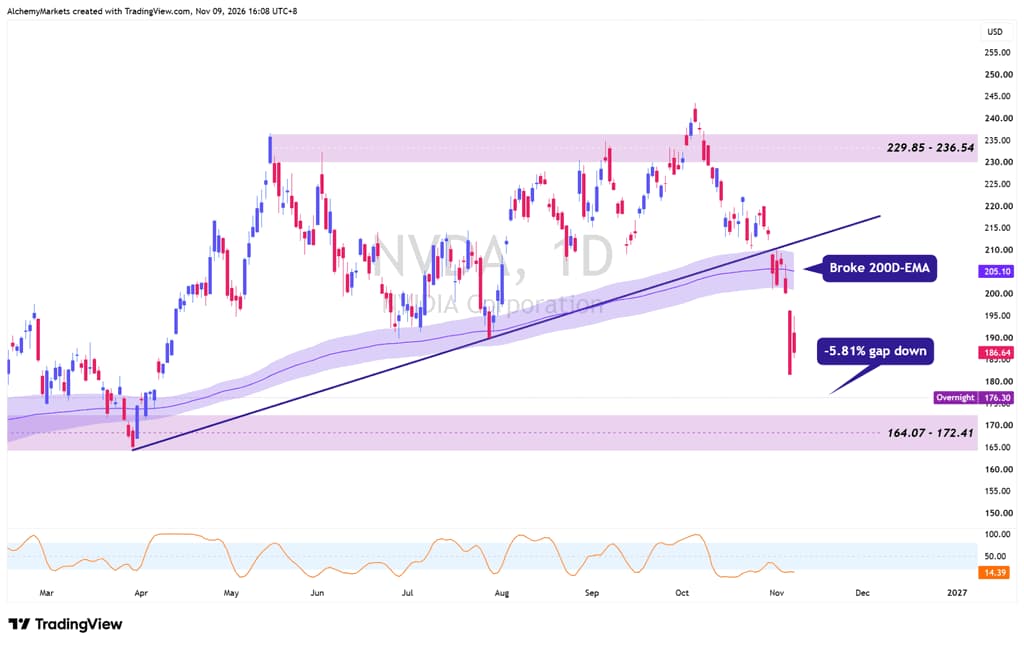
Monday’s overnight weakness threatens that tentative stabilisation.
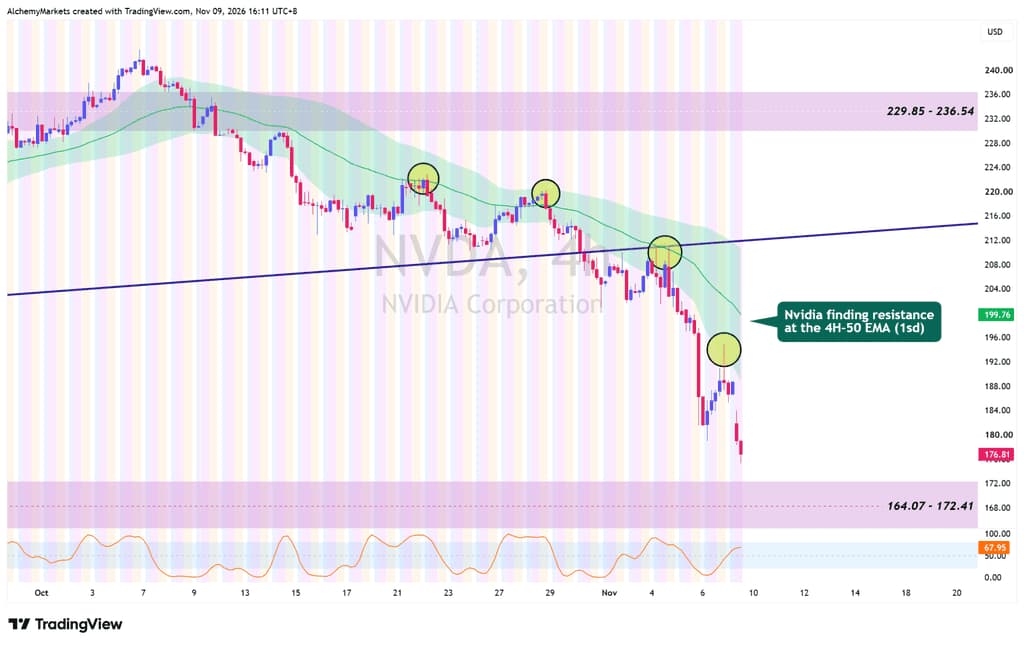
On the 4-hour chart, the 50-period EMA with a one-standard-deviation band (Bollingers Band) continues to cap rallies, most recently around its outer edge. A bounce toward roughly $195–200 would test that resistance again. Below, the next major demand zone spans $172.41 to $164.07
What about the rest of the AI trade?
The sympathy sell-off is surprisingly limited in the chart snapshots. AMD is holding around its daily 200 EMA, while Meta and Alphabet show a firmer hold. TSMC remains technically weak, but not every chip or AI name is following Nvidia lower. That argues against calling this a sector-wide panic, at least before New York opens.
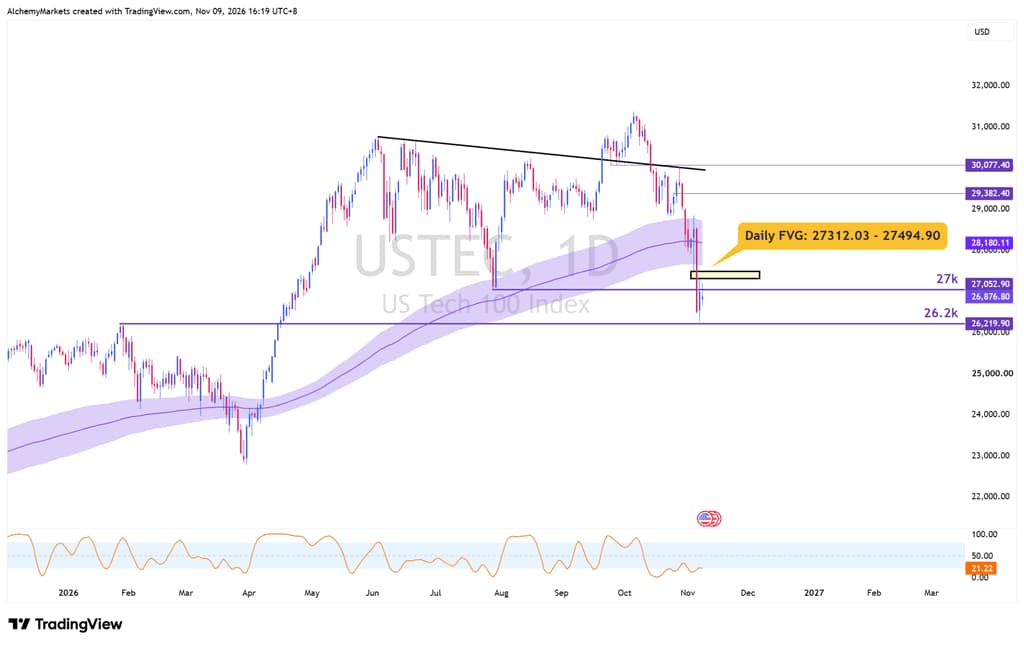
US Tech 100 faces its first important hurdle near 27,050, followed by a daily fair-value gap at 27,312–27,495. Below, 26,220 is the most important support to watch. A loss of that level would make the wider tech picture considerably less comfortable.
Is it sensationalisation or an opportunity?
For now, the sell-off looks more dramatic than the demonstrated business damage.
A public apology doesn’t change chip demand. But a confirmed security breach, export-control problem or leadership disruption would change the investment case. That is why Jensen’s handling of the story matters, but cannot settle it.
Watch the price action, not just the punchlines. If USTEC holds 26,220, peers stay resilient and Nvidia begins reclaiming its 4H resistance near $195–200, the reaction may prove to be a headline-driven shakeout.
A break below Nvidia’s $164–172 demand zone alongside wider tech weakness would challenge that view.
New York’s 9:30 a.m. ET open is the next test. Scandals can produce opportunities. The opportunity comes when the market overprices a risk; not merely because the headline is embarrassing.
Author

Zorrays Junaid
Alchemy Markets
Zorrays Junaid has extensive combined experience in the financial markets as a portfolio manager and trading coach. More recently, he is an Analyst with Alchemy Markets, and has contributed to DailyFX and Elliott Wave Forecast in the past.