US Consumer Confidence Preview: Confidence remains down, but DXY aims up
- CB Consumer Confidence is expected to have shrunk in May to 99.1.
- Uncertainty about the Federal Reserve's next steps undermines the US Dollar's strength.
- The Dollar Index has room to extend recovery gains beyond the 105.00 mark.

Consumer confidence in the United States has come under the spotlight in 2022, as soaring inflation in the aftermath of the coronavirus-related lockdowns carved Americans’ earnings. The world continues to suffer from higher-than-desirable inflation, but price pressures are easing and bringing some hope to speculative interest. Consumers, however, are experiencing a different story.
The Conference Board Consumer Confidence Index fell in April to 101.3 from 104.0 in March and is expected to have shrunk further in May to 99.1. Since February 2022, the Expectations sub-component has remained below 80, a level usually associated with expectations of a recession within the next year. In fact, the sub-index fell to 68.1 in April from 74 in the previous month, indicating people do not see the situation improving and still fear worsening economic conditions.
Furthermore, US Federal Reserve (Fed) officials have surprised financial markets with hawkish comments, suggesting they may hike rates at least once or twice more. An upward revision to the Q1 Gross Domestic Product (GDP) somehow diminished the chances of a downturn while boosting speculation for additional hikes.
With that in mind, market players should not be surprised by a dismal reading. The opposite scenario, however, could fuel the recent optimism related to US authorities' announcement of a debt-ceiling deal. According to the latest on the matter, President Joe Biden and House Speaker Kevin McCarthy reached an agreement that still needs to pass Congress. Still, Democrats and Republicans are confident they will solve the situation before the country falls into default.
USD possible scenarios
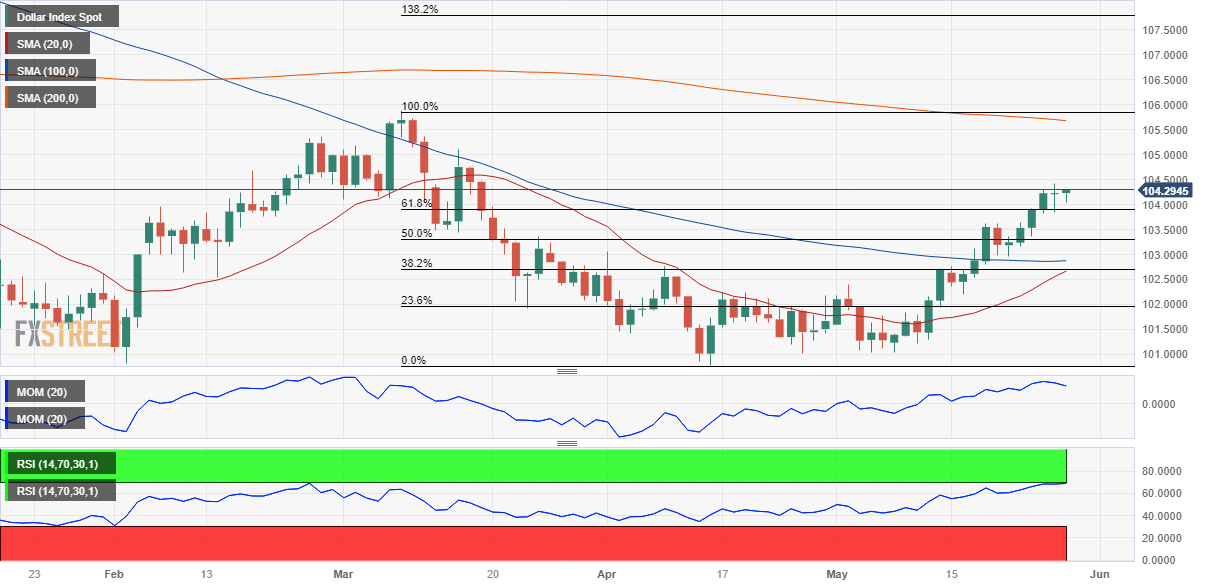
The US Dollar preserves its strength ahead of the release, in an unusual start to the week, with bank holidays in Europe and the US. Wall Street’s futures are up but confined to tight ranges. The US Dollar Index (DXY) has changed course after bottoming at 100.78 in mid-April and currently hovers around 104.30. It’s yet to be seen if the Greenback could extend gains in a risk-on environment, which is more likely to happen once markets return to full mode.
From a technical perspective, it seems the DXY has additional room to reconquer, as it is currently finding support at the 61.8% retracement of its latest slide, measured between 105.88 and the aforementioned low at 103.92.
Additionally, the daily chart shows that DXY advances above its 20 and 100 Simple Moving Averages (SMAs), with the shorter about to cross above the longer one. Technical indicators consolidate near overbought readings, losing their bullish momentum amid a quiet start to the week, but without anticipating an upcoming decline.
The DXY has an immediate resistance level at 104.41, Friday’s two-month high, followed by 104.77. Once beyond the latter, it could rally towards the top of the range. On the other hand, a break through 103.90 could lead to a steeper correction towards the 103.30 area.
Author

Valeria Bednarik
FXStreet
Valeria Bednarik was born and lives in Buenos Aires, Argentina. Her passion for math and numbers pushed her into studying economics in her younger years.