US and France face growing debt challenges ahead of crucial elections

The United States has reached a significant milestone in its public finances, with federal debt held by the public climbing to approximately 100% of gross domestic product (GDP) for the first time since the aftermath of World War II. Across the Atlantic, France is facing an even heavier public debt burden, alongside rising government borrowing costs and growing difficulties implementing spending cuts.
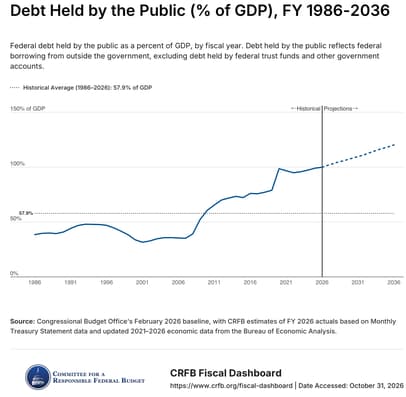
Federal debt held by the public as a percent of GDP - Source: CFRB
Despite their different economic circumstances, the two countries share an increasingly difficult political challenge: convincing investors that their governments can bring public finances under control while navigating divided political institutions and electoral pressures. The timing is particularly important, because American voters will head to the polls for the midterm elections on November 3, 2026, while France is preparing for a presidential election in April and May 2027.
Both electoral cycles could influence fiscal policy decisions, potentially making unpopular tax increases and spending reductions harder to implement. For financial markets, the question is whether political uncertainty will further delay the measures needed to stabilise government debt.
US and France face mounting public debt pressures
The latest US figures highlight the scale of the country’s fiscal challenge. According to calculations reported by The Wall Street Journal on October 29, federal debt held by the public reached 100.03% of GDP at the end of the 2026 fiscal year, which closed on September 30. This compares with 99.4% a year earlier and represents the highest level since 1946, when wartime borrowing pushed the ratio to 106%.
The federal budget deficit reached almost $2 trillion, equivalent to 6.2% of GDP. The increase in borrowing comes despite relatively strong economic activity, with US GDP expanding at a rapid pace in the third quarter. This illustrates how persistent spending commitments and insufficient revenue growth can push debt higher even when the economy is performing well.
Rising interest payments are becoming another important concern. The Committee for a Responsible Federal Budget estimated that net interest expenditure reached approximately $1.1 trillion in fiscal 2026, equivalent to 3.4% of GDP. Meanwhile, longer-term spending pressures are expected from an ageing population and entitlement programmes. Social Security is projected to face insolvency in 2032 unless Congress introduces changes to its financing or benefits.
France is confronting a different combination of fiscal and economic difficulties. According to the French Treasury’s October 2026 public debt report, Maastricht public debt is expected to increase from 115.7% of GDP in 2025 to 119.3% in 2026 and 121.7% in 2027. The government is also struggling to reduce its budget deficit, which is forecast to reach 5.4% of GDP in 2026.
Unlike the US, France is experiencing weak economic momentum alongside its deteriorating fiscal position. Its economy unexpectedly contracted by 0.1% in the third quarter, complicating efforts to increase tax revenues and reduce government borrowing. French 10-year bond yields also reached their highest level since 2002 in October above 5.14%, as investors questioned the country’s ability to deliver sustainable fiscal reforms.
Although the headline debt ratios are not directly comparable because they use different accounting definitions, both highlight a growing dependence on government borrowing. The underlying challenge is particularly significant when interest payments absorb an increasing share of public resources, leaving governments with less flexibility to respond to future economic shocks.
Political divisions could complicate fiscal consolidation
The challenge facing Washington is not simply a matter of identifying where spending could be reduced or revenues increased. Reaching political agreement on the necessary measures is becoming increasingly difficult.
The US budget debate involves competing priorities, including taxation, defence expenditure, healthcare and retirement benefits. Social Security and Medicare represent particularly sensitive areas because changes to eligibility, benefits or contributions can affect millions of voters. Although lawmakers increasingly recognise the long-term implications of rising debt, reaching a compromise remains difficult in a politically polarised environment.
The November midterm elections could add another layer of uncertainty. All 435 seats in the House of Representatives and approximately one-third of Senate seats will be contested. The outcome will determine the balance of power in Congress for the next two years and could influence the administration’s ability to pass budget legislation and implement fiscal priorities.
An opposition-controlled chamber could make negotiations over spending and taxation more difficult, potentially increasing the risk of legislative deadlock. However, even a favourable electoral outcome would not necessarily guarantee agreement on unpopular fiscal measures. Both parties face pressure to protect popular programmes while avoiding tax increases that could prove politically costly.
France faces similar obstacles, although its political structure creates a different set of constraints. The fragmented National Assembly has made it difficult for successive governments to secure support for deficit-reduction measures. Prime Minister Sébastien Lecornu is seeking to advance a 2027 budget targeting a reduction in the deficit to 5% of GDP, but proposed spending cuts have faced resistance from opposition parties.
The political environment could become even more complicated as the presidential election approaches. The first round is scheduled for April 18, 2027, followed by a second round on May 2. Competing parties are likely to put forward different approaches to taxation, public expenditure and economic policy, potentially making parliamentary compromise more difficult.
The cost of fiscal adjustment is also a major political consideration. In France, demonstrations over living costs, public services and spending reductions have highlighted the difficulty of implementing austerity measures when households are already under financial pressure. In the US, debates over entitlement programmes and government spending are similarly sensitive, particularly ahead of elections.
In both countries, the risk is that governments postpone difficult decisions to avoid alienating voters, allowing structural deficits and borrowing requirements to remain elevated.
What rising debt means for bond markets and investors
The consequences of persistent borrowing extend beyond government balance sheets. As debt increases, governments become more exposed to changes in interest rates and investor confidence. A higher cost of issuing and refinancing bonds can gradually increase interest expenditure, potentially limiting the resources available for infrastructure, healthcare, defence and other public priorities.
France is already experiencing this pressure through its sovereign bond market. The increase in OAT yields reflects concerns about the country’s fiscal outlook, political fragmentation and difficulties implementing budgetary reforms. A sustained rise in borrowing costs could further complicate debt stabilisation, particularly if economic growth remains weak.
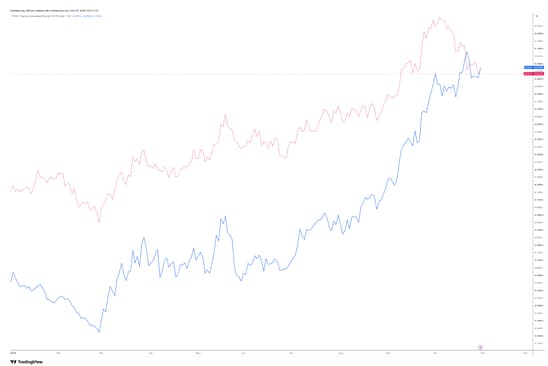
US (pink) vs France (blue) 10-year government bond yields - Source: TradingView
The US benefits from a different financing environment. Treasury securities are supported by the dollar’s international reserve-currency role and the depth and liquidity of American financial markets. This gives Washington considerable financing flexibility, but it does not eliminate the economic consequences of accumulating debt. Higher interest payments can crowd out other government expenditure, while persistent borrowing may increase the sensitivity of public finances to future increases in market rates.
The two countries also operate under different monetary arrangements. The US issues debt in its own currency and has an independent central bank, the Federal Reserve. France issues debt in euros and operates within the eurozone’s shared monetary framework, meaning that its financing conditions are influenced by both national fiscal credibility and broader ECB policy.
For investors, the distinction is important. Similar debt burdens do not necessarily translate into identical sovereign risks or market reactions. Nevertheless, both countries face the same fundamental question: how can governments maintain fiscal credibility without undermining economic growth or creating further political instability?
The upcoming elections could influence how quickly policymakers address these challenges. However, the underlying pressures extend beyond individual electoral cycles. Without credible medium-term fiscal strategies, persistent deficits and rising interest payments could increasingly constrain government budgets on both sides of the Atlantic.
Sources: The Wall Street Journal, Reuters, Committee for a Responsible Federal Budget, Congressional Budget Office, French Treasury, European Commission, Yahoo Finance, USAGov, French Government
Stay up to date with what's moving and shaking on the world's markets and never miss another important headline again! Check ActivTrades daily news and analyses here.
Author

Carolane de Palmas
ActivTrades
Carolane graduated with a Masters in Corporate Finance & Financial Markets and got the AMF Certification (Financial Markets Regulator in France). Afterward, she became an independent trader, investing mostly in European and American stocks/indices.