|

United States: The Fed’s discount window now more attractive for smaller banks

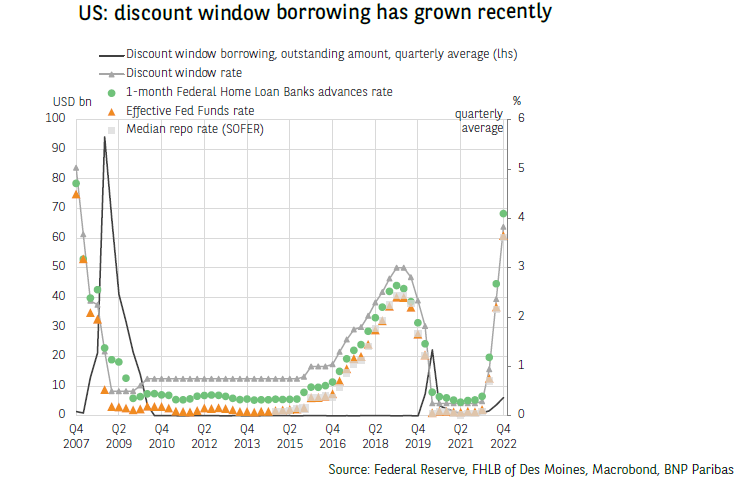
The drawdowns of depository institutions from the US Federal Reserve’s (Fed) discount window have intensified over the past year. Their outstandings amounted to USD 4.6 billion on 18 January, certainly far from the USD 110 billion borrowed at the height of the 2008 financial crisis, but well above the USD 360 million borrowed on average for 15 years1. However, no major financial stress or central bank money shortage seems to justify this. The list of borrowers – which will only be disclosed in two years’ time – should mainly include small institutions, which are distanced from the risk of stigma associated with the use of this window. We see two main reasons for this.

The first is that the reduction in the Fed’s balance sheet has significantly reduced the liquid assets (reserves) and stable resources (deposits) of smaller banks. Their reserve-to-asset ratio is now at a level comparable to that of the last round of quantitative easing (and the massive central bank liquidity injection) at 6.5% (Fed H.8 data), while their loan-to-deposit ratio has risen by 10 percentage points in just one year.

The second reason is the relaxation of the scheme in March 2020 by the Fed. On the one hand, the Fed removed the penalty applied, by fixing the discount rate at the upper limit of the target rate for federal funds2 and, on the other hand, extended the maturity of loans3. Since the beginning of monetary tightening in March 2022, so-called “ emergency” loans from the Fed (4.5% on 18 January 2023) have thus become less expensive than collateralized loans from Federal Home Loan Banks (4.59% overnight, 4.54% at 1 week, 4.68% at 1 month and 4.95% at 3 months).
Chart

Download The Full Eco Flash

Author

BNP Paribas Team

BNP Paribas Team

BNP Paribas

BNP Paribas Economic Research Department is a worldwide function, part of Corporate and Investment Banking, at the service of both the Bank and its customers.


More from BNP Paribas Team
Share:

Editor's Picks

EUR/USD climbs to daily highs near 1.1820

EUR/USD now picks up pace and advances to the area of daily peaks north of the 1.1800 barrier at the end of the week. The pair’s decent move higher comes against the backdrop of a generalised lack of direction in the FX galaxy and the mild offered stance in the US Dollar.

GBP/USD trims losses, retests 1.3460

After briefly challenging its key 200-day SMA near 1.3440, GBP/USD now manages to regain some balance and revisit the 1.3460 zone on Friday. Cable’s pullback comes as the selling pressure on the Greenback gathers traction, reigniting some recovery in the risk-linked space.

Gold flirts with four-week highs past $5,200

Gold extends its rebound, climbing for a third consecutive session and pushing back above the $5,200 mark per troy ounce on Friday. The move higher continues to draw support from lingering geopolitical tensions and the ongoing uncertainty surrounding US trade policy, both of which are keeping safe-haven demand firmly in play.

Bitcoin, Ethereum and Ripple consolidate with short-term cautious bullish bias

Bitcoin, Ethereum and Ripple are consolidating near key technical areas on Friday, showing mild signs of stabilization after recent volatility. BTC holds above $67,000 despite mild losses so far this week, while ETH hovers around $2,000 after a rejection near its upper consolidation boundary. 

Changing the game: International implications of recent tariff developments

The Supreme Court ruling on International Emergency Economic Powers Act (IEEPA) tariffs provides limited relief for the rest of the world, with weighted average tariff rates modestly lower.

Starknet unveils strkBTC, shielded Bitcoin transactions on Ethereum Layer 2

Starknet, the Ethereum Layer 2 network developed by StarkWare, today announced strkBTC, a wrapped Bitcoin asset that introduces optional shielding while preserving full DeFi composability.












