United Kingdom: From Brexit to reset


The EU-UK summit on 19 May marks a new phase in economic rapprochement, more than five years after the Brexit, which has undeniably weakened the UK economy1. The structural challenges facing the UK – high inflation, sluggish business investment, low productivity – partly result from this event.
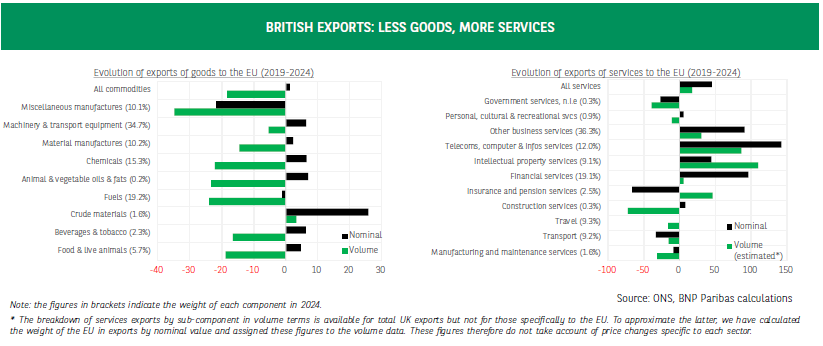
The European Union: a key market. Due to its geographical proximity, the EU remains by far the main destination for British goods, accounting for 47% of total merchandise exports (by value) in 2024; this share has remained broadly stable since 2019. Exports in volume to the EU have fallen significantly since 2019 (left chart), as have those to the rest of the world. This trend partly reflects a ‘Brexit effect’, linked to the higher cost of imports from the EU, but not only: it also reflects the wider structural loss of competitiveness of British industry in the face of competition from outside Europe, particularly from Asia. The slight increase in nominal exports to the EU reflects a price effect only. The decline in volume between 2019 and 2024 (-18% overall) affected almost all segments; the biggest export items, machinery and equipment and fuels (and derivatives) fell by 5.3% and 24% respectively.
The weight of services is increasing significantly. Conversely, certain high-value-added service sectors have coped better with the Brexit. The volume of exports to the EU of information and telecommunication services and intellectual property products grew at a very sustained rate (see graph on the right), pushing higher the surplus on the bilateral balance of services. The share of services in total exports to the EU has grown steadily since the Brexit (42% in 2019 vs. 51% in 2024 in nominal terms), and they now account for the majority of UK exports. However, this increase only partially offsets the widening of the UK’s bilateral trade deficit with the EU (trade in goods), which reached record levels in the first half of 2025.
A rapprochement beneficial for growth and competitiveness. The resetting of trade relations with the EU is a positive economic development for the UK. Recent trade agreements with third countries (India and the United States) cannot fully compensate for the UK’s distance from the EU. The Security and Defence Partnership, which brings the UK closer to participating in the SAFE2 programme for funding European rearmament, and the discussions aimed at integrating the UK into the European GHG emissions trading scheme, will ease some of the structural impediments to the competitiveness of British industry caused by Brexit, while preserving the country’s strengths in technology-related services.
Author
BNP Paribas Team
BNP Paribas
BNP Paribas Economic Research Department is a worldwide function, part of Corporate and Investment Banking, at the service of both the Bank and its customers.