UK inflation preview: How CPI may finally break the pound's prowess
- UK inflation figures for January are set to show a rebound to 1.6%.
- GBP/USD has shown resilience to weak wage figures and worrying Brexit headlines.
- Downbeat CPI figures may be a breaking point for the pound.

Sterling is strong – but for how long? GBP/USD has shown remarkable prowess in shrugging off adverse developments. It managed to brush aside economic damage from the coronavirus outbreak – news that boosted the dollar. Cable has also overcome heightened rhetoric around Brexit from both sides of the Channel, as posturing continues.
GBP/USD did decline after the jobs report for December showed a worse than expected deceleration in wage growth. However, the "buy the dip" mentality pushed the pound higher again.
Will inflation figures serve as a breaking point and send sterling well below 1.30?
Here is the case for a potential longer-lasting drop:
Downside surprise more likely
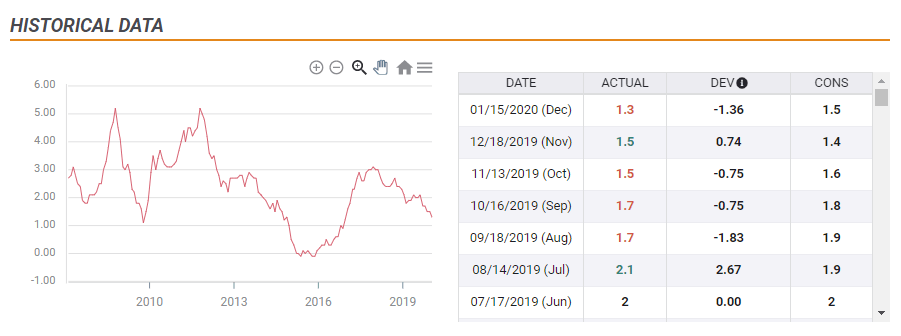
First – contrary to labor data – expectations are higher. The economic calendar is pointing to a possible acceleration in the headline Consumer Price Index from 1.3% to 1.6% yearly in January. Higher estimates facilitate a shortfall.
Secondly, looking back at 2019, inflation figures missed expectations seven times and topped projections only three times. Looking at last year's statistics points to a higher chance of a downside disappointment – double the probability of an upside surprise.
Inflation matters more than jobs
The Bank of England's sole objective is price stability, and it does not directly target employment – thus making CPI figures more significant than employment ones. Moreover, the inflation report is for January, while the labor statistics were for December. The recency of the data makes the publication more significant.
Even if CPI hits 1.6%, it would still come out below the BOE's 2% target, weakening the case for gradual rate hikes – that the bank aims for. Investors may see any upside – driven by energy prices that have since fallen – as temporary as the downtrend continues.
Accumulated effect
Circling back to the question at the outset, how long can the pound resist the downside? If CPI fails to meet expectations, it would be the second consecutive data miss, contributing to a gloomier picture of the British economy.
Moreover, sterling's resilience to Brexit headlines is also becoming shaky. The latest comments by David Frost, the UK's chief negotiator, have clarified the stark and perhaps irreconcilable gap between London and Brussels. The senior diplomat rejected any rule-taking from the bloc, saying that was the whole point of Brexit.
Both sides may undoubtedly compromise behind closed doors, but official talks begin only in early March, and the aggregate effect of the rhetoric may weaken GBP/USD's defenses.
GBP/USD scenarios
1) CPI at 1.5% or 1.6%: If headline inflation meets expectations or falls marginally short, GBP/USD may succumb to pressure and decline, without an immediate recovery. This outcome has a high probability, as explained earlier.
2) CPI beats with 1.7% or 1.8%: In case of a surprising rise, pound/dollar has room to advance and hold its ground. It would reinforce the resilience of the pound, which has been characterizing it in recent weeks. The probability is medium.
3) CPI misses with 1.3% or 1.4%: With higher chances of a disappointment, a more significant one cannot be ruled out. In this case, sterling may fall sharply and struggle at lower ground. The probability is low, especially for 1.3%, which would be a substantial shortcoming.
Conclusion
After pulling off remarkable recoveries, GBP/USD may succumb to pressure and fall in response to the UK's inflation report for January. A beat would be necessary to keep sterling at higher levels while a significant miss cannot be ruled out.
Author

Yohay Elam
FXStreet
Yohay is in Forex since 2008 when he founded Forex Crunch, a blog crafted in his free time that turned into a fully-fledged currency website later sold to Finixio.