UK GDP growth Increased by +0.6% in Q2

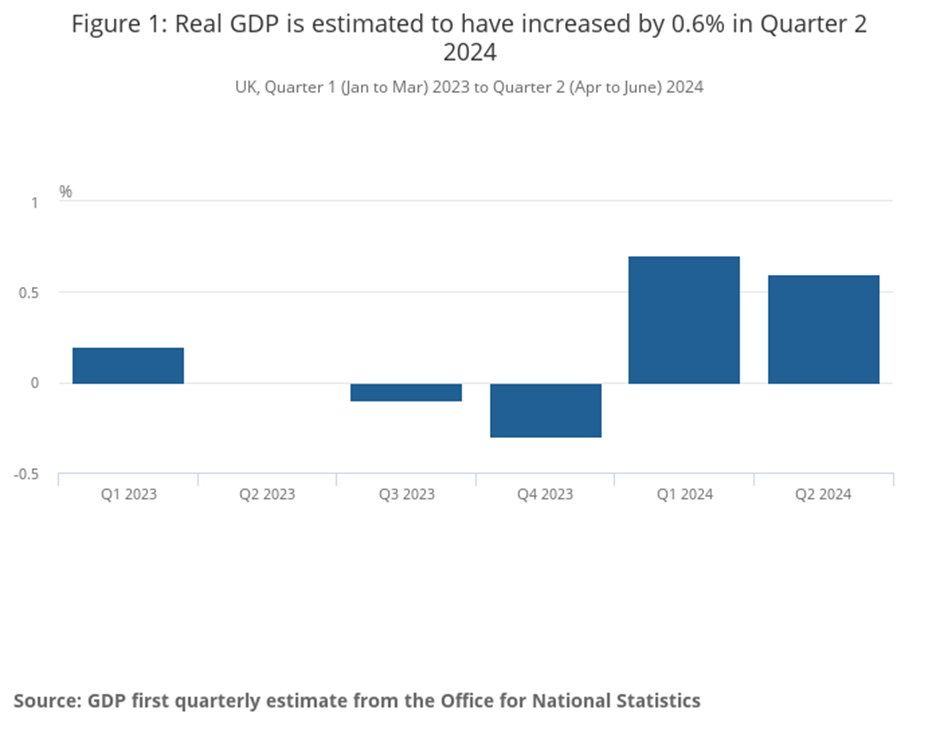
According to the Office for National Statistics (ONS), UK economic activity increased by +0.6% in the April to June quarter (Q2), following the UK economy's growth of +0.7% in Q1 (January to March). This fell in line with economists’ estimates and indicates that the UK economy has so far had a solid year: +1.3% growth in H1 (annualised: +2.6%). You may recall that the UK economy fell into a shallow ‘technical recession’ in the second half of last year (two consecutive negative quarters of economic growth).
ONS director of economic statistics, Liz McKeown, commented: ‘The UK economy has now grown strongly for two quarters, following the weakness we saw in the second half of last year. Growth across the three months was led by the service sector, where scientific research, the IT industry and legal services all did well’.
Comparing UK economic activity to other G7 economies, Q2 economic activity in the US showed an expansion of +0.7%, with the euro area expanding +0.3% in the quarter (matching the previous quarter).
Service sector output increased in Q2
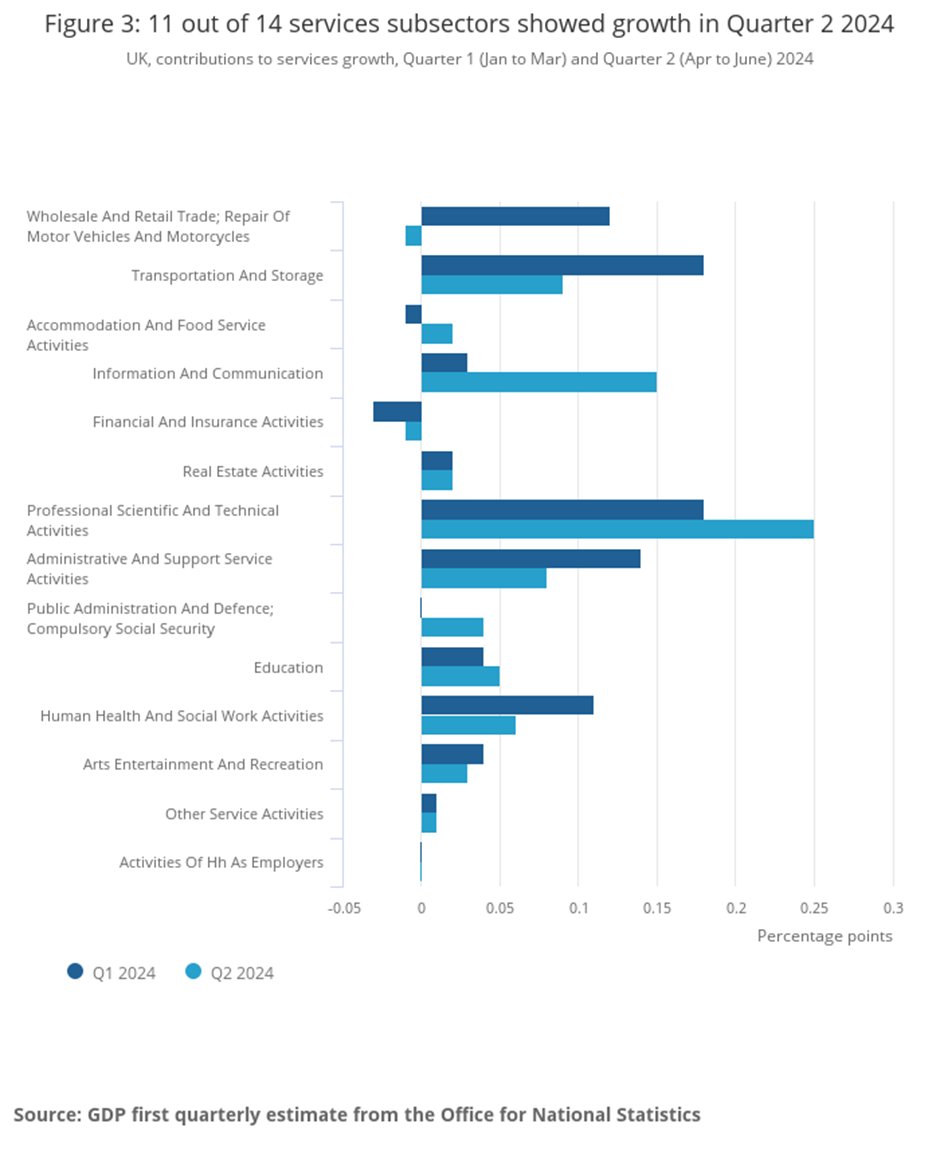
Driving Q2 economic activity was strong growth in the services sector.
According to the latest data, services increased by +0.8% in Q2; 11 of the 14 service categories exhibited growth, with the largest upward contributor coming from ‘Professional, Scientific and Technical Activities’ – ‘Scientific Research and Development’ is estimated to have grown +11.0%. Additional upward contributors were from ‘Transportation and Storage’ and ‘Information and Communication’. The report also added that consumer-facing services fell -0.1% in Q2, powered by declines in ‘buying and selling, renting and operating of own or leased real estate, excluding imputed rental, and a fall in wholesale and retail trade; repair of motor vehicles and motorcycles’.
Offsetting the increases in the services sector were declines in production and construction, which both fell -0.1% in Q2. Of note, manufacturing was the largest downward contributor, with 9 of the 13 manufacturing categories showing a decline in Q2.
Economic activity flat between May and June
Economic activity exhibited no growth between May and June, following an increase of +0.4%. The 0.0% print also fell in line with economists’ forecasts.
Surprisingly, while services underpinned growth in Q2, services output dropped -0.1% between May and June, following +0.3% growth in May (this follows five straight months of growth and 7 of the 14 services categories falling in June). This, however, was offset by strength in production and construction on the month, up +0.8% and +0.5%, respectively. The ONS added: ‘The largest contribution to the growth in June 2024 was +1.1% growth in manufacturing’.
Market reaction limited
Given that the data came in as expected, the market reaction was muted. A slight uptick in sterling (GBP) was seen, though price action has since reversed gains and is testing pre-announcement levels.
Following softer UK wage growth (Tuesday’s report), a solid miss on the UK Consumer Price Index (CPI) inflation (Wednesday), and a reasonably solid start to the first half of 2024 in terms of economic activity, this is ideally what the Bank of England want to see. Markets are still pricing in around -50 basis points of cuts for the entire year, with -10 basis points implied for September’s meeting and -27 basis points for November.
Author
Aaron Hill
FP Markets
After completing his Bachelor’s degree in English and Creative Writing in the UK, and subsequently spending a handful of years teaching English as a foreign language teacher around Asia, Aaron was introduced to financial trading,