Turks holding large amounts of Gold under their pillows

Turks are holding billions of dollars in gold “under their pillows.”
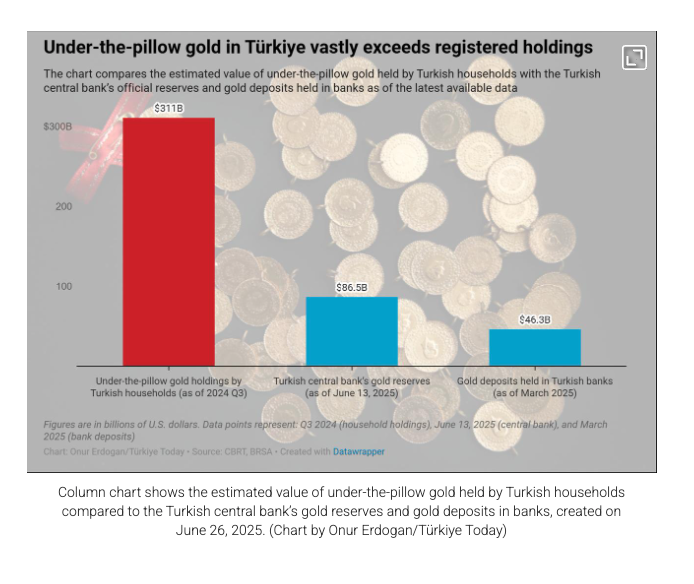
The Turkish central bank estimates that Turkish households have more $311 billion worth of unregistered gold, most of it outside of the official financial system.
The central bank calculated this amount by adding the current quarter’s gold production and imports to the previous period’s stock and then subtracting gold exports.
To put the amount into perspective, the Turkish central bank holds $86.5 billion in gold reserves.
Turks have a long history of "saving under the pillow,” a term that refers to keeping valuables such as gold at home.
Why?
There are a number of reasons, some of them deeply embedded in Turkish culture.
Turks traditionally gift, save, and invest in gold. As Turkiye Today put it, “This cultural norm is deeply embedded in social life, where gold serves both symbolic and financial functions in weddings, religious ceremonies, and as a trusted form of family savings.”
Turks view gold as the most trusted safe haven and tend to “view jewelry as a hedge against financial volatility—reinforcing their longstanding preference for tangible, personally held assets.”
Turks hold a lot of gold in the form of jewelry. But it isn’t the same kind of gold jewelry you typically find in the U.S. Turkish gold jewelry tends to be much purer – generally 18 karat or greater. This is much closer to investment-quality gold.
According to the World Gold Council, Turkey ranks as the fourth-largest gold jewelry market in the world, trailing only China, India, and the U.S. Over the past decade, annual gold jewelry demand has averaged 41 tonnes.
Tepid economic growth has created headwinds for Turkish gold demand, particularly after the global recession in 2008. In the late 1990s and early 2000s, Turkish gold jewelry demand exceeded 150 tonnes annually. This corresponded with double-digit GDP growth.
Even as jewelry demand contracted, gold coin and bar demand remained resilient. According to Turkiye Today, the gap between investment-oriented and jewelry demand has become “more pronounced” in recent years, as "macroeconomic instability intensified.”
“With persistent inflation and a weakening Turkish lira eroding trust in the national currency, households increasingly shifted their savings toward physical gold. This trend favored bars and coins over traditional jewelry, especially after Türkiye's inflation rate peaked at 85.51 percent in October 2022, according to official data.”
However, cultural impulses die hard. Jewelry demand has increased as well, with the final quarter of 2023 coming in at the highest level since 2016.
“This surge was primarily driven by households seeking a tangible hedge against inflation and currency depreciation. Rather than opting for formal investment products, many preferred jewelry as a practical, wearable form of savings, allowing both value preservation and direct control over personal wealth.”
Gold also shields investors from taxation on deposit interest and large financial transactions. Simply put, the government can’t collect taxes on gold stuffed under the pillow.
“In contrast, gold purchased and held privately—especially outside the banking system—remains largely beyond the reach of tax authorities. This makes gold not only a stable store of value but also a discreet way to preserve wealth.”
Economist Mahfi Egilmez told Turkiye Today that these stashes of gold serve as a financial buffer for the country.
“During periods of economic distress, individuals and businesses liquidate part of their gold or foreign exchange holdings to meet urgent needs. Once stability returns, they tend to replenish these reserves gradually, usually through informal, undocumented means. This ongoing cycle of withdrawal and replenishment reflects a widespread strategy for managing risk, especially in environments of financial volatility.”
This is similar to the way Indians use gold.
According to a 2018 ICE360 survey, one in every two households in India had purchased gold within the last five years. Overall, 87 percent of Indian households own some gold. Even households at the lowest income levels in India hold some of the yellow metal. According to the survey, more than 75 percent of families in the bottom 10 percent of income managed to buy some gold.
The yellow metal was a lifeline for Indians buffeted by the economic storm caused by the government's response to COVID-19. After the Indian government locked down the country, banks tightened credit to mitigate the default risk. Unable to secure traditional loans, Indians used gold to secure financing. As Indians endured a second wave of lockdowns, many Indians resorted to selling gold outright to make ends meet.
The Turkish government has tried to harness some of the revenue in the country's massive underground gold market, but has had limited success. The government recently introduced a 0.2 percent transaction tax on gold purchases not made through banks. This simply drove more investors away from formal channels, pushing them toward physical holdings purchased through private transactions.
To receive free commentary and analysis on the gold and silver markets, click here to be added to the Money Metals news service.
To receive free commentary and analysis on the gold and silver markets, click here to be added to the Money Metals news service.
Author

Mike Maharrey
Money Metals Exchange
Mike Maharrey is a journalist and market analyst for MoneyMetals.com with over a decade of experience in precious metals. He holds a BS in accounting from the University of Kentucky and a BA in journalism from the University of South Florida.
















