Trump’s trade deal derails BoE’s dovish stance


The BOE may have cut rates by 25bps to 4.25%, as expected, however, there were plenty of surprises. The first surprise was the vote split, there was some expectation that it would be a 9-0 vote for a rate cut, instead it was a 5-4 3-way split. Catherine Mann and Huw Pill voted to keep rates unchanged.
The BOE said that monetary policy is not on a preset path, and that they will assess incoming information as it arrives, this follows the Fed’s message closely. The most surprising element of this statement was the BOE’s intent to maintain a ‘gradual and careful approach’ to further rate cuts. This line was included in recent statements; however, some analysts had expected this statement to be removed in May due to the obvious downside pressures for inflation.
Trade deal with the US could limit rate cuts
Instead, we believe that the BOE chose to keep that line in their statement because of the announcement that a US/ UK trade deal is coming. The BOE Governor Andrew Bailey said that the announcement of a trade deal was welcome news, and it would reduce economic uncertainty. However, the BOE also urged caution, and said that the UK is impacted by global trade policies, so more trade deals need to be announced for the BOE to be confident about the outlook for the UK economy. Even so, a UK trade deal could mean that the economy avoids any pain from global trade disruption, and it gives a platform for the UK economy to outperform for the rest of this year.
Is the BoE too worried about inflation?
The Bank reduced their long-term inflation forecasts, however, they still expect prices to rise to 3.5% by Q3 this year, before falling back to the 2% target after that. Although risks are to the downside for inflation, the BOE’s report seems to be underplaying some of the deflationary risks in our view, like lower energy prices.
The GDP forecast was mixed. Q2 GDP has been revised higher to 0.8%, from 0.3% in February, although the Q2 2026 GDP forecast was revised lower to 1.3% from 1.5%. The unemployment rate is also expected to pick up this year to 4.6% in Q2, and to peak at 5% in 2027. However, this is still a low level by historical standards, and it suggests that the market is expecting a limited amount of economic pain from the fallout from US tariffs.
Market recalibrates UK rate cut expectations
The BOE’s own forecast for monetary policy was revised lower. Interest rates are expected to be 4.3% in Q2, down from 4.4% in February, and fall to 3.5% in a year’s time, down from the 4.1% expected in Feb. This means that the BOE is not expecting to cut rates in June. The market has immediately recalibrated its expectations for UK rate cuts. On Wednesday the interest rate futures market was expecting a 55% chance of a rate cut in June, and for more than 2.5 rate cuts for the rest of the year. However, after today’s BOE meeting, the market has scaled back hopes of a June rate cut. There is only a 20% chance of a cut next month with the next full cut expected in August, when the next Monetary Policy Report is released. Approx. 20 bps of cuts by year end have been priced out by the interest futures market since this meeting. This is a sign that the ‘hawkish’ vote split, along with the ‘careful and gradual’ approach the BOE is continuing to employ towards its rate cutting cycle, has resonated with financial markets.
US trade deal announcement more important for pound and UK stocks
UK stocks are mostly unchanged after the BOE meeting, as investors wait for the main news today: the detail on the US/ UK trade pact. The FTSE 250 is continuing to outperform the FTSE 100, as it is more domestically focused than the main UK index, it generates more than 50% of annual revenue at home, compared to approx. 20% for the FTSE 100.
The pound has erased some losses but is still below the high of the day and GBP/USD is trading around $1.3340. Although the news from the BOE is hawkish, and thus should boost the pound, and UK bond yields are rising, this is not enough to counter some caution in the FX market as we wait to hear the details of the UK/ US trade deal. If the announcement is scant on details, or if it does not include a large enough reduction in tariffs, particularly for autos, steel and film exports then it may be deemed a disappointment, and it could impact market sentiment later on Thursday.
EU still in tariff limbo, which could weigh on the euro
EUR/GBP is under pressure, which is to be expected. A trade deal between the US and the UK is likely to weigh on the euro, since a deal with the EU does not look like it is close. The UK took advantage of Brexit and forged ahead on its own, and that could pay off if the trade deal with the US is successful. EUR/GBP is approaching some key support levels including £0.8457, the 50-day sma, a break below this level could trigger further declines towards £0.84 in the short term.
Overall, the BOE was more hawkish than expected, but we think that the main move in UK assets will come once we get the details of the trade announcement at 1500 BST.
EUR/GBP daily chart
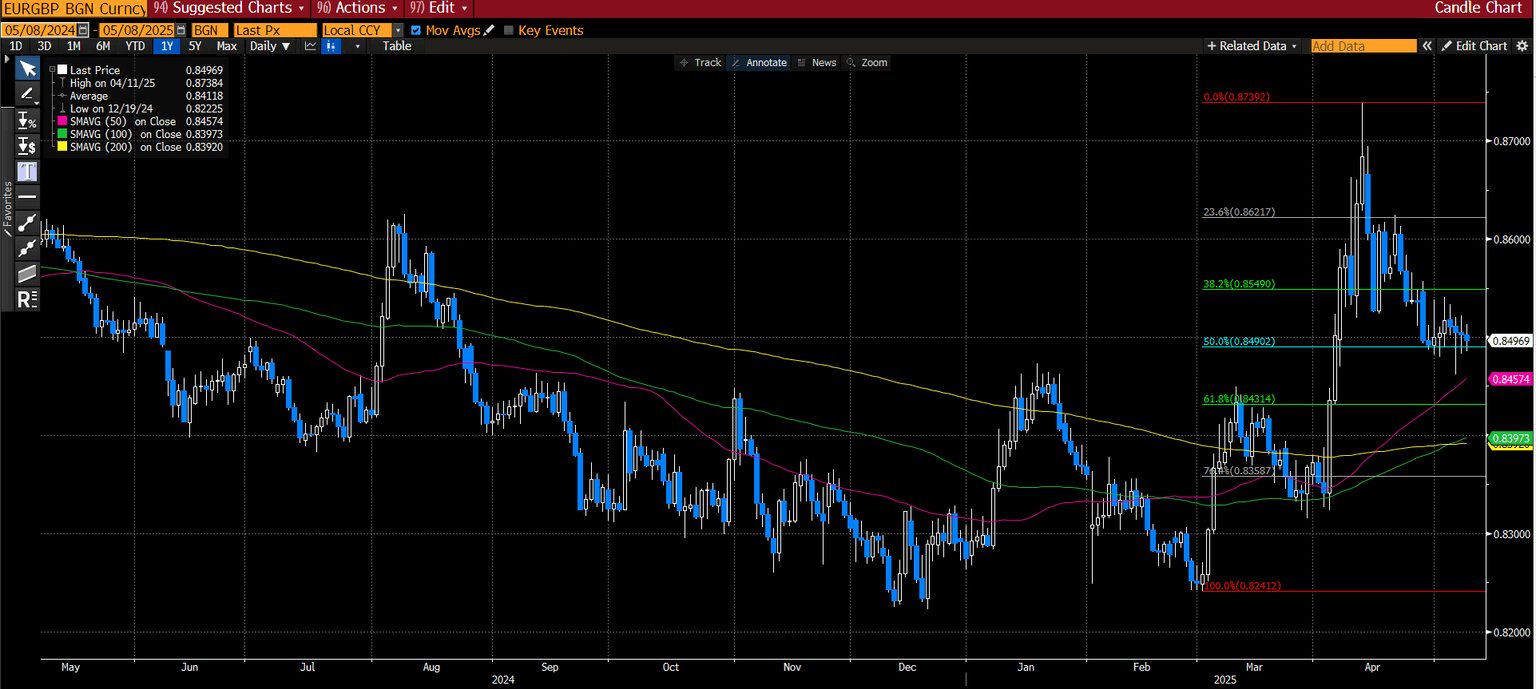
Source: XTB and Bloomberg
Author
Kathleen Brooks
XTB UK
Kathleen has nearly 15 years’ experience working with some of the leading retail trading and investment companies in the City of London.

















