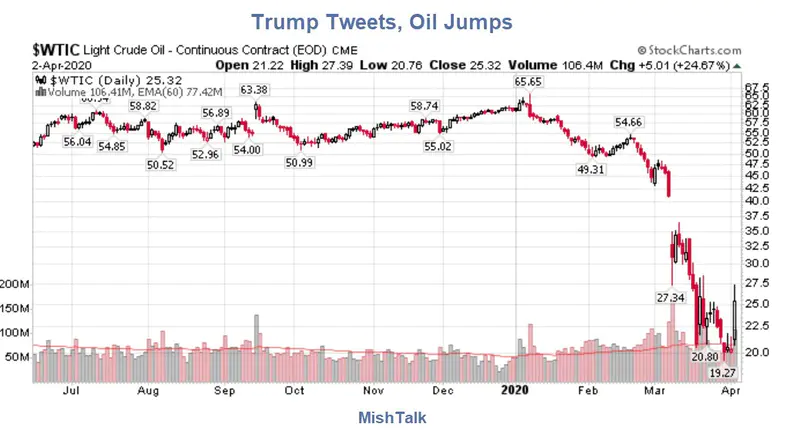
Trump tweet sends oil up 20% but demand prevails

Trump Calls on Saudi Crown Prince
How Big a Supply Cut?
Disbelief Prevails
Bloomberg reports Trump’s Push for Huge Deal to Cut Oil Supply Draws Disbelief
After the president’s social-media intervention on Thursday, oil traders are frantically assessing whether Saudi Arabia, Russia and possibly even the U.S. -- the world’s three biggest producers -- are poised to strike a once-unthinkable grand bargain to cut daily supplies in unison by 10 million to 15 million barrels.
It’s unclear whether it’s feasible -- or even legal -- for such a coalition to come together. Or indeed whether it would be enough to tame the tsunami of unwanted crude now bearing down on world markets, which could be two to three times bigger than the cut touted by Trump.
“The more people are at the table, the more difficult it is to get a deal,” said Pierre Andurand, whose Andurand Commodities Fund soared more than 140% last month through bearish bets on crude. “I find it difficult to believe that a deal like that could be agreed quickly.”
Details in Questions
Also consider Trump’s Disputed Claim of Saudi, Russia Oil Cuts Jolts Markets
Conflicting messages from the administration -- the president has said he likes low gas prices, while Secretary of State Michael Pompeo and others have urged the Saudis to cut production -- have undermined the U.S. government’s leverage, the person said, asking not to be identified because of the sensitivity of the matter.
Trump also said he had spoken to Saudi Prince Mohammed bin Salman, who had in turn spoken with Russian President Vladimir Putin. But a Kremlin spokesman, Dmitry Peskov, said the conversation hadn’t happened and that no production cut had been agreed with the Saudis.
Riyadh has until now made clear it’s ready to cut production provided that other big oil producers, including some that aren’t part of the OPEC+ group like the U.S., Canada and Brazil, also reduce their output. OPEC+ refers to a previous alliance between OPEC and Russia to set production levels.
The White House has considered tariffs on foreign oil imports to protect U.S. producers, though the idea is opposed by some top Trump advisers led by Larry Kudlow, the director of the National Economic Council, according to people familiar with the matter.
Negative Oil Prices
For some grades of crude, Negative Prices Are Already Here
The collapse in appetite for gasoline, jet fuel and diesel has been unprecedented in speed and scale. Goldman Sachs Group Inc. estimated Monday that with economies representing 92% of global gross domestic product now under some form of social distancing, the loss of demand this week stands at 26 million barrels per day, roughly a quarter below last year’s levels. Over a month, that’s almost 800 million barrels lost. Numbers since published from the shuttered economies of Italy and Spain suggest levels of destruction could be even worse. Spanish diesel demand is down 61%. The collapse is translating into a surplus that’s straining refineries, pipelines and the world’s limited ability to squirrel away oil.
For landlocked drillers, though, there are greater worries. They are facing a lack of local storage, and pipeline companies asking them to cut back or prove they have a buyer for their crude before loading. This all means that negative oil prices — when producers are effectively paying customers to take the oil — aren’t only possible, but already a reality.
Wyoming Asphalt Sour, used in paving, was among the first to slide into the red at a negative $0.19 per barrel in mid-March, as my colleagues Javier Blas and Sheela Tobben reported last month.
Texas Weighs Curtailing Oil Production for First Time in Decades
The Wall Street Journal reports Texas Weighs Curtailing Oil Production for First Time in Decades
Texas, which hasn’t limited production since the 1970s, was a model for the Organization of the Petroleum Exporting Countries, which has sought to control world-wide oil prices in recent decades. OPEC and Russia were unable to reach a deal on reducing output in response to the coronavirus pandemic, which helped trigger the current collapse in prices.
It is unclear whether regulators will ultimately act to curtail production, but staffers are examining what would be required in such an event, the people said.
The Permian Basin, which straddles Texas and New Mexico, is America’s most productive oil field and the center of the revival in American output resulting from shale drilling, which has helped boost U.S. output to roughly 13 million barrels a day, the most in the world.
Best Option - Do Nothing
Trump trots out tariffs but he also wants low prices.
Artificially jacking up the cost of crude which implies jet fuel hardly seems like the right thing to do.
Saudi is willing to cut production as long as Russia, Mexico, Canada and the US do as well. Good luck with that.
The best option is to not get involved.
Demand Rules
This is a demand issue. For another month global demand will be in the gutter.
Tweets cannot fix that.
The most important stat comes from Goldman Sachs: The loss of demand this week stands at 26 million barrels per day, roughly a quarter below last year’s levels.
It seems that even IF Saudi talked to Russia (as Trump claims and Russia denies), and the whole world agreed to take action, Trump's proposed 10-15 million barrel reduction will not stop the oil slide.
Do nothing and someone will blink as soon as storage capacity runs out.
Author

Mike “Mish” Shedlock's
Sitka Pacific Capital Management,Llc
Mike “Mish” Shedlock is a registered investment advisor for SitkaPacific Capital Management.
















