Trump China trip chaos? Mixed results – Does the US need the Strait of Hormuz for Oil? [Video]
![Trump China trip chaos? Mixed results – Does the US need the Strait of Hormuz for Oil? [Video]](https://editorial.fxsstatic.com/images/i/Commodities_Oil-2.jpg)
Welcome to today’s Market Blast, and today we will take a look at Forex Trading on the USD Index, Soybean futures, Nvidia, the NASDAQ, WTI Crude Oil, and Boeing.
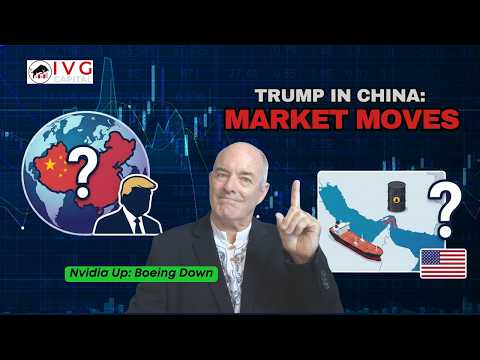
Donald Trump spent the last couple of days in China, and, good or bad, the meetings and talks moved the markets.
For example, Chinese airlines agreed to purchase 200 airliners from Boeing while they were actually expecting to sell 500 planes.
This caused the share price of Boeing to fall dramatically, but is this a buy-the-dip opportunity?
Boeing has a strong order book, but it is also suffering from high debt and reputational damage in recent years.
Many analysts had set a target of $250 and $300 so, long term this might be an investment.
However, short-term investors and traders should also take one factor into account: whenever any tradable instrument is caught up in US-China trade issues, there is always volatility.
Also, during the trip, the subject of Iran and crude oil came up, but nothing was agreed.
However, Donald Trump stated that the US didn’t need the Strait of Hormuz opened as it already has lots of oil.
This, of course, represents an incredible lack of understanding of the global crude market as so much hinges on the price of crude in the US.
Higher prices for consumers, overall inflation in every sector, bankruptcies (like Spirit Airlines), and no incentive for the Federal Reserve to lower interest rates, which is something the White House has always wanted.
The good news from the China trip came from talks around chip exports, and Nvidia soared higher.
Agricultural products were discussed, but there was some confusion about a huge item, soybeans.
Some say that a deal had already been done, but there were no concrete figures.
Keep an eye on the news as this may be a buying opportunity.
Despite the rise in Nvidia, the NASDAQ and other US Indices have pulled back today.
Mostly due to the uncertainty over Iran, which many fear may be another “Forever War.”
And, finally, inflationary fears and higher bond yields are seeing USD and USD pairs stronger right across the board.
Let’s catch up on this next week.
Author

Brad Alexander
FX Large Limited
Brad became fascinated with the Currency Markets from a young age and researched fundamental analysis.