Trade balance widens in October but normalization likely still in train


Summary
The U.S. trade deficit widened for the second straight month in October amid a drop in exports and only a modest growth in imports. Net exports are positioned to be a fairly neutral force on Q4 growth, but we're still in the early innings.
Two is a coincidence, but three would make a trend
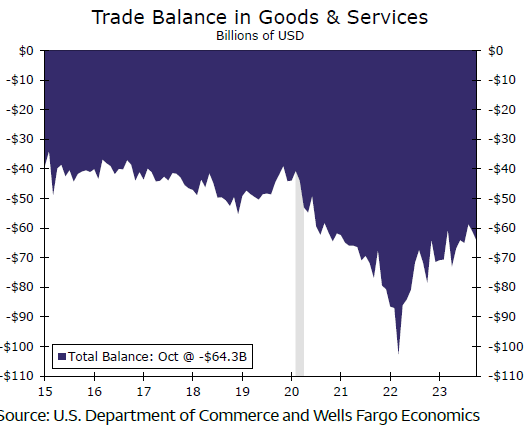
The trade deficit widened for the second straight month in October to -$64.3 billion, leaving the deficit nearly as wide as it was in July and consistent with levels of late 2020 (chart). The deficit remains about 45% wider than it was just ahead of the pandemic, though the process of normalization in the deficit is likely still in place. As indicated by the advance merchandise trade data released last week, exports slid 1.0% or by $2.6 billion, while imports rose by just 0.2% or $0.5 billion.
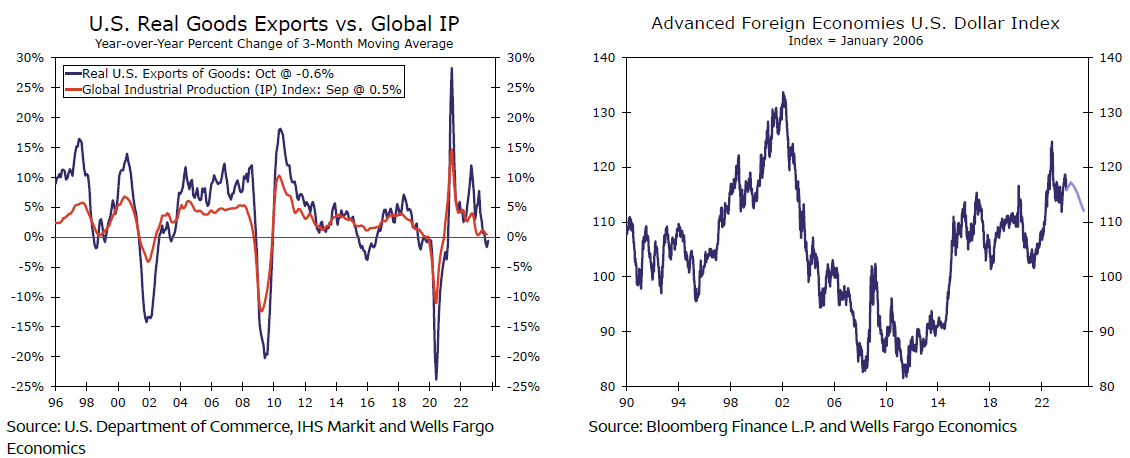
Export weakness was largely tied to a $2.1 billion decline across an array of consumer goods categories, and a pullback in the still-volatile auto category which slipped $927M. Most other categories rose during the month. Drilling into consumer goods, the largest decline was tied to big-ticket items like gem diamonds, jewelry and cell phones, electronics & TVs, which suggests higher rates overseas are slowing consumer goods spending abroad just like they gradually are in the United States. Exports of industrial supplies rose 2.0% in October, marking the fourth straight monthly improvement. A pickup in organic chemicals, oil and gas exports drove the latest increase, while agriculture-related products were weak. Despite the recent momentum, industrial supplies exports are down more than 9% on a year-ago basis as growth in global industrial production has faltered (chart).
Although import growth was modestly positive, the gain can largely be chalked up to a $1.8 billion rise in capital goods. Imports are still lower overall so far this year amid weakening demand for goods, with auto imports the lone exception. On a year-to-date basis, imports are off by about $150 million, while overall exports are roughly $30 million higher than they were by this time last year.
Author
Wells Fargo Research Team
Wells Fargo