Top Trade Setups in Forex – Risk on Sentiment In Play!

The U.S. stocks pared most of their early gains to close little changed, as U.S. Fed Chairman Jerome Powell stated lawmakers the central bank is monitoring the coronavirus outbreak, "which could point to disturbances in China that spread the rest of the global economy."
The U.S. National Federation of Independent Business's Small Business Optimism Index posted at 104.3 for January, better than 103.5 expected. Later today, the U.S. government is expected to post a monthly budget deficit of 10.0 billion dollars for January.
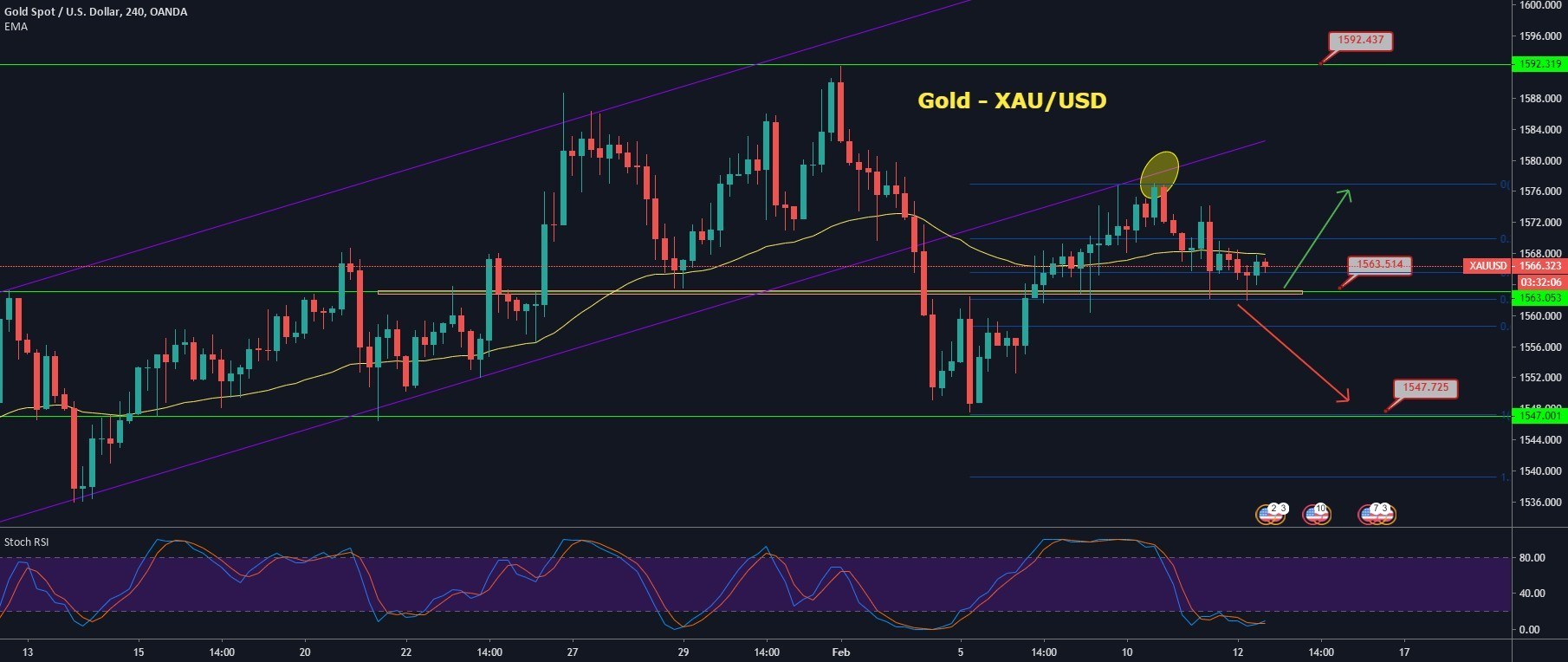
XAU/USD - Bullish Channel Putting Up Resistance
Gold price slipped 0.3% to $1,567 an ounce ending a four-day rally. Gold futures are consolidating in a slightly bearish mode on Wednesday as risk appetite recovered after China announced its weakest number of new coronavirus incidents since last January. The Chinese business is also feeling the pressure after China's foremost medical adviser on the coronavirus outbreak declared the epidemic might peak this month.
Gold was also pressed by remarks from Federal Reserve Chairman Jerome Powell, who announced on Tuesday that the U.S. central bank is not likely to cut the interest rates in the short-term. With hazards like trade policy uncertainty dropping and global growth preserving, Powell indicated he observed no reason to improve U.S. interest rates except new developments produce a "material reassessment" to the contemporary outlook.
Besides, the greenback lingered near to four-month highs following a fading demand for safe-haven assets as concerns about the coronavirus coincided with recent data showing the U.S. economy's strength.
XAU/USD - Daily Technical Levels
|
Support |
Pivot Point |
Resistance |
|
1562.34 |
1568.25 |
1576.29 |
|
1554.3 |
1582.19 | |
|
1540.35 |
1596.14 |
XAU/USD - Daily Trade Sentiment
Gold's technical outlook hasn't improved much as it extends to maintain the same trading range of 1,573- 1,560. For the moment, gold is anticipated to face resistance nearby 1,573, along with the support of around 1,564 and 1,560 today.
On Wednesday, the trader's focus will be on the Fed Chair Powell, who is scheduled to testify on the Semiannual Monetary Policy Report ere the Senate Banking Committee in Washington DC. His comments can assist in determining new movements in the market.
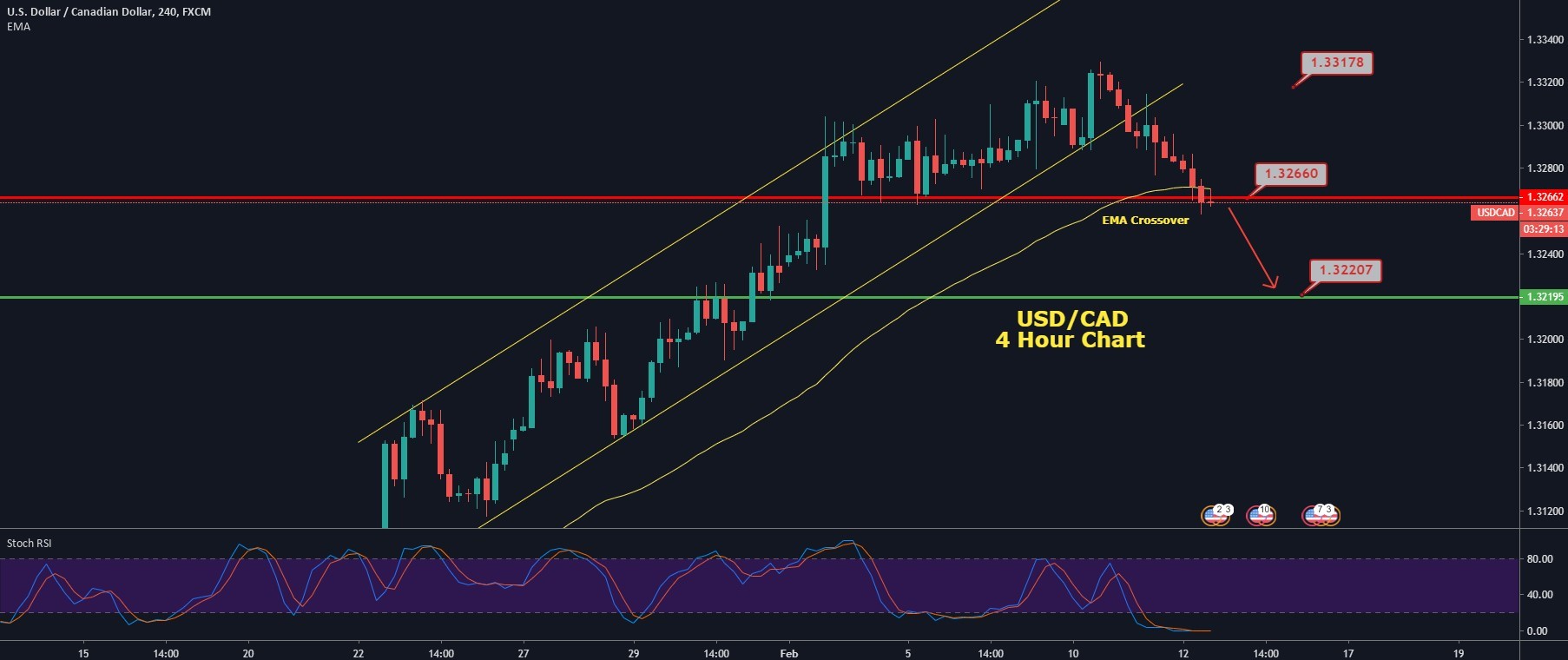
USD/CAD - Bullish Channel Continues to Play
The USD/CAD fell 0.2% to 1.3290. The USD/CAD surged almost 3% over the last month and a half owing to general instability in the Canadian dollar; however, the recent trend may reverse soon. The commodity currency Loonie has drifted lower along with the appetite for risk as coronavirus fear knocks market sentiment and the price of oil.
The robust Canadian employment market and adhesive inflation stand to promote a hawkish monetary policy sentiment by the Bank of Canada (BOC). Meanwhile, the crude oil prices rebounded after heavy losses in recent sessions, which are weighing on crude oil.
The U.S. Nymex crude oil futures increased 0.8% to $49.94 a barrel, and Brent gained 1.4% to $54.01 a barrel. Meanwhile, the U.S. Energy Information Administration lowered its 2020 forecast for West Texas Intermediate (WTI) crude price by 6.0% to $55.71 a barrel and that for Brent price by 5.5% to $61.25.
USD/CAD - Daily Technical Levels
|
Support |
Pivot Point |
Resistance |
|
1.3283 |
1.3302 |
1.3325 |
|
1.3259 |
1.3344 | |
|
1.3217 |
1.3387 |
USD/CAD - Daily Trade Sentiment
The USD/CAD traded mostly bearish in the wake of upward channel breakout. The pair is trading bearish around 1.3265, passing under an immediate support mark of 1.3300, which is now working as a resistance level for Loonie.
The USD/CAD has also crossed below 50 periods EMA at 1.3266, which is likely to drive more selling in Aussie until 1.3219. The RSI and Stochastics are staying in the selling zone today. Let's look for selling trades below 1.3266 as the pair can drop until 1.3240 and 1.3219 below this level.
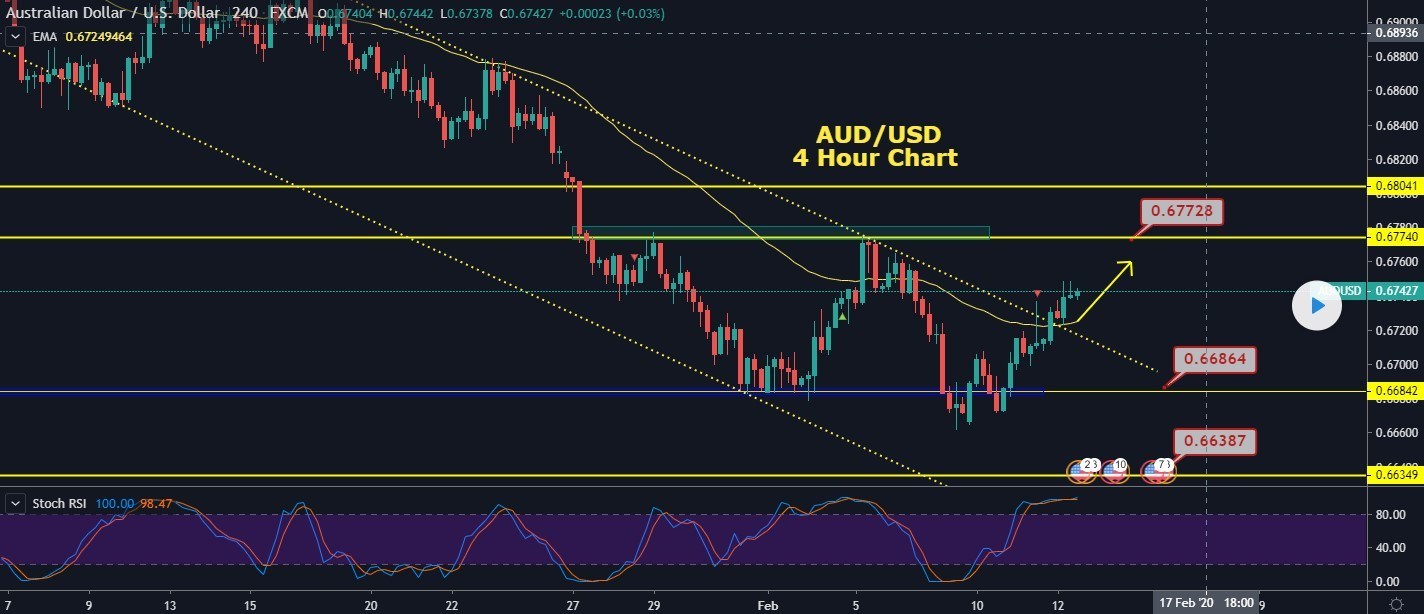
AUD/USD – Triangle Pattern Breakout
The AUD/USD currency pair picked up strong bids because the New Zealand Dollar increased sharply mainly after the Reserve Bank Of New Zealand (RBNZ), which released its monetary policy statement at 01:00 GMT. The Aussie dollar surged from 0.6717 to 0.6733 in the 15 minutes to 01:15 GMT. During the same time frame, the NZD/USD pair jumped from 0.6408 to 0.6462.
The buying interest around the Kiwi increased because the RBNZ delivered a status quo decision with a hawkish tilt. Whereas the bank kept rates unchanged at 1%, as expected. Its forecasts for the official cash rate (OCR) showed the borrowing costs would remain unchanged throughout 2020.
The investors were expecting that the RBNZ will deliver a rate cut later this year in the wake of coronavirus impact on the market, but the RBNZ took a page out of its Australian counterpart - the Reserve Bank of Australia (RBA) - which kept rates steady on February 4.
On the other hand, the risk improvement in the stock markets is also the basis for the sustained increases in the AUD and NZD currency pairs. The S&P and Nasdaq eked out historical close on Tuesday, despite the drop in tech shares.
AUD/USD - Technical Levels
|
Support |
Pivot Point |
Resistance |
|
0.665 |
0.6687 |
0.6711 |
|
0.6625 |
0.6749 | |
|
0.6563 |
0.6811 |
AUD/USD - Daily Trade Sentiment
The AUD/USD continues trading bullish at 0.6742, especially after violating the downward channel at 0.6720. Bullish trend continuation is likely to lead the AUD/USD prices towards 0.6770. Taking a look at the RSI and Stochastics, the pair is in the overbought zone, which means we may see a correction in Aussie dollar very soon.
Since the AUD/USD immediate resistance is around 0.6772, we can look for buying now with a target of the same level today. While selling can be seen below 0.6770.
Author

EagleFX Team
EagleFX
EagleFX Team is an international group of market analysts with skills in fundamental and technical analysis, applying several methods to assess the state and likelihood of price movements on Forex, Commodities, Indices, Metals and