Top Trade Setups in Forex – New Home Sales In Focus!

The USD/CAD edged up 0.1% to 1.3143. Official data showed that Canada's retail sales grew 0.9% on month in November (+0.6% expected). Other commodity-linked currencies were broadly lower against the greenback. AUD/USD slid 0.3% to 0.6829 and NZD/USD slipped 0.1% to 0.6609.
Regarding economic data, the Markit U.S. Manufacturing Purchasing Managers Index (PMI) unexpectedly declined to 51.7 (preliminary reading) in January, missing 52.4 expected, while the Services PMI rose to 53.2, better than 53.0 anticipated. Later today, December U.S. new home sales will be reported (up to an annualized rate of 731,000 units expected).
USD/JPY - 61.8% Fibonacci Retracement Completes
The USD/JPY closed at 109.278 after placing a high of 109.650 and a low of 109.170. The USD/JPY pair dropped for the 4th consecutive day on Friday on the back of increased demand for safe-haven Japanese Yen amid rising fears of coronavirus effects on the global economy.
On the data front, the National Core CPI for the year from Japan was released at 4:30 GMT, and it remained flat with the expectations of 0.7%. At 5:30 GMT, the Flash Manufacturing PMI from Japan exceeded the expectations in January and came in as 49.3 against the expected 48.9. Hence, I supported the Japanese Yen on Friday.
The strength of the Japanese Yen after the release of Manufacturing PMI put pressure on USD/JPY and dragged its prices further on Friday.
Meanwhile, the Bank of Japan released its December Monetary policy meeting minutes on Friday. In those minutes, the members of the Bank of Japan showed a possible need for further easing if personal spending decreases after the consumption tax increase in October.
Bank of Japan narrated that there will be a need for further monetary easing if the underlying consumption trend continued in the economy.
The Governor of Bank of Japan, Haruhiko Kuroda, said on Friday that economy likely to suffer in the final quarter of 2019 because of 2 cyclones that struck the country and affected the factory output. He added that natural disasters have intensified in Japan.
He also added that prolonged lower interest rates could impose adverse effects on the country's banking system. On the other hand, he also defended BoJ's ultra-easy policy, which helped to eradicate deflation from the country.
USD/JPY - Daily Technical Levels
|
Support |
Pivot Point |
Resistance |
|
108.68 |
108.86 |
108.98 |
|
108.55 |
109.17 | |
|
108.37 |
109.29 |
USD/JPY - Daily Trade Sentiment
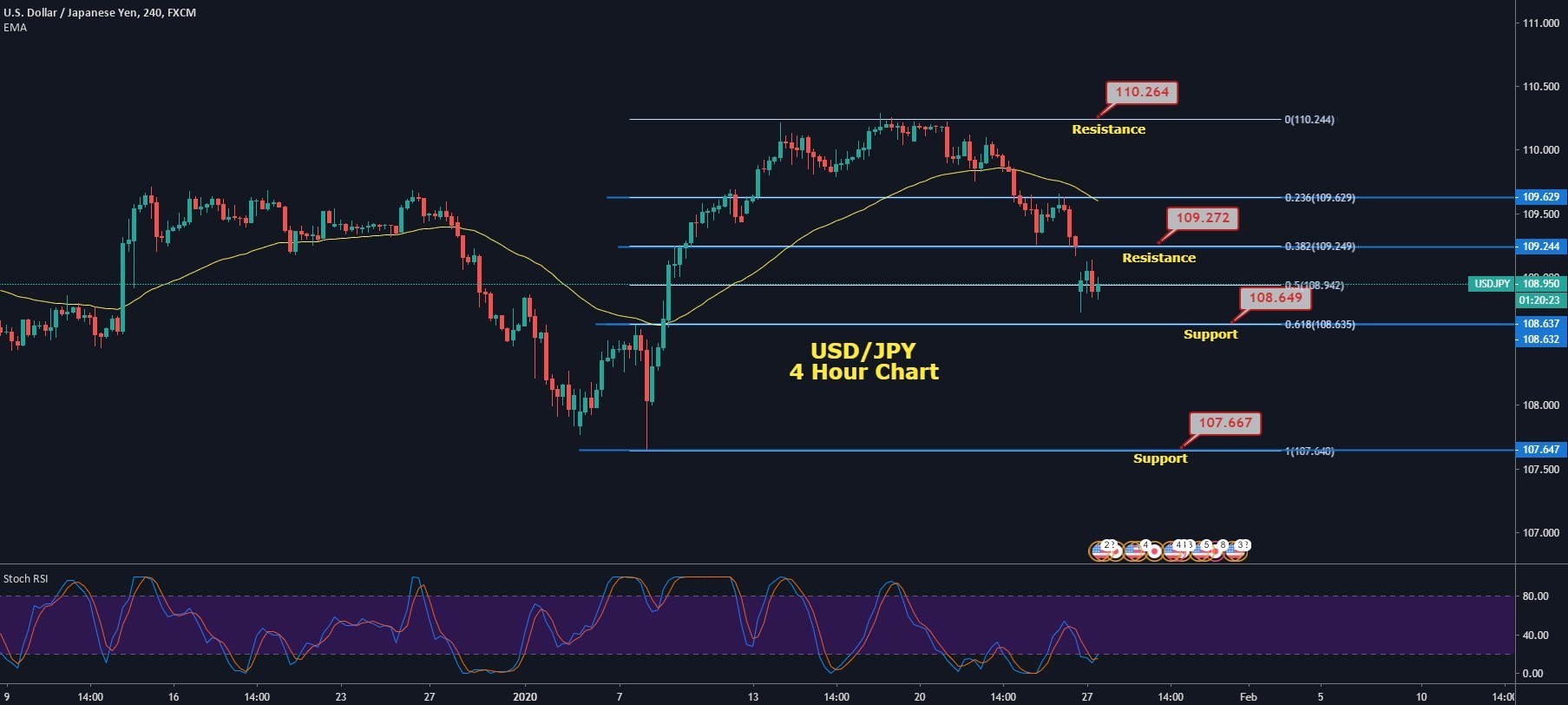
The USD/JPY is still trading in a selling mode at 108.850, dropping below 50% Fibonacci retracement level, and it's heading towards 61.8%, which marks 108.620.
The RSI and Stochastics are also heading into the selling zone, signaling chances that the USD/JPY may need to retrace back a bit before heading down further. On the 4 hour timeframe, the USD/JPY pair has opened a with a gap, and typically such gaps are filled with on the same day or a day after that. Let's see. But today, we should look for selling trades below 109.150 and buying positions above $108.650.
USD/CAD - Overbought Pair, Is It Going to Retrace?
The USD/CAD closed at 1.31469 after placing a high of 1.31524 and a low of 1.31175. At 18:30 GMT, the Core Retail Sales for the month of November from Canada was released, which showed a decline of 0.2% against the expectation of 0.5% and weighed on the Canadian dollar. The Retail Sales, however, showed an expansion to 0.9% against 0.6% in the month of November and supported the Canadian dollar.
The Core Retail Sales was closely watched among traders to place their bets for Loonie, and when it was released weaker than expected, it weighed on the Canadian dollar and ultimately raised the prices of USD/CAD on Friday.
Furthermore, Crude oil was on bearish trend on the back of coronavirus fears on Friday and reached to its lowest since early November. Weak crude oil weighed on commodity-linked Loonie and supported the rise on USD/CAD prices at the ending day of the week.
From the American front, the U.S. dollar was in strength against its rival currencies on Friday amid the sharp rise in U.S. Services PMI. At 19:45, the Flash Services PMI from the U.S. for the month of January exceeded the expectations of 52.9 and came in as 53.2. Expansion in the Services sector of the United States gave strength to the U.S. dollar and added in the upward movement of USD/CAD pair.
USD/CAD - Daily Technical Levels
|
Support |
Pivot Point |
Resistance |
|
1.3153 |
1.3158 |
1.3167 |
|
1.3144 |
1.3172 | |
|
1.3139 |
1.3181 |
USD/CAD - Daily Trade Sentiment
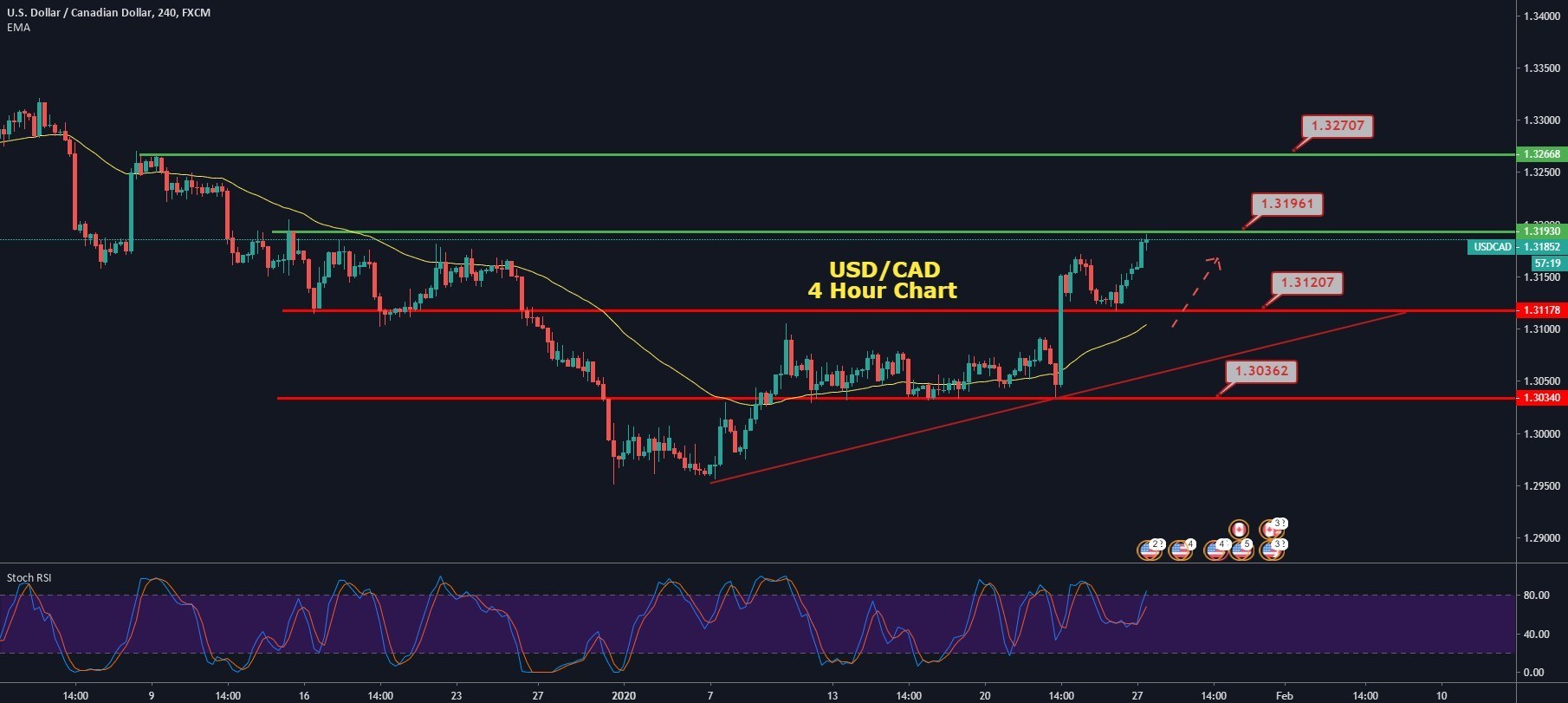
The USD/CAD is testing the double top level at 1.3196 as the stronger dollar drove the pair higher. On the 240 mins chart, the pair has formed a bullish engulfing candle followed by a series of green candles is also suggesting odds of more buying in the USD/CAD currency pair. Bullish crossover of 1.3196 can lead the USD/CAD prices higher towards 1.3270, while the support continues to stay around 1.3110.
AUD/USD – Triangle Pattern Breakout
The AUD/USD pair closed at 0.68251 after placing a high of 0.68569 and a low of 0.68172. The AUD/USD sank to its lowest level since December 11 on Friday amid the sensitive outlook of China's economy due to coronavirus fears.
The outlook of the Chinese economy suffered due to widespread of latest coronavirus in China. The origin of the virus was blamed at Wuhan city of China, which has been blocked by Chinese officials to embrace the spread of the virus.
Chinese Equity Market has fallen and suffered a lot because of this virus, and it has also raised the fears that the global economy could get affected because of viruses too. This has resulted in weakened Chinese Yuan, and as a result, China-proxy Australian dollar got weakened also.
The weak Australian dollar dragged the prices of the AUD/USD pair on Friday. The downfall in pair's prices was added after the release of Manufacturing PMI from Australia. At 3:00 GMT, the Flash Manufacturing PMI came in as 49.1 in the month of January, which was less than the December's 49.2. The contraction in the Manufacturing Sector of Australia added to the weakness of Aussie.
The Flash Services PMI from Australia for the month of January also declined to 48.9 from December's 49.8 and weighed on the Australian dollar. Both the Manufacturing & Services Sector of Australia showed a contraction in the month of January and dragged the pair AUD/USD further on Friday near its multi week's lowest level of 0.68100.
On the other hand, the U.S. dollar was strong in the financial market against its rival currencies on the back of strong Services PMI. At 19:45 GMT, the Flash Services PMI form the United States showed an expansion in the services sector of the United States for the month of January when released as 53.2 against 52.9. Strong U.S. dollar added in the downfall of Aussie, and hence AUD/USD was dropped further at the ending day of the week.
AUD/USD - Technical Levels
|
Support |
Pivot Point |
Resistance |
|
0.6794 |
0.6807 |
0.6813 |
|
0.6788 |
0.6826 | |
|
0.6775 |
0.6833 |
AUD/USD - Daily Trade Sentiment
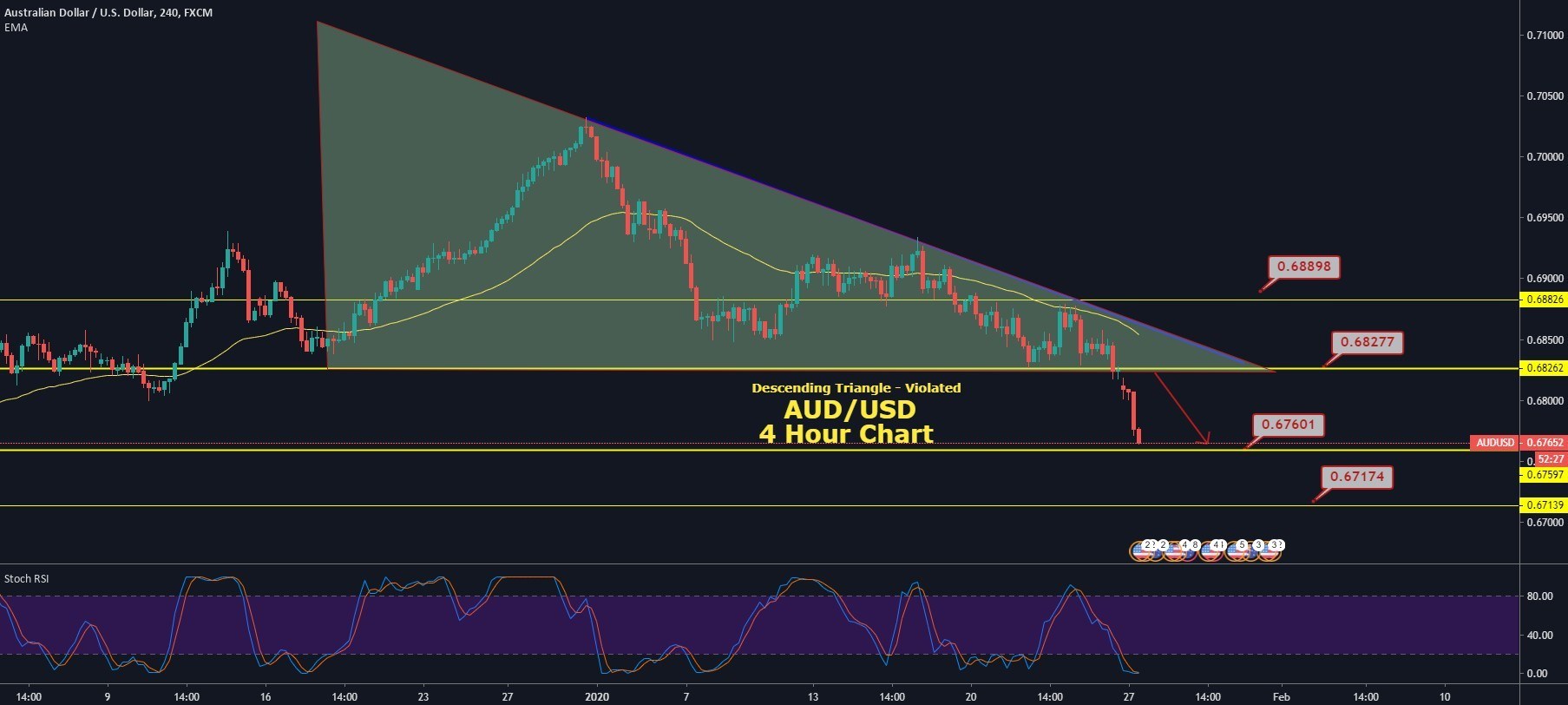
The AUD/USD has violated the long-held triangle pattern, which supported the Aussie around 0.6825. The AUD/USD is now trading at 0.6760, having formed a bearish marabou candle on the 4-hour chart.
The pair may find immediate support around 0.6760, and below this level, we may see further sell-off until 0.6715. Since the RSI is heavily oversold, we may also experience a bullish correction in the AUD/USD pair. Let's consider taking a sell trade below 0.6800 and buying above 0.67500.
Author

EagleFX Team
EagleFX
EagleFX Team is an international group of market analysts with skills in fundamental and technical analysis, applying several methods to assess the state and likelihood of price movements on Forex, Commodities, Indices, Metals and