Three rate hikes, one warning: The inflation fight isn't over
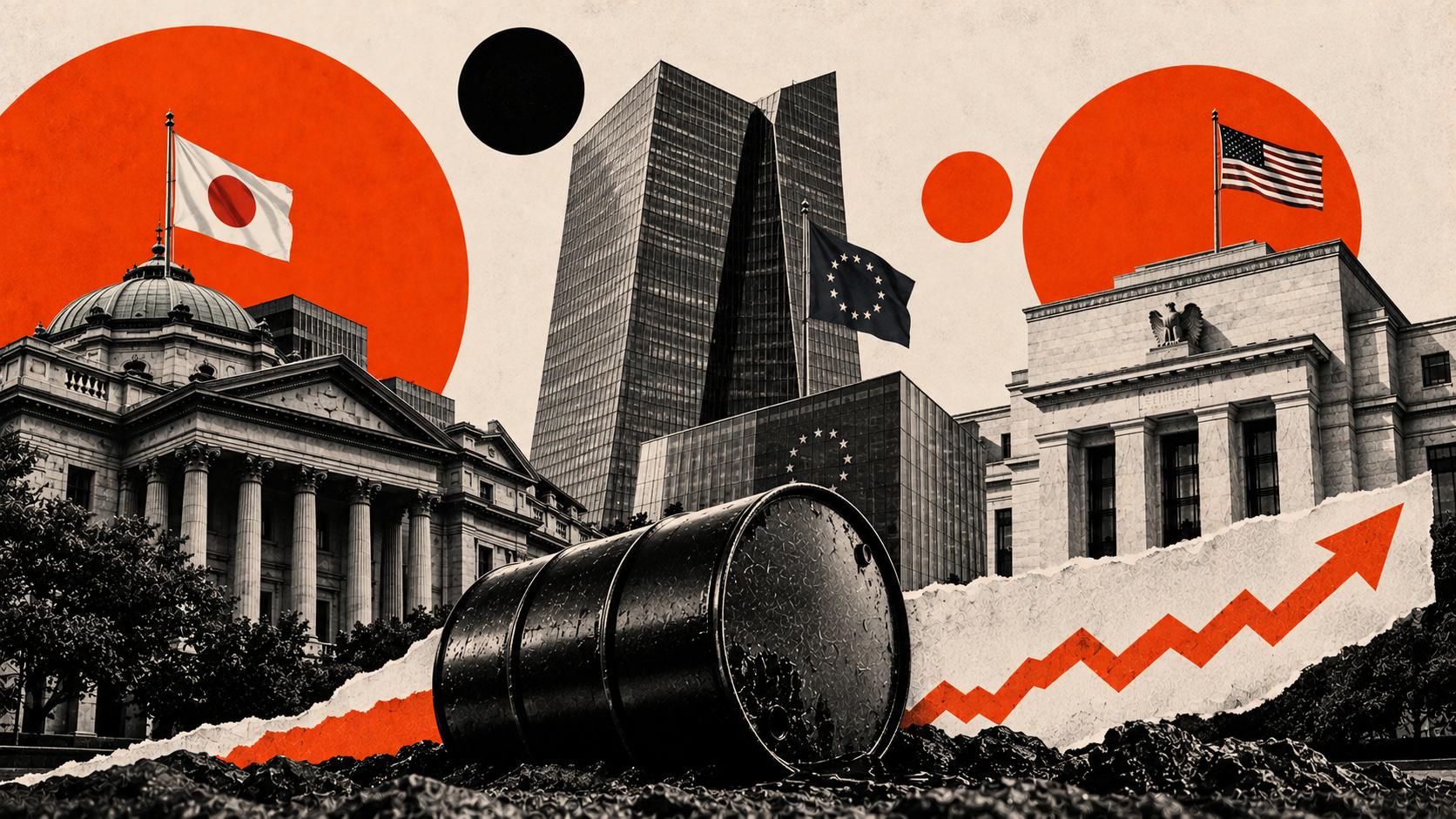
It is rare for the world's biggest central banks to move in the same direction.
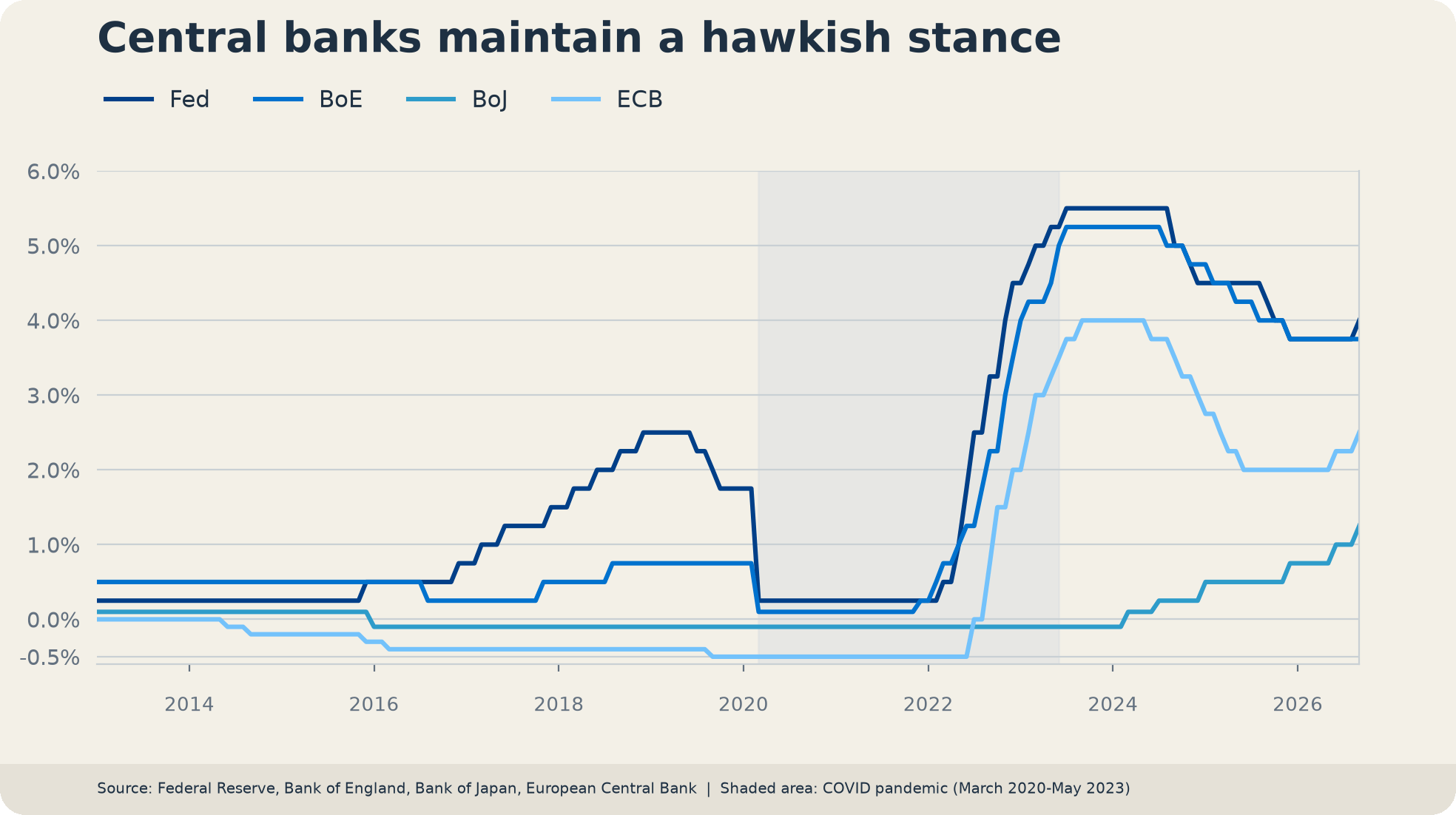
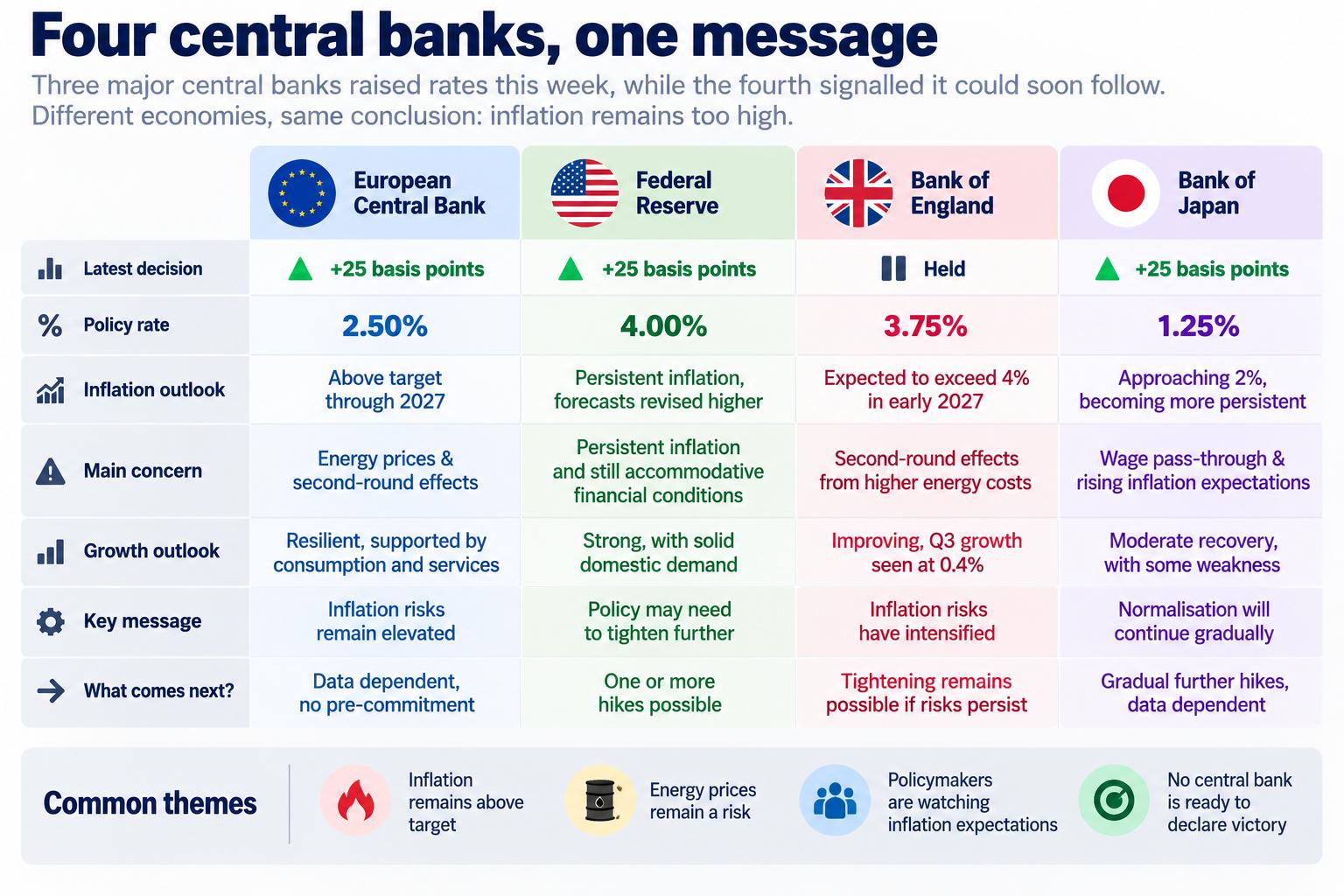
Yet within the space of just over a week, the European Central Bank (ECB), the Federal Reserve (Fed) and the Bank of Japan (BoJ) all raised interest rates, while the Bank of England (BoE) stopped just short of joining them.
The decisions came against very different economic backdrops. The US economy continues to outperform expectations, the Euroland is proving more resilient than many anticipated, Japan is only beginning to emerge from decades of ultra-loose monetary policy, and the UK remains caught between slowing inflation and subdued domestic demand.
So why are policymakers in such different economies suddenly sounding so similar?
The answer may lie less in where inflation is today than in where central banks fear it could be heading.
Inflation is changing shape
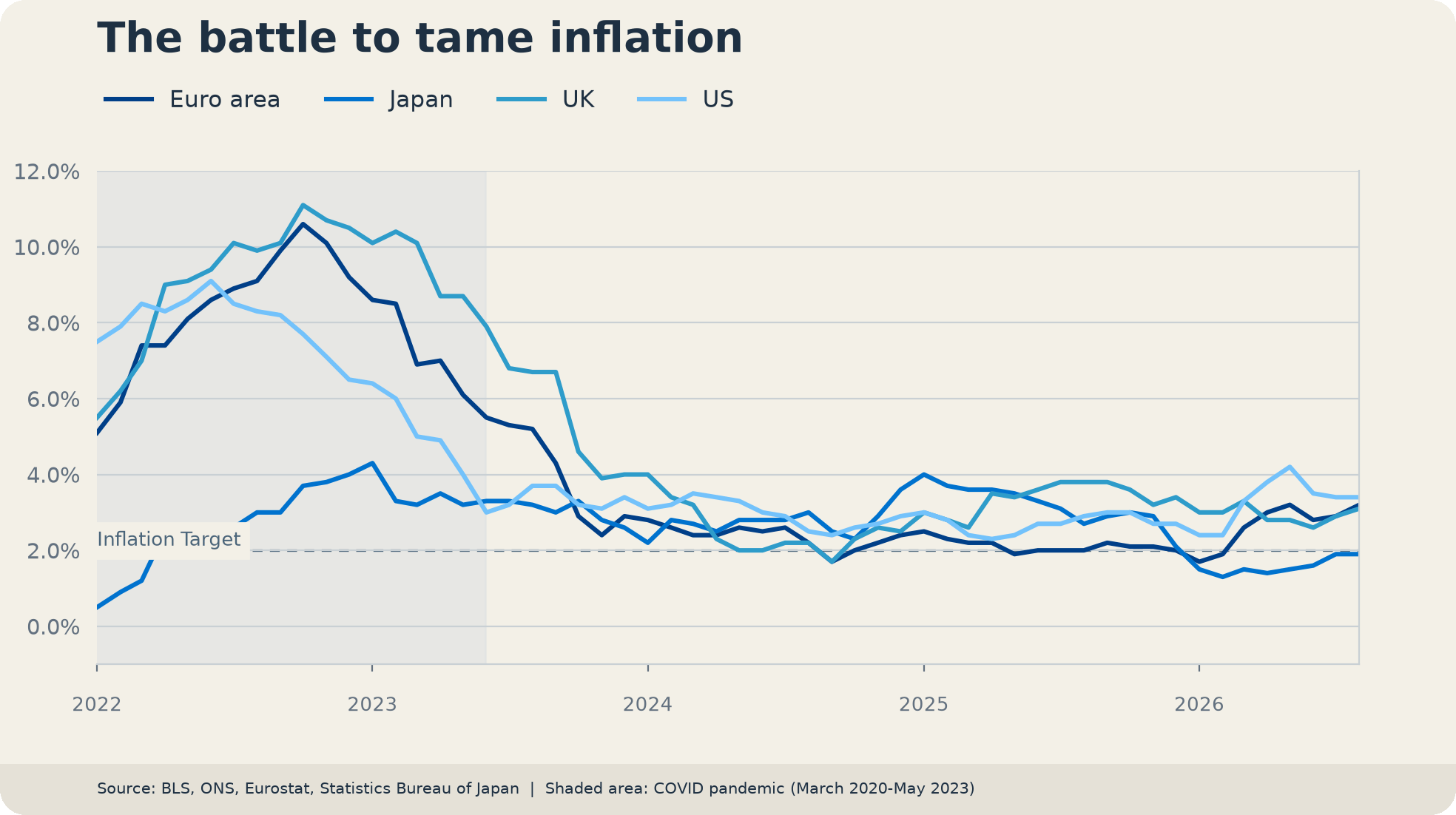
Only a few months ago, markets became increasingly confident that inflation was finally moving under control. Supply chains had largely normalised, goods inflation had eased and investors began looking beyond inflation towards economic growth.
That optimism has faded.
The renewed rise in energy prices following the conflict in the Middle East has forced central banks to reassess the outlook. Yet it is not crude Oil itself that concerns policymakers most.
The real worry is what happens after the initial shock.
The ECB raised its deposit rate to 2.50% and warned that higher energy prices could keep inflation above its 2% goal well into 2027. While domestic demand has remained resilient and the labour market continues to hold up, President Christine Lagarde cautioned that higher energy costs could gradually feed into core inflation and food prices if the shock proves persistent.
The Federal Reserve delivered another 25-basis-point increase and reinforced its message through higher inflation projections and a steeper policy-rate path. Chair Kevin Warsh argued that financial conditions were still not restrictive enough and made clear that policymakers were focused on persistent inflation rather than temporary price shocks.
The Bank of England kept rates on hold at 3.75%, but its revised forecasts painted a far more worrying picture for inflation. Consumer prices are now expected to exceed 4% during early 2027, while Governor Andrew Bailey warned that prolonged geopolitical tensions could ultimately require tighter monetary policy.
Meanwhile, the Bank of Japan continued its gradual policy normalisation with another 25-basis-point increase to 1.25%. Governor Kazuo Ueda acknowledged that underlying inflation was approaching the bank's target and said rising wages, higher import costs and firmer inflation expectations justified gradually reducing monetary accommodation.
Different economies.
Remarkably similar concerns.
The next battle is no longer about Oil prices
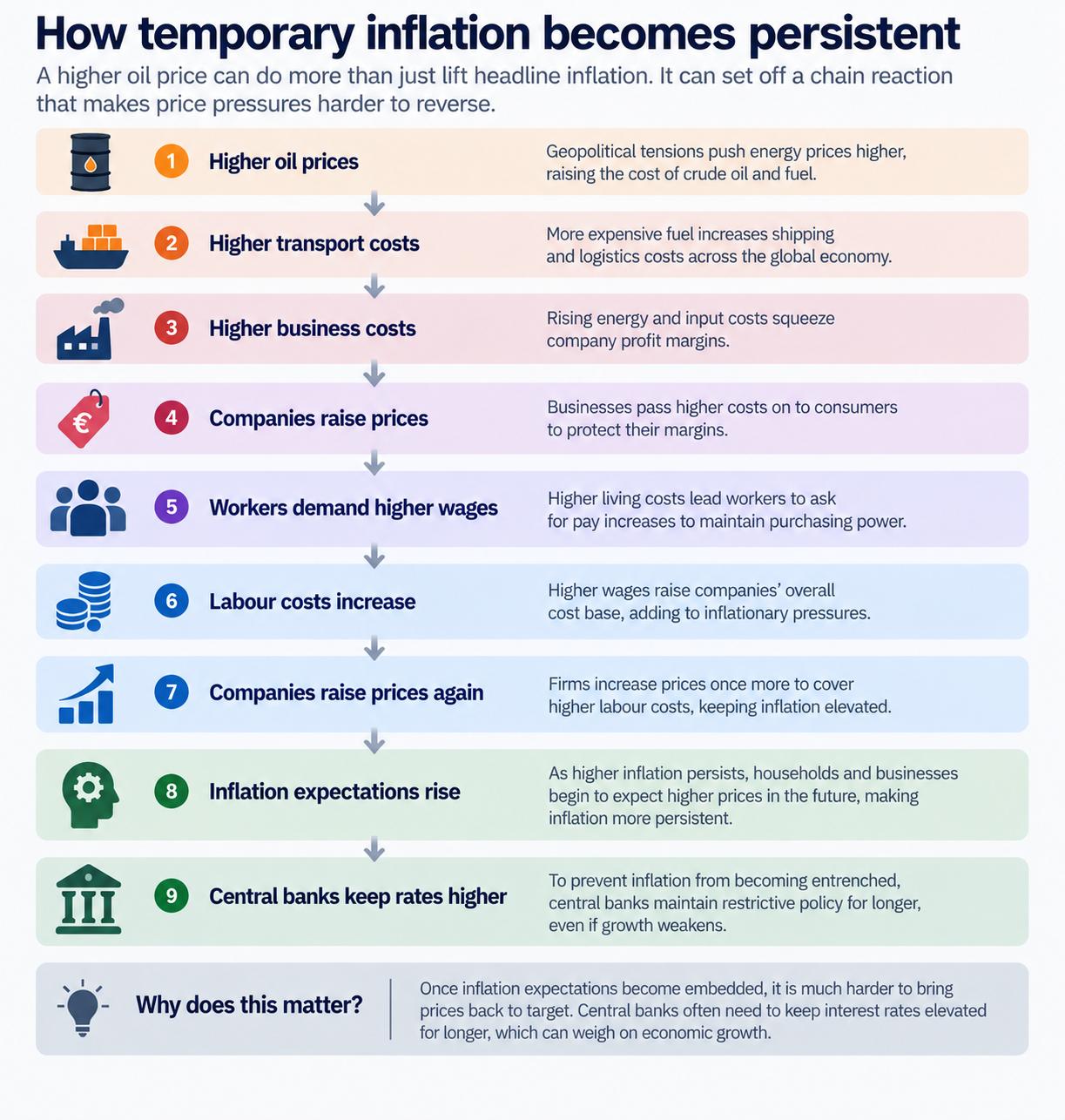
Higher Oil prices matter because they increase transport costs, squeeze company margins and reduce households' purchasing power.
But central banks are increasingly worried about something much more persistent.
Economists refer to it as second-round effects.
The danger is not simply that businesses face higher costs today. It is that companies begin raising prices more aggressively, workers demand higher wages to protect purchasing power and households gradually come to expect permanently higher inflation. Once those expectations become embedded, inflation develops its own momentum and becomes considerably harder to reverse.
That concern appeared repeatedly throughout this week's policy meetings.
The ECB warned that prolonged energy shocks could generate second-round inflationary pressures. The BoE acknowledged that, while there is still limited evidence that those effects have become widespread, the risk has increased enough to justify a distinctly hawkish tone. The BoJ pointed to wage pass-through and rising inflation expectations as signs that underlying inflation is becoming more durable, while the Fed shifted its emphasis away from temporary supply disruptions towards the persistence of price pressures.
Different terminology.
The same diagnosis.
Growth is holding up better than expected
Perhaps the biggest surprise from this week's meetings was not that three central banks raised rates.
It was that they felt comfortable doing so despite an increasingly uncertain global backdrop.
The ECB described the Euro area's economy as resilient, supported by stronger consumption, investment and services activity, even as energy prices continue to cloud the outlook.
The Federal Reserve upgraded its growth projections, citing robust domestic demand, solid productivity growth and a labour market that remains in good health. The so-called “exceptionalism” remains well and sound.
The Bank of England also struck a somewhat more optimistic tone on activity than many investors expected. Third-quarter growth forecasts were revised higher, consumer confidence has improved and manufacturing has shown tentative signs of recovery, although policymakers remain cautious about the outlook.
Japan likewise continues to recover moderately, giving the BoJ greater confidence that the economy can withstand a gradual withdrawal of extraordinary monetary stimulus.
Taken together, the four meetings suggest that central bankers currently view resilient growth as an opportunity to finish the inflation fight rather than a reason to ease policy.
Japan is no longer the exception
For decades, Japan occupied a unique place in global monetary policy.
While other central banks struggled to contain inflation, the BoJ spent years attempting to generate it.
That era appears to be drawing to a close.
The latest rate increase to 1.25% marks another milestone in Japan's long journey away from ultra-loose monetary policy. Underlying inflation is approaching the BoJ's target, firms are increasingly passing higher wage costs on to consumers, and inflation expectations continue to rise.
Even so, Governor Ueda carefully avoided committing to a predetermined path. Future moves will depend on incoming data and the cumulative effects of previous tightening, suggesting that the BoJ wants to continue normalising policy without jeopardising the recovery.
Japan may still be following a different road from its Western counterparts.
But it is now heading in the same direction.
A new phase of the inflation fight
The inflation challenge confronting policymakers today is very different from the one that emerged after the pandemic.
The first phase was dominated by supply-chain disruptions, reopening demand and extraordinary fiscal and monetary stimulus.
The next phase may prove considerably more difficult.
Rather than responding to temporary shocks, central banks are increasingly trying to prevent inflation expectations from becoming embedded across the economy. Once businesses routinely raise prices, workers consistently demand higher wages, and households begin assuming inflation will remain elevated, restoring price stability becomes significantly more costly.
That explains why four central banks separated by thousands of miles, facing different economic conditions and operating at very different interest-rate levels, have delivered such remarkably similar messages.
The ECB, the Fed and the BoJ have already tightened policy again.
The Bank of England has made clear it is prepared to follow if inflation broadens further.
The message from global policymakers is becoming increasingly difficult to ignore.
The inflation fight is not over.
It has entered a new, and potentially more challenging, phase.
Author

Pablo Piovano
FXStreet
Born and bred in Argentina, Pablo has been carrying on with his passion for FX markets and trading since his first college years.