This week we get US CPI and Retail Sales

This week we get CPI and retail sales. We get PPI on Tuesday and CPI on Wednesday, followed by retail sales on Thursday, all important for reading the Fed's mind and conjuring up a scenario for US growth. The use of credit cards going negative is a siren cry… of something.
In addition, we get inflation numbers for the UK, EU members and the EU overall, mostly on Wednesday.
Looking back, we thought even the best jobs report would not impress the bond vigilantes and dollar boys, but both the 10-year and the dollar index claimed a few extra points in the immediate aftermath of the release—with no sign of "sell on the news." A pullback would have been "normal," insofar as that concept is applicable in markets.
That the gung-ho sentiment persisted and even increased is noteworthy. Abnormal behavior needs to be watched carefully. The market is sending a loud message to the Fed. The WSJ says the Fed is getting the message.
The WSJ’s selected St Louis Fed Pres Musalem to explainthe Fed’s stance. First, things have changed since Sept when the Fed did 50 bp. He had gone along with the two cuts in the dot-plot, but now he’s worried about the neutral rate. Musalem brights up the critical point of whether the tariffs are one giant thing or spread out. He credits the yield rise to the term premium, which is okay now that uncertainty is so high. “The interpretation could be, ‘The future’s more uncertain, and we need more premium for that.’ ” He is a voter this year.
Then, as noted above, the CME FedWatch tool delivered a punch—futures traders now think the Fed will not cut at all this year. Even by the Dec 10 meeting, the probability of a single cut is less than 50% at 40.8%.
This is full-bore panic. The top factor driving it is, of course, the reckless and incompetent Trump. Press reports now say he may declare a “national economic emergency” to justify wild tariffs using the International Economic Emergency Powers Act (IEEPA), gives the president the power to manage imports during an emergency. He threatened to use during the first term against Mexico, but backed off. CNN notes various organizations “like the Chamber of Commerce and the Business Roundtable to prepare lawsuits challenging the legality of such a move.”
We would normally consider that the bond situation has gone too far and the “bear steepening” is exaggerated. Bloomberg, always trying to be cute, calls it a tantrum. But then in the midst of wordy WSJ essay, we came across this: Bond yields are up because investors are demanding more term premium. Keeping this in mind, what is happening to bonds makes sense. Fixed-income investors have ruled out a “hard landing” for the economy, and have been persuaded by officials that returns on cash probably won’t dip below 3.5% for the foreseeable future. They have thus started demanding a larger reward to lock up their money for longer.
“This term premium still isn’t huge: It is reportedly adding 0.6 percentage point to 10-year yields, when the historical average is 1.5 percentage points. The steepness of most of the yield curve remains mild by historical standards.’
Yikes. Foes that mean the 10-year will be going up by 1.5% to 6.28%--?
Forecast
We are in an unprecedented set of conditions, starting with a new president next week who speaks wildly and boldly about taking over just about everything and doing things his way, when the whole world knows from past experience he is not a competent manager. Apologists wonders if this bombast is not just a negotiating ploy, but we are not seeing any sign of that. The markets have chosen to believe Trump and that’s all of them —stocks, bonds, FX.
Because this is a brand-new situation, we can’t consult past market behaviors to guess what might come next that is not continuation. Normally we would say the fever will break during the first quarter, but then we also think Trump will go after the Fed during that period to get the rate cuts he wants. A projected rise in the 10-year to 6.28% would be too tame.
We must therefore say there is no end in sight. The dollar can keep going, and going, and going. This will trim US exports and do tremendous harm to emerging markets. We await other world leaders—all of them—to speak out and better, take some concrete action. History is not the side of that, alas.
Tidbit: The dollar goes up as bond yields rise on sticky inflation, the prospect of Trumpian deficits, and the red-hot economy.
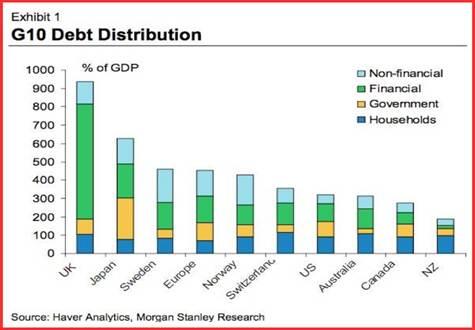
In the UK, the opposite is happening—the prospect of higher deficits is fatal. Rising bond yields are not working. It’s hard to compare deficits but here is one that works as the good-enough explanation for the two bond experiences diverging.
Tidbit: The NYT and FT each calculated what the US would have to pay Denmark to sell Greenland to the US. We bought the Virgin Islands fron Denmark in 1917 for $25 million. We bught Alaska from Russia in 1867 for $7.2 million. Earlier, it was the Louisiana Purchase from France for $15 million in 1803 (not used by the newspapers).
The NYT has two answers, depending on which previous land deals are included--$12.5 billion ore maybe $77 billion. The FT has $1.1 trillion.
Greenland is not for sale. Trump thinks it's "real estate" and has no time for that thing named sovereignty. Many press stories point out Greenland would rather be independent that belong to either Denmark or the US. We suspect it's a lot like Scotland deciding not to choose independence when the voters discovered how much in subsidies they got from the UK. What does Trump have as bargaining chips? Jobs in the new mines he would dole out to US company pals, outright income handouts, voting rights in the US, and more.
A probable start to what Trump sees as the real estate bargaining process might be a referendum. Or maybe not, because the potential for loss is too high. But a bargaining process is in the cards. If that fails, there's always the military. Then the question becomes whether the US military would refuse to carry out an illegal order—invading a treaty ally must be illegal, right?
We researched the question and discovered "the military" won't answer. "Military.com reached out to the Joint Chiefs of Staff, who also declined to comment. Finally, the office of the defense secretary, after several weeks of queries, provided a response." In essence, the top brass would have to consult lawyers. Oh, dear.
Why is this relevant to the dollar? Other sovereigns infuriated by Trump's conduct could well choose to dump dollars from their reserves and opt for something eles, even non-interest bearing assets like gold. Would countries give up interest or take less in interest as a matter of principle? Trump doesn't have or understand "principles" so he thinks not, but we are not so sure in this age of mass comunication.
Betting line: we put $10 onTrump buying Greenland.
This is an excerpt from “The Rockefeller Morning Briefing,” which is far larger (about 10 pages). The Briefing has been published every day for over 25 years and represents experienced analysis and insight. The report offers deep background and is not intended to guide FX trading. Rockefeller produces other reports (in spot and futures) for trading purposes.
To get a two-week trial of the full reports plus traders advice for only $3.95. Click here!
This is an excerpt from “The Rockefeller Morning Briefing,” which is far larger (about 10 pages). The Briefing has been published every day for over 25 years and represents experienced analysis and insight. The report offers deep background and is not intended to guide FX trading. Rockefeller produces other reports (in spot and futures) for trading purposes.
To get a two-week trial of the full reports plus traders advice for only $3.95. Click here!
Author

Barbara Rockefeller
Rockefeller Treasury Services, Inc.
Experience Before founding Rockefeller Treasury, Barbara worked at Citibank and other banks as a risk manager, new product developer (Cititrend), FX trader, advisor and loan officer. Miss Rockefeller is engaged to perform FX-relat