The week ahead: Events in Venezuela have limited market impact as macro stress test awaits
- Markets shrug off Venezuela fears for now.
- Oil price in focus as crude has another weak start to the year.
- Why Venezuela won’t tank the oil price, yet.
- Fallout from geopolitical news is limited.
- Does the US have an advantage on China?
- US assets in focus this year.
- A continuation of old themes power January markets.
- Macro Stress tests await.


As we start the first full trading week of the year, it is Venezuela and the US’s overthrowing of the Madura regime that is dominating the airwaves, however, it is yet to dent market sentiment. Stock market futures are in the green, with indices in Europe poised to open higher, futures for the S&P 500 are also pointing to a higher open later today. Asian stocks have also had a strong start early on Monday and the MSCI Asia index surged to a record, as the AI theme continues to drive global markets.
Markets shrug off Venezuela fears for now
Stock traders are looking through the Venezuela news and instead waiting for a torrent of economic data that will have a bigger short to medium term impact on price action. This does not mean that the markets are overlooking geopolitical risks altogether. The gold price has surged by nearly $90 so far this morning, and another attempt to breach the $4,500 per ounce level could be on the cards.
Oil price in focus as crude has another weak start to the year
The spotlight will be on how the oil price reacts, after all, Venezuela has the world’s largest oil reserves, slightly more Saudi Arabia. So far, Brent and WTI crude are both lower by less than 1%, and Brent crude is managing to stay above $60 per barrel. However, the bigger picture is that this latest geopolitical event is unlikely to boost demand for oil and it has been another weak start to the year for crude oil, which performed poorly in 2025, with Brent and WTI posting losses of more than 20%.
Why Venezuela won’t tank the Oil price yet
The question is, will traders focus on the potential for future Venezuelan oil flooding the market, which could tank the oil price, or will they focus on how much investment will be needed to get Venezuela to pump more oil? Right now, Venezuela pumps less than 1 million barrels per day, at its peak in 1998, before socialist dictators took control, it was pumping out nearly 3.5 million barrels per day. To get back to this level will take hundreds of billions of dollars in investment, which President Trump has said will partly come from US oil companies. However, the type of investments needed including upgrading old and decaying infrastructure, drilling new oil wells and building more refineries to process Venezuela’s heavy crude oil. Optimizing resource-rich Venezuela to generate the income needed to turn the country around could take until 2030 and beyond, according to some oil analysts. Thus, any decline in the price of oil at the start of this week could be short lived.
Fallout from geopolitical news is limited
While there could be plenty of future riches for American oil companies, these will not happen overnight, and their success will depend on the peaceful transition of power to a functioning democracy. That is not a given at this stage, as President Trump has ruled out fresh elections, and for now Maduro’s deputy is in charge. This is a fluid situation that could change quickly, and the markets are likely to be reactionary on the back of news flow. For now, the market is not over-trading the Venezuela theme and the fall out from events at the weekend are mild, even if gold is catching a bid.
Does the US have one up on China?
However, there could be a longer-term impact from the weekend’s events. Part of the US’s action in Venezuela may be to secure US oil supply for many years into the future. Another part is US/ China relations. China bought more oil from Venezuela than anyone else. By controlling Venezuela’s future oil production, the US can exert some influence and power over China. For now, President Trump has said that he will continue to sell oil to China, but this is a major power move from the US and cements their position as the world’s most important global economy.
Could US assets be in focus this year?
Thus, as we start the first full trading week of the year, the macro economy is shifting, and the repercussions of President Trump’s may trigger a shift towards the US for many years to come. In the short term the fallout is likely to be small, but in the long term it could provide a major boost for US assets and help them to outperform after the USD and US stock indices underperformed the rest of the world last year. In the short term, we expect the Venezuelan bolivar to rally along with Venezuelan debt, as FX and bond traders assume that nothing could be as bad for the economy as Maduro.
A continuation of old themes power January markets
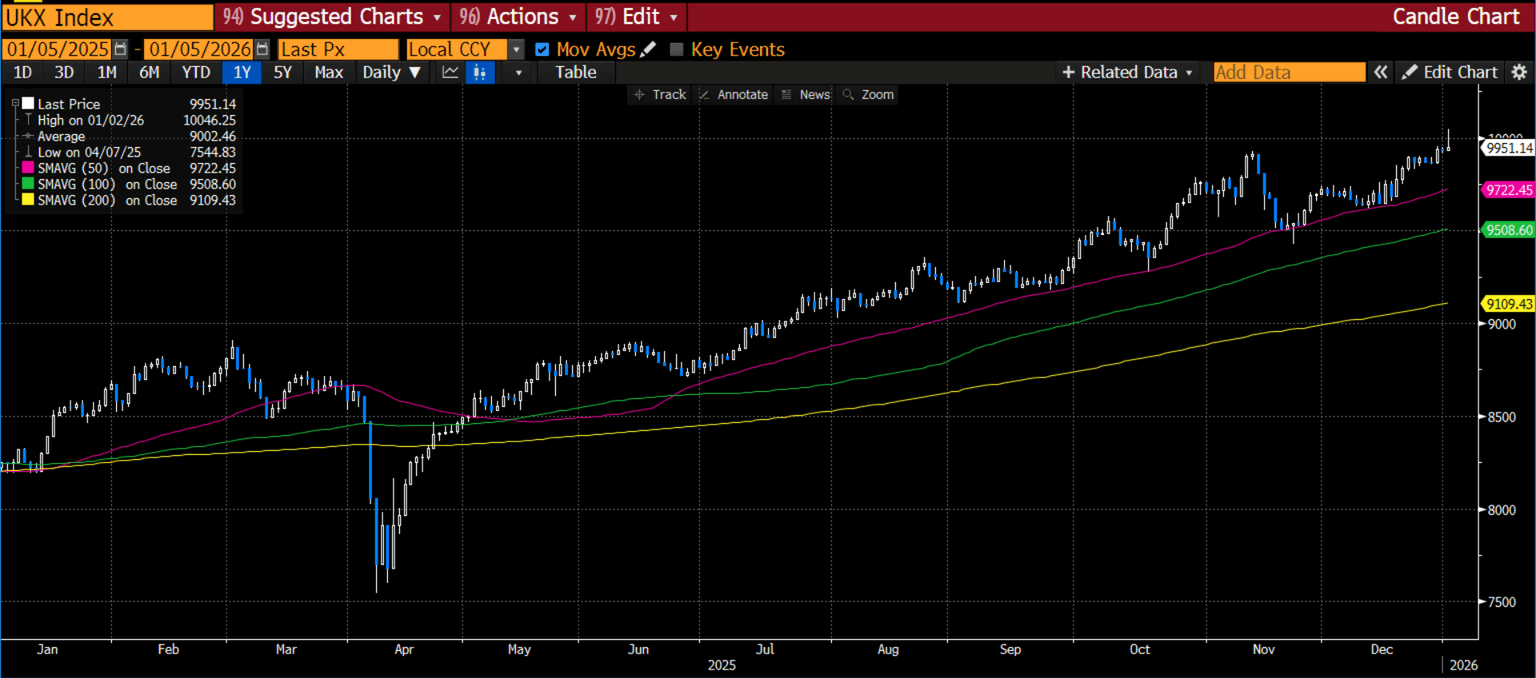
Global stocks and risk sentiment started strong in 2026. There were decent gains for European indices and the FTSE 100 managed to break above 10,000 for the first time. Friday’s top performers could tell us a lot about the market psyche as we start the new year. Rolls Royce rose by a stunning 4%, followed by Burberry, which was higher by 3.7%. Rolls Royce has been one of the UK’s top performing stocks in recent years. Its strong performance on 2nd January suggests that traders are willing to continue buying good companies and let the results compound.
FTSE 100 breaks new ground
Source: XTB and Bloomberg
The same was true in Germany, where Rheinmettall was one of the top 10 best performers on the Dax, and in the US the AI theme is still going strong, with gains for Intel and Micron Technology on Friday. A continuation of the themes from 2025 could see strong and stable companies outperform this year, which includes defense stocks, which could also be given a boost by events in Venezuela. Thus, the key market themes that drive stocks at the start of this year may not be too different from what we have been used too. Along with defense, consumer stocks may also be in focus, especially in the UK, as markets expect the economy to pick up this quarter after a confidence draining budget caused economic pain in Q4. Thus, old and new themes could unite to boost stocks in 2026, with virtually no one looking for a market upset or decline at this stage.
Macro Stress tests await
However, to keep things spicy in financial markets, the week ahead is jam packed with event risk, and investors and markets are about to get a full macro stress test, including global December PMI reports, US Nonfarm payrolls, and inflation data from Europe. Below, we take a look at the three main events to watch out for this week.
US Nonfarm Payrolls
Without a doubt, this is the big event that the market will be watching for this week. Following two months of volatile labour market readings due to last year’s government shut down, the December report should give Fed officials a more accurate reading of the prevailing trend in the US jobs market. Economists surveyed by Bloomberg expect a modest 59k increase in payrolls, however, the November figure is expected to be revised lower. The unemployment rate is expected to drop back to 4.5% from 4.6%, after it was artificially inflated by furloughed US government employees, and wage growth is expected to pick up to a 3.6% annual pace from 3.5% in November.
2025 is expected to have been one of the weakest years for employment growth in the US since 2009, after the global financial crisis, and a weak report at or below expectations could give the Fed more ammunition to cut interest rates, even though inflation remains well above target. It is also worth noting that although jobs growth is expected to slow, there is no sign yet of mass layoffs that could trigger economic pain in the US.
We do not expect the balance in the US labour market to have shifted last month, and we think that for now, the Fed Funds Rate, is appropriately pricing in rate cut expectations for this year. It currently expects 2 further cuts this year, and we think that the December data won’t do enough to shift the dial to change these expectations. As we move through January, the CPI report will be more important for financial markets, in our view, and the next few readings on US inflation could trigger more volatility.
Even so, the dollar could still be impacted. After a torrid year in 2025, the US dollar had a stronger start to January and was the top FX performer vs. the G10 last week, the dollar index is also climbing on Monday. Could this be the year when the dollar fights back? Commodity bulls may hope not, since part of the strength of precious metals in the last 12 months has been attributed to dollar weakness.
Global PMIs
The overriding theme for the global PMI reports for December could be that the US is slowing down at a moderate rate, while the rest of the world, especially the Eurozone and the UK are picking up. The Eurozone could be the star of the show for December, and any improvenent in sentiment in the service or manufacturing sector could boost the euro, which opened the year on a weak note. EUR/USD has been stuck in a tight range between $1.1720 and $1.1850. It will need a new driver in the form of better economic data that suggests an economic comeback is already happening, for the euro to attempt $1.20 vs. the USD in the short term especially as the dollar is getting back on its feet as we move through the start of January.
EUR/USD daily chart
-1767600793754-1767600793754.png&w=1536&q=95)
Source: XTB and Bloomberg
UN security council meeting
The start of the week will begin with an emergency UN Security Council meeting to discuss Venezuela. This could focus minds on the events in recent days and what the collective international community’s thoughts are on the US’s toppling of Maduro. This meeting could be controversial, as China and China-aligned countries including some of the BRICS oppose the US action, and US allies support it.
There could be concerns about what else Trump might do, is Cuba or Columbia next on his list? Or could Greenland and even Canada be subject to a US ‘invasion’ at some point. Another issue that could arise from the events in Venezuela is whether it empowers the likes of China and Russia to extend their own force further into Ukraine or other parts of Eastern Europe for Russia, or if it could makes a Chinese invasion of Taiwan more likely?
While we expect this meeting to result in zero actual action, a split UN Security Council may cause some market jitters as we enter unchartered geopolitical waters.
Author
Kathleen Brooks
XTB UK
Kathleen has nearly 15 years’ experience working with some of the leading retail trading and investment companies in the City of London.