The US Dollar is set for a fourth straight weekly gain on hawkish Fed bets

The US Dollar Index (DXY), which measures the value of the US Dollar (USD) against a basket of six major currencies, is on track to register its fourth consecutive weekly gain, approaching the psychological 104.00 level, its highest since April 2025.
The Greenback has strengthened considerably in recent weeks as investors reassess the outlook for US monetary policy. Expectations of further interest rate hikes by the Federal Reserve (Fed), combined with growing risk aversion across global financial markets, have created a favorable environment for the American currency.
However, after four weeks of gains, the question is whether the US Dollar has enough momentum to extend its winning streak into a fifth consecutive week.
Hawkish Fed expectations remain the main driver of US Dollar strength
The latest Minutes from the Federal Open Market Committee (FOMC) October meeting reinforced expectations that US monetary policy will remain restrictive for longer than previously anticipated. Nearly all policymakers indicated that additional interest rate increases would likely be necessary to bring inflation sustainably back toward the Fed's 2% target. At the same time, several officials expressed concerns about persistent upside inflation risks.
The hawkish Minutes further reinforced market expectations for additional monetary tightening, which had already strengthened following recent hawkish comments from Fed officials and hotter-than-expected inflation data. According to the CME FedWatch Tool, traders are pricing in a 98.5% chance of a 25-basis-point interest rate hike at the December meeting, with expectations also building for another increase in January.
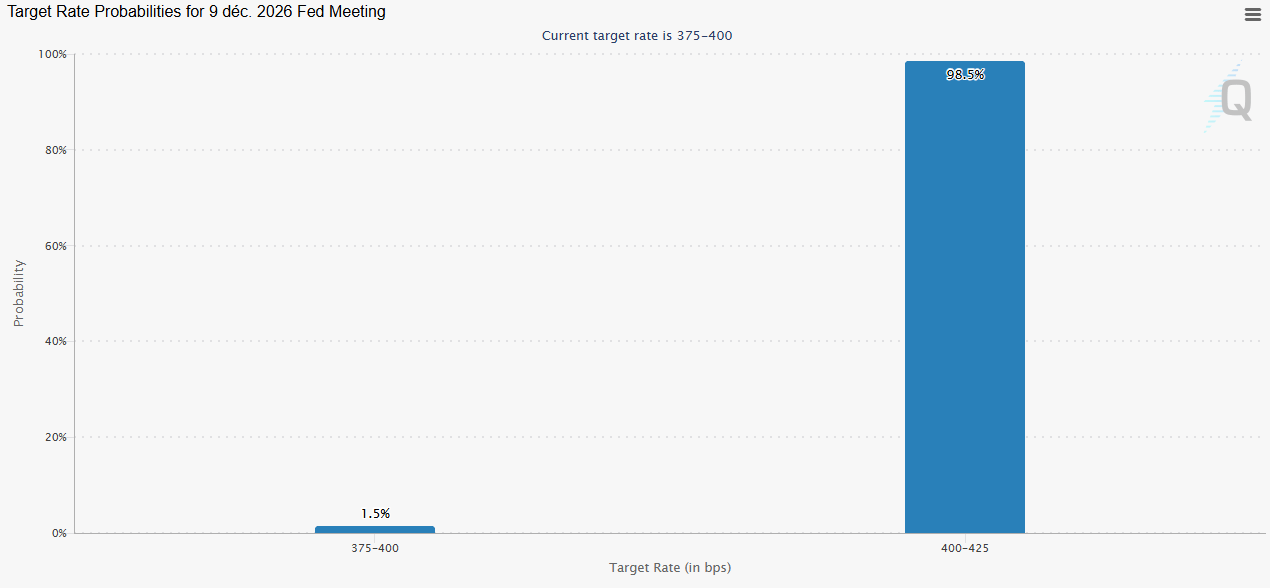
The prospect of higher US interest rates supports the US Dollar by making US-denominated assets more attractive. Recent comments from Fed officials have reinforced this narrative. Chicago Fed President Austan Goolsbee described the labor market as stable but warned that inflation remains "way higher" than the central bank's target. Strategists at OCBC share this assessment, noting that "hawkish Fed risks should keep the USD supported for now." The bank nevertheless expects a conventional 25-basis-point increase in December rather than a more aggressive 50-basis-point move.
Risk aversion provides a second engine for the US Dollar rally
Beyond monetary policy, deteriorating risk sentiment is adding another layer of support to the US Dollar. The recent sell-off in technology stocks has raised concerns about stretched AI-related valuations and the sustainability of investment spending across the sector. Meanwhile, rising US Treasury yields and falling commodity prices have encouraged investors to reduce exposure to riskier assets, particularly emerging-market currencies. This environment has accelerated the unwinding of carry trades, in which investors borrow in lower-yielding currencies to purchase higher-yielding assets. As these positions are liquidated, demand for funding currencies, including the US Dollar, tends to increase.
ING strategists highlight this dynamic: "The prospect of faster Fed tightening and continued dislocation in tech stocks is sucking funds into the dollar and the yen. Popular FX carry trade positions are being unwound across the board."
Geopolitical tensions are also contributing to defensive positioning. Renewed concerns about potential US military action against Iran and instability surrounding the Strait of Hormuz reinforce the US Dollar's traditional safe-haven appeal.
The combination of tighter monetary policy expectations and defensive capital flows therefore gives the current rally broader support than interest rate differentials alone.
Can the US Dollar extend its winning streak to five weeks?
The outlook for a fifth consecutive weekly advance depends largely on whether incoming economic data continue to justify the Fed's increasingly hawkish stance. Attention now turns to next week's release of the Personal Consumption Expenditures (PCE) Price Index, the Fed's preferred inflation gauge. Economists expect annual core PCE inflation to accelerate to 3.2% in October.

ING notes upside risks to inflation potentially reinforcing expectations of further tightening. The bank consequently maintains a constructive outlook for the Greenback, stating: "We expect the dollar to hold gains into next week and keep 104.60 as a near-term DXY target."
However, the US Dollar's advance is not without vulnerabilities. Commerzbank warns that the currency's recent strength partly reflects capital inflows associated with the AI investment boom. A sharper correction in US equities could undermine these flows and eventually weigh on the Greenback. The bank cautions that "if growing doubts about the sustainability of the AI boom were to trigger a sharper correction in US equity markets, a reversal of these capital flows could also hit the dollar hard."
This creates a potential contradiction for US Dollar bulls: moderate risk aversion supports safe-haven demand, but a deeper deterioration in US financial markets could eventually challenge the currency's strength.
US Dollar Index technical outlook: 104.00 breakout could open the door to 104.71
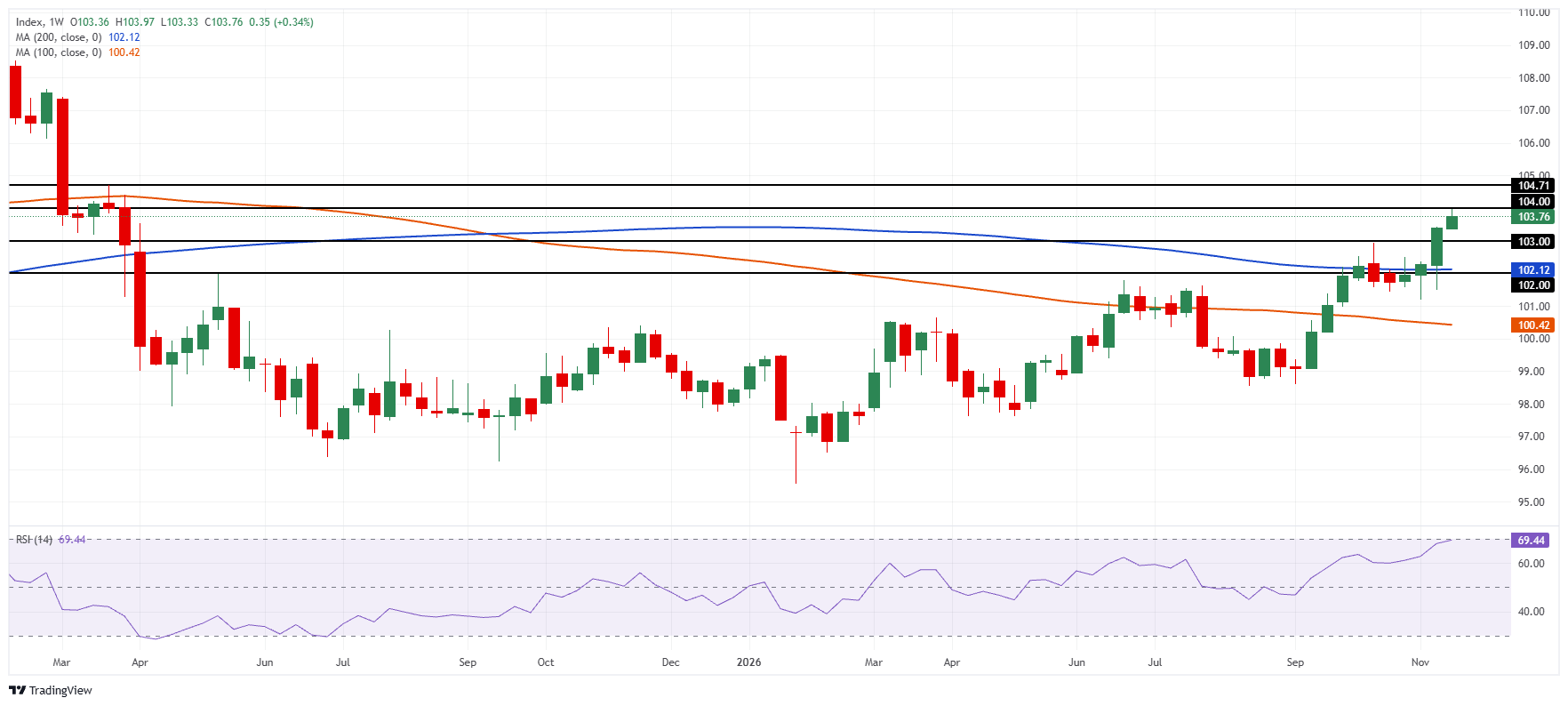
The weekly chart shows that the US Dollar Index has recovered significantly from its lows around 96.00 earlier this year, establishing a sequence of higher lows and pushing above several important resistance levels. The index currently trades above its 200-week Simple Moving Average (SMA) at 102.12 and its 100-week SMA at 100.42, reinforcing the improving medium-term technical outlook. The Relative Strength Index (RSI) stands near 69 on the weekly timeframe, indicating strong bullish momentum while approaching overbought territory.
Immediate resistance emerges at 104.00, followed by the more significant 104.71 level. A sustained break above these barriers could strengthen the bullish outlook and encourage further gains.
Conversely, failure to overcome 104.00 could trigger profit-taking following the recent advance. Initial support is located around 103.00, followed by the 200-week SMA near 102.12 and the psychological 102.00 level. As long as the index holds above this support region, the broader recovery remains intact.
Ultimately, a fifth consecutive weekly gain appears achievable if US inflation remains elevated and Fed officials maintain their hawkish rhetoric. However, with momentum approaching overbought conditions and expectations of further tightening already firmly embedded in market pricing, extending the rally may require fresh catalysts rather than simply a continuation of the existing narrative.
Author
Ghiles Guezout
FXStreet
Ghiles Guezout is a Market Analyst with a strong background in stock market investments, trading, and cryptocurrencies. He combines fundamental and technical analysis skills to identify market opportunities.

















