The US 10-year just hit a 2002 high. Does it give the US Dollar its next leg?
In 2026, the US Dollar Index (DXY), which measures the Dollar against six major currencies, has risen on days when Federal Reserve (Fed) rate expectations pushed Treasury yields up and barely moved on days when something else did. The last stretch of the 10-year yield's climb to its highest since 2002 was the second kind. Another leg higher for the Dollar needs two-year yields, which track where traders expect the Fed's rate to go, rising faster than 10-year yields again. The October 14 inflation report is the first chance for that.
The yield on the 10-year Treasury note was 5.31% on Monday in the Fed's daily figures, its highest since May 2002, after it went past its June 2007 peak on September 30. Its rise in the third quarter was the largest for any quarter this century. The Dollar Index is trading above 102.00, its highest since April 2025, and has risen almost 4% from its September 10 low. The 10-year reached its 2002 high in the same days that traders took about half a quarter-point Fed rise out of their bets.
The Fed did the lifting until the end of September
From the Dollar's January 27 low to October 2, the two-year Treasury yield rose 1.30 percentage points and the 10-year rose 1.04. The yield on 10-year inflation-protected Treasuries, which pay a return on top of inflation, rose 1.02 points, and the inflation rate the market expects over the decade rose 0.02. The Fed raised its rate to 3.75%-4.00% on September 16, its first rise since 2023.
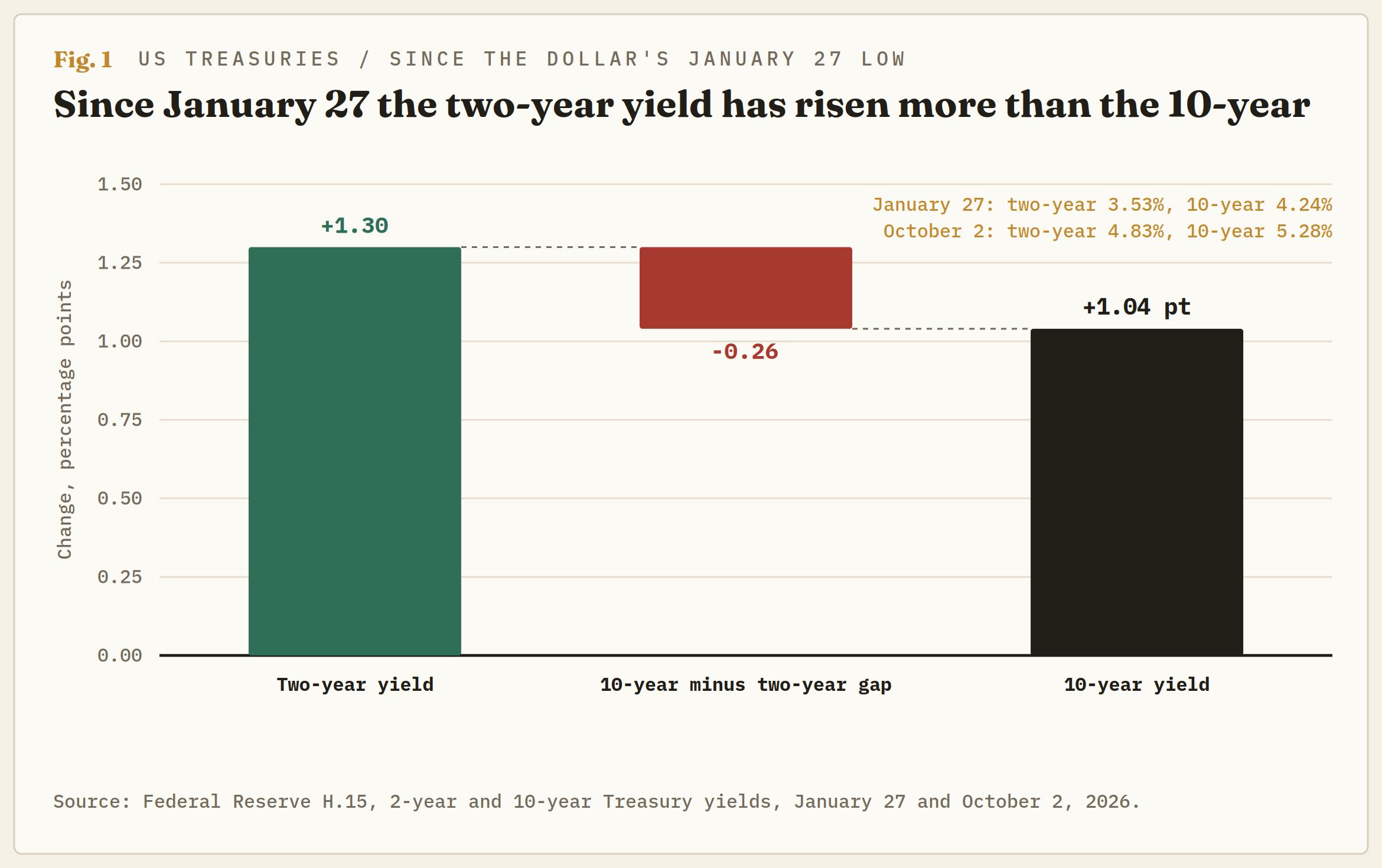
When two-year yields rise faster than 10-year yields, the reason is usually the Fed, and a higher Fed rate means investors earn more holding Dollars over the next year or two. The Dollar Index rose about 6% over the same stretch. Inflation, the thing a higher bond yield is supposed to compensate you for, accounted for two hundredths of a point of the 10-year's rise.
The last stretch to 2002 came from 30-year bonds
Since September 25, the two-year yield has risen 0.03 of a point, the 10-year 0.14 and the 30-year 0.17. Traders' bets now imply a 26% chance of a Fed rise on October 28 and a Fed rate of about 4.68% by September 2027, down from about 4.80% on September 30. In late August the same bets had the Fed's rate reaching only about 4.05% by September 2027. Most of the rises added in September are still priced, but the adding has stopped.
What's pushing long-dated yields up is the extra investors’ demand to lend for decades. Brent is above $100 a barrel, the war with Iran is seven months old and the US budget deficit means large Treasury auctions. None of that raises what a foreign investor earns on Dollars held for a year, which is what moves a currency. It's possible bond investors expect inflation the Fed doesn't, but the inflation rate the market expects over the next decade has stayed in a 2.3%-2.4% range since late August.
Long-bond selloffs have been worth slightly less than nothing to the Dollar
There have been 18 days in 2026 when the two-year yield rose and the gap between it and the 10-year narrowed by at least 0.03 of a point. That's the pattern of a selloff driven by Fed expectations. The Dollar Index rose on 14 of them, by 0.20% on average. The index rose on seven of the 18 days when the 10-year rose and that gap widened by 0.03 or more, and fell 0.08% on average.
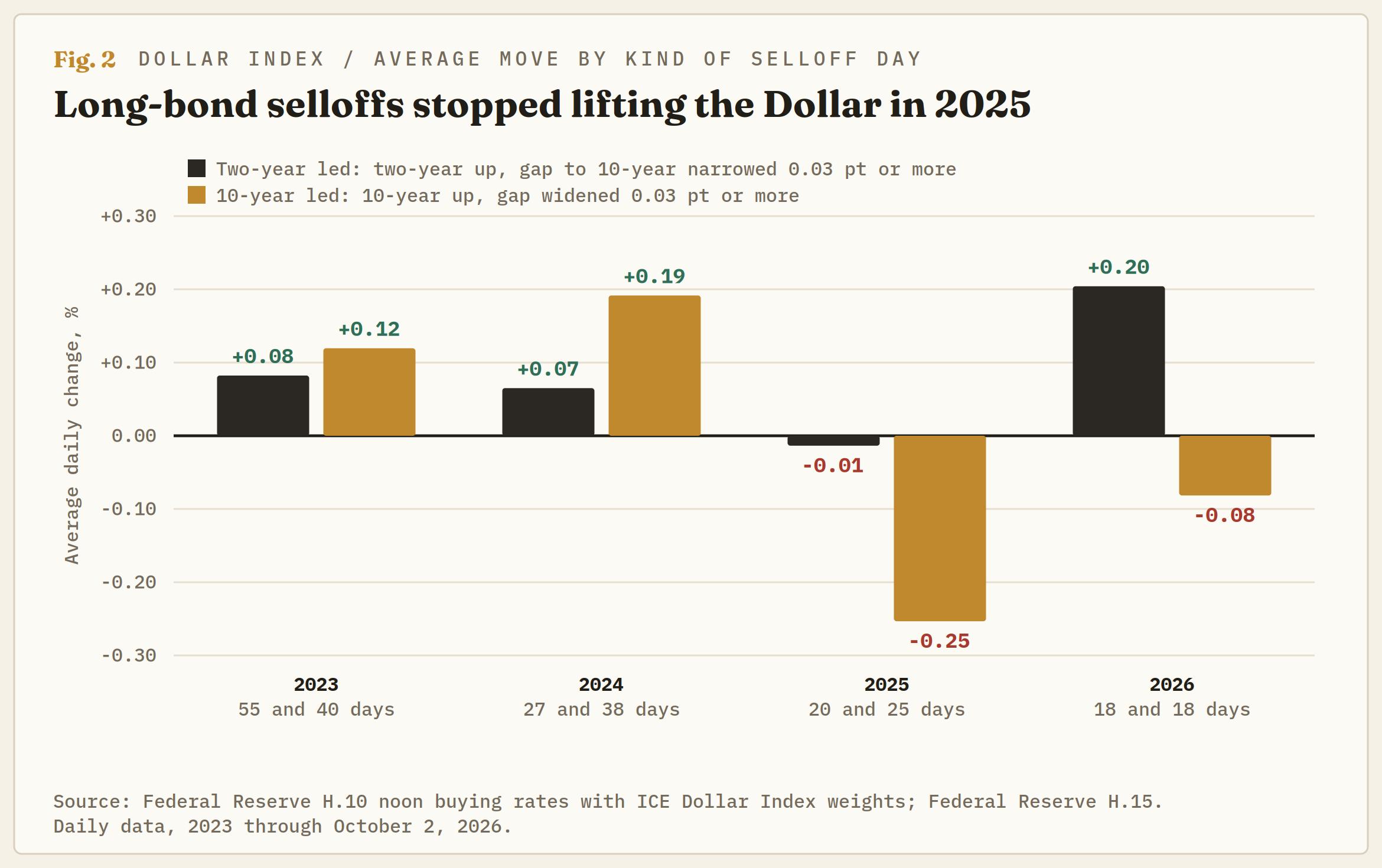
In 2023 and 2024, the Dollar rose on the second kind of day too. The clearest break came in the week to April 11, 2025, when investors sold US assets after the tariff announcements, and the 10-year rose almost half a point while the Dollar Index fell 2.3%. Since then, investors demanding more to hold US debt for decades haven't been asking for more Dollars, so for the Dollar the 10-year's 24-year high has so far been a statistic.
Three-fifths of the Dollar's rally is a European problem
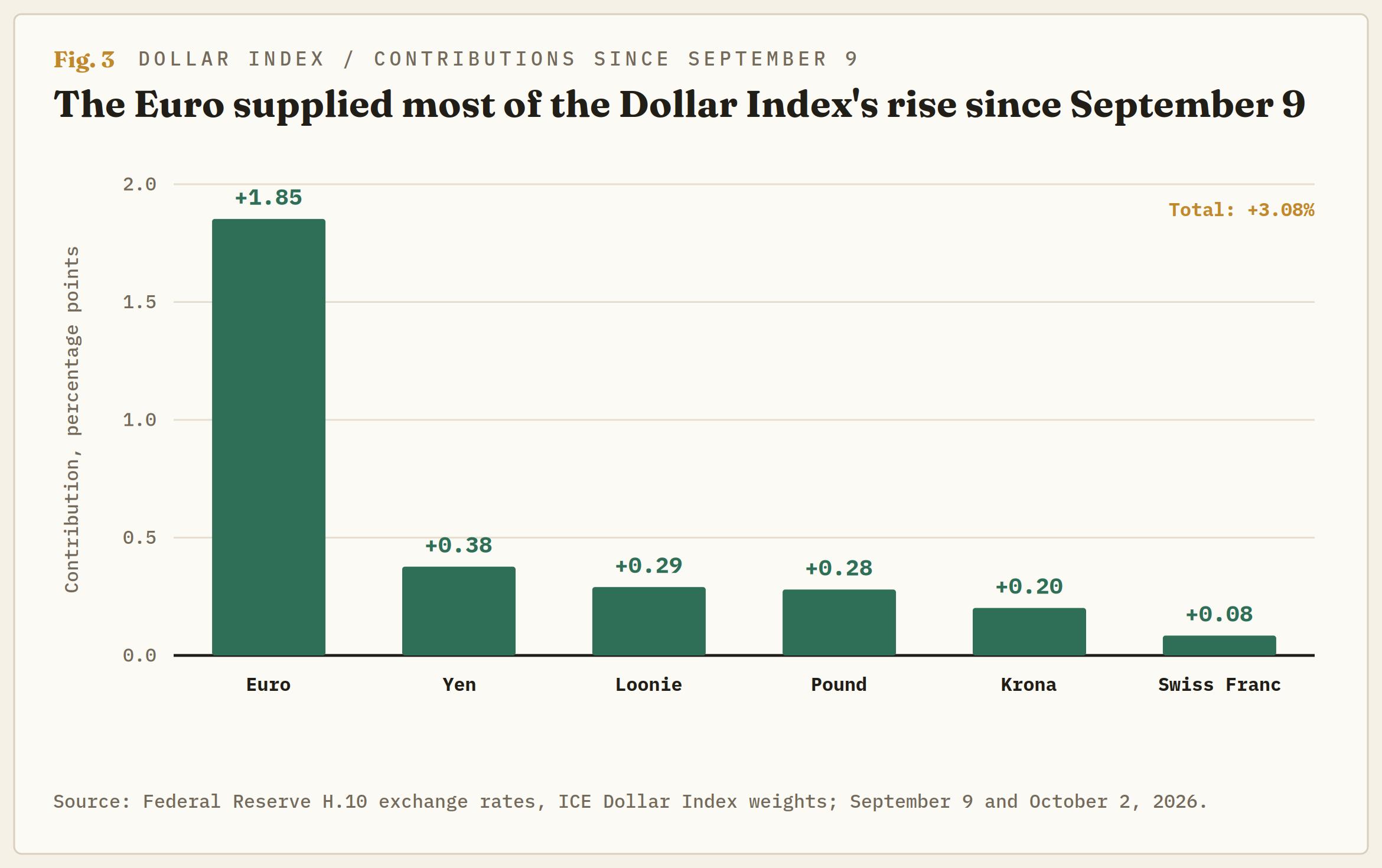
Since September 9, the Euro has accounted for about three-fifths of the Dollar Index's rise and the Yen for about an eighth. EUR/USD fell to its lowest since May 2025 on Monday during a selloff in French government bonds. The gap between US and German two-year yields widened by about 0.4 of a point between September 14 and Monday, as traders took European Central Bank (ECB) rate rises out of their bets.
EUR/USD's best day in seven weeks, on Tuesday, followed plans to cut spending from the frontrunner in France's 2027 presidential election, and it has been reversed on Wednesday. The Stochastic Relative Strength Index (Stoch RSI), a 0-100 gauge of how stretched a move is, has been below 20 on EUR/USD for three weeks. 1.1150, just under Monday's low, is the level that matters for the Dollar Index. Translated, a good part of what reads as a US rate story is a French budget story.
The next leg needs a hot inflation report, not a higher 10-year
The Dollar Index has risen from a double bottom near 98.50, set on August 20 and September 10, and has retraced all of its late-July to August fall. It went through its June and July highs, just below 102.00, on October 1. The daily bars have got smaller since, and the index reached about 102.50 on Monday and again on Wednesday before falling back.
Its Stoch RSI has been above 80, where a rise counts as stretched, since about September 22. Its 50-day exponential moving average (EMA), a running average that gives more weight to recent days, crossed above the 200-day in mid-September, and both are about two points below the price.
The September Consumer Price Index (CPI), due on October 14, is the first test. A hot core reading, the measure that leaves out food and energy, would put an October 28 Fed rise back in play and two-year yields back in front. That's the kind of selloff the Dollar has risen on in 2026, and a daily close above 102.50 would mark the next leg.
Fed Chair Kevin Warsh told Congress in July that the committee would not put up with inflation staying high, and traders give an October rise a 26% chance. A soft reading leaves the Fed's expected path slipping while Brent and US borrowing hold long-dated yields up. On the 2026 evidence that keeps the Dollar Index below 102.50, with the next leg left to the Euro.
A daily close back below 101.50, the top of the late-September range, would mean the break above the summer highs has failed. The case is wrong if the index breaks above 102.50 on a day the two-year yield falls.
Author

Joshua Gibson
FXStreet
Joshua joins the FXStreet team as an Economics and Finance double major from Vancouver Island University with twelve years' experience as an independent trader focusing on technical analysis.

















