Not the Fed, not the ECB: The Euro's biggest problem is France's €283.7 billion debt wall

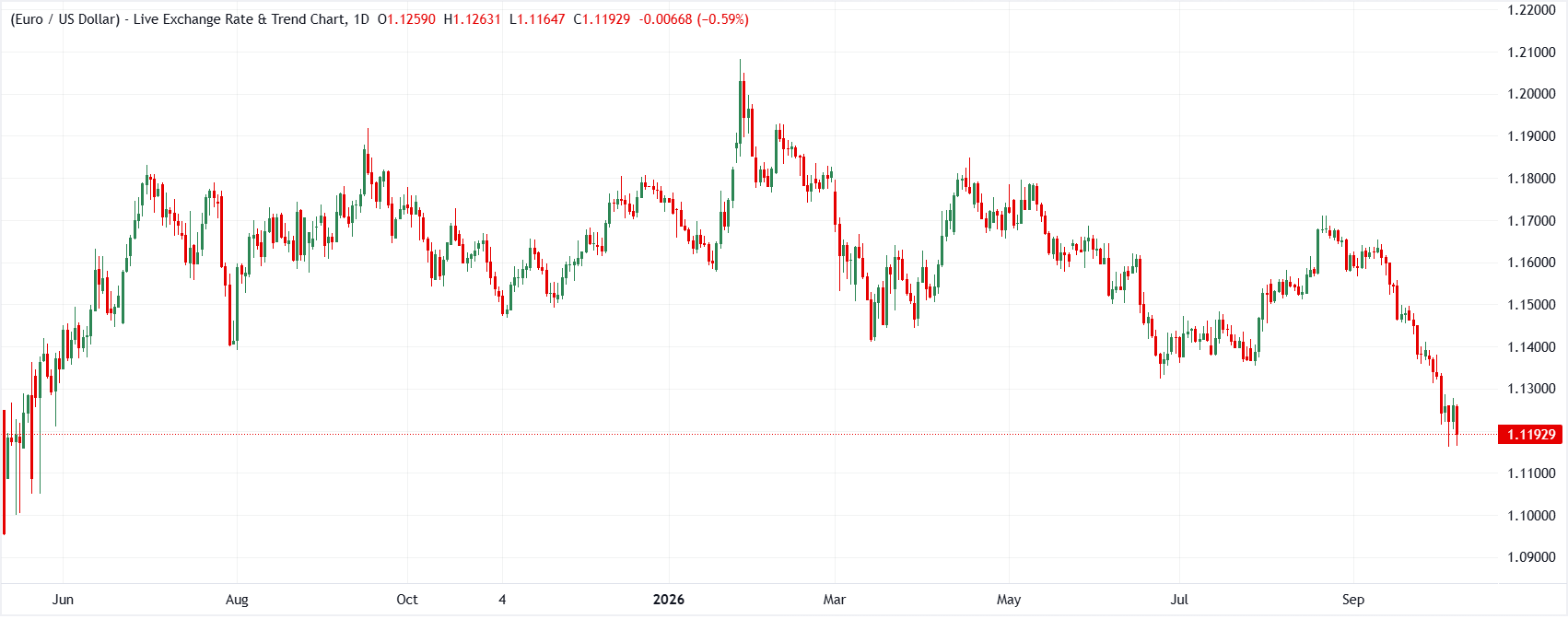
The Euro (EUR) is holding near 1.1200 as traders wait for the Federal Reserve's (Fed) meeting Minutes, and the three freshest analyses share a bearish lean — but disagree on what is actually driving it. One reads the pressure as purely technical, with dated downside targets. Two point to the same underlying problem, France's debt picture, though they differ on how the trade resolves: one sees any rally capped by political risk, the other argues the Euro is caught in a vicious circle of falling bond prices and a falling currency.
RoboForex Analysis Department: A downtrend with dated targets
RoboForex's technical team is the most concretely bearish. On the 4-hour chart, "EUR/USD remains in a steady downtrend" with the price below the descending resistance line, and the team lays out a ladder of targets: "The nearest downside target is 1.1210. A close below this level would open the way for a further decline towards 1.1173 and, within the broader structure, towards 1.1129." They flag one caveat — the Stochastic oscillator is in the oversold zone, "so a short-term correction is possible before the decline resumes" — but their call is unambiguous: "Selling remains the priority while the price holds below the descending resistance line." — Read the full report
Ebury's Matthew Ryan: The rebound is technical, and the risk premium caps it
Ryan is the voice of the capped bounce. He notes the Euro ended London trading on Tuesday closer to 1.1300 than 1.1200 as fiscal jitters eased after Marine Le Pen pledged €140 billion in net savings by 2032 — and while he thinks such cuts "would be bullish for French bonds, by lowering the fiscal risk premium," he dismisses the rally itself: "we see Tuesday's rally as more a byproduct of a simple technical rebound after the sharp sell-off." With nothing resolved, the 2027 budget still to clear a divided parliament and the election months away, "we expect the French political risk premium to remain elevated, which could act to cap any relief rally in the euro." — Read the full report
FxPro's Alexander Kuptsikevich: The debt vicious circle
Kuptsikevich supplies the structural bear case, anchored in France's redemption calendar: scheduled redemptions of French bonds jump from €60.2 billion to €187.4 billion in 2027, rising to €283.7 billion by 2029, forcing Paris into ever-larger issuance and "fuelling panic amongst investors." For him, the mechanics are self-reinforcing: "Foreign bondholders are incurring losses due to both falling prices and the decline of the EURUSD exchange rate. These trends have coincided since the second half of August, creating a vicious circle from which it is difficult to escape." On the other side of the pair, US Dollar strength completes the squeeze: "The combination of attractive assets and a strong economy explains why the dollar is not falling," even with October Fed tightening odds down to 19% — while Le Pen's calls for ECB rate cuts risk putting France at odds with both the EU and the central bank. — Read the full report
The takeaway
All three analyses point the Euro lower, but their trades resolve differently: RoboForex says to sell breakdowns below 1.1210 toward 1.1129, Ryan expects any relief rally to stay capped by the French risk premium, and Kuptsikevich argues the bond-currency vicious circle itself keeps pressure on the pair. Watch the Fed minutes and ECB officials' remarks on the bond market later this week — plus whether EUR/USD can reclaim 1.1275, the level RoboForex says would invalidate the bearish setup.
(This article was created with the help of an Artificial Intelligence tool and reviewed by an editor. Know more.)
Author

FXStreet Insights Team
FXStreet
The FXStreet Insights Team is a group of journalists that handpicks selected market observations published by renowned experts. The content includes notes by commercial as well as additional insights by internal and external analysts.