The UK 30-year gilt just hit a 1998 high. Is that good or bad for the British Pound?

The yield on the UK's 30-year government bond, or gilt, went through 6% on October 1 for the first time since early 1998, and on Monday the Pound was at its strongest against the Euro since June 2025. The gilt market's 28-year high is mostly someone else's. Since early May, the 30-year gilt yield has risen about 0.15 of a percentage point and the US 30-year about 0.7. Investors have no particular reason to sell Pounds over a selloff imported from the US, and Chancellor Healey's October 28 Budget is the test of whether the next one is made in Britain.
The exception is the Dollar, which has risen against almost every major currency since early September. GBP/USD has fallen about 2.5% since September 10 and EUR/USD almost 4%, which is not how a currency with a home-grown bond problem trades.
The UK now borrows for 20 years at almost the US rate
The UK's 20-year yield was 0.54 of a percentage point above the US 20-year on May 5, on the daily figures published by the Bank of England (BoE) and the Federal Reserve (Fed). By Monday, the gap was 0.04, the smallest since June 2025, and the 10-year gap had shrunk to 0.05.
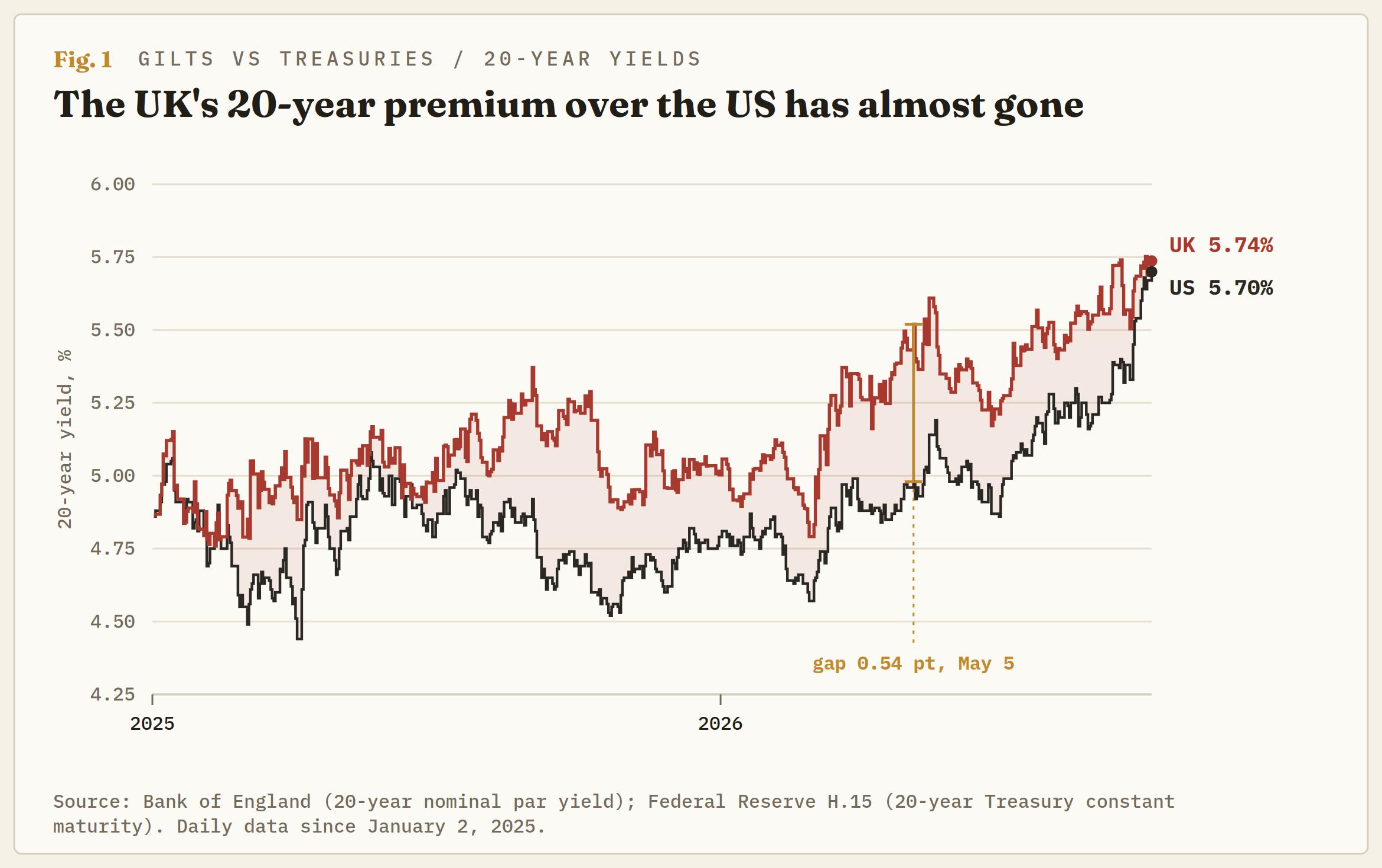
The US 30-year reached its highest since 2002 over the same months, pushed up by Oil and heavy US government borrowing, and gilt yields rose with it. A British problem would show up as the UK paying more than the US, and investors who sell gilts because they're selling Treasuries aren't asking to be paid for one. The UK's 30-year yield has risen a fifth as much as the US 30-year since early May, and the UK's is the one that made the headlines.
The same 6% as 1998 with half the interest rate behind it
In January 1998, the Bank Rate, the BoE's main interest rate, was 7.25%, and long gilts paid about 6%, more than a point less, because investors expected rates to fall. Bank Rate has been 3.75% since December 2025, so the same 6% is now more than two points above it.
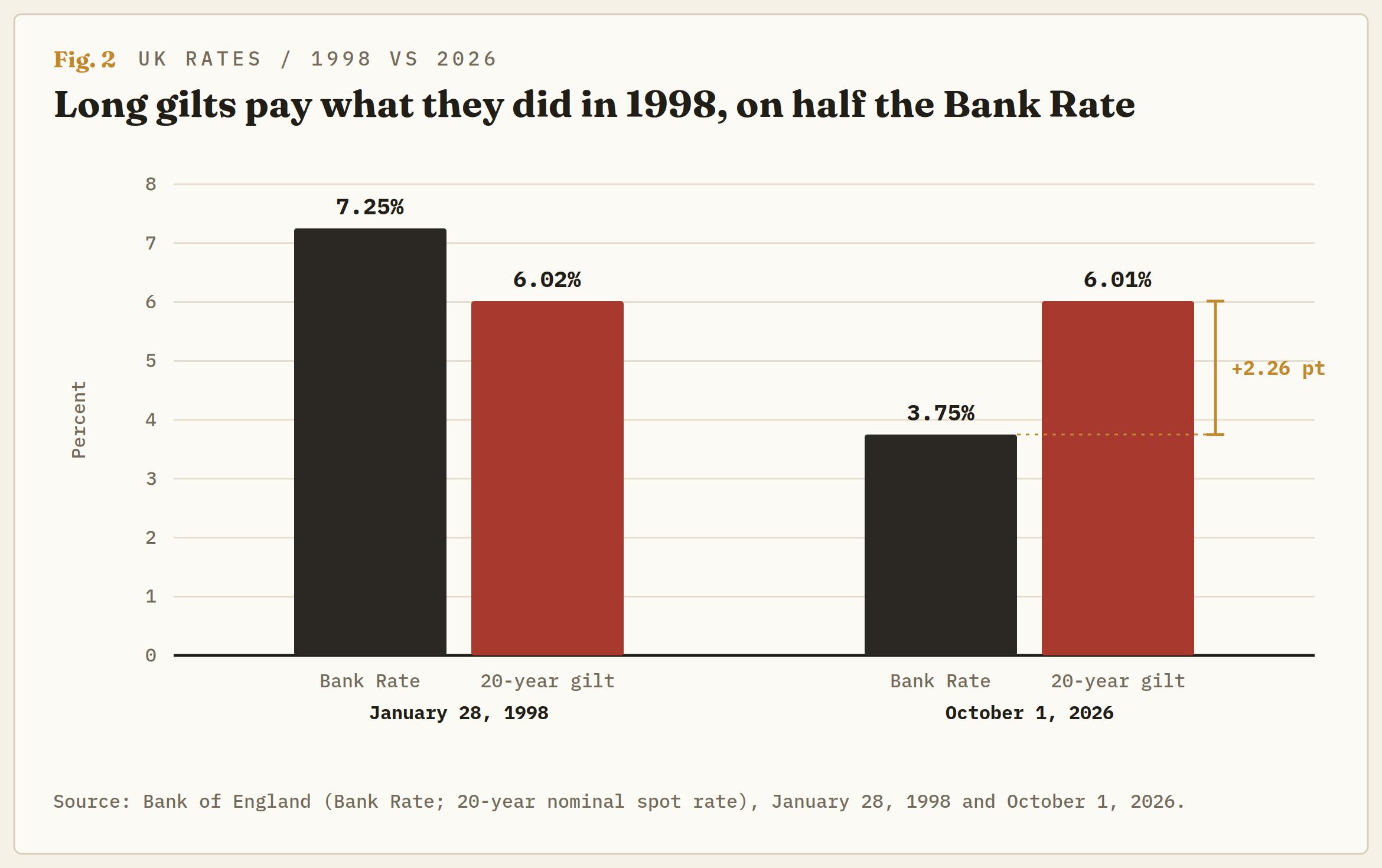
Part of that gap is the four rate rises traders expect from the BoE, and the rest is what investors charge for tying money up for three decades. BoE staff estimate that charge has risen about two percentage points since February 2022, mostly on global uncertainty and heavy government borrowing everywhere, plus weaker UK demand for long-dated gilts. They put the effect of the BoE's own gilt sales at 0.2-0.3 of a point. Investors have no reason to prefer one currency over another because of a charge every rich country pays.
On September 17 the BoE set aside £120 billion of its longest-dated gilts to back banknotes, so it will never sell them, and paused its gilt sale auctions until it announces new arrangements by April 2027. The 30-year went through 6% two weeks later.
The Pound has fallen with gilts when the problem was British
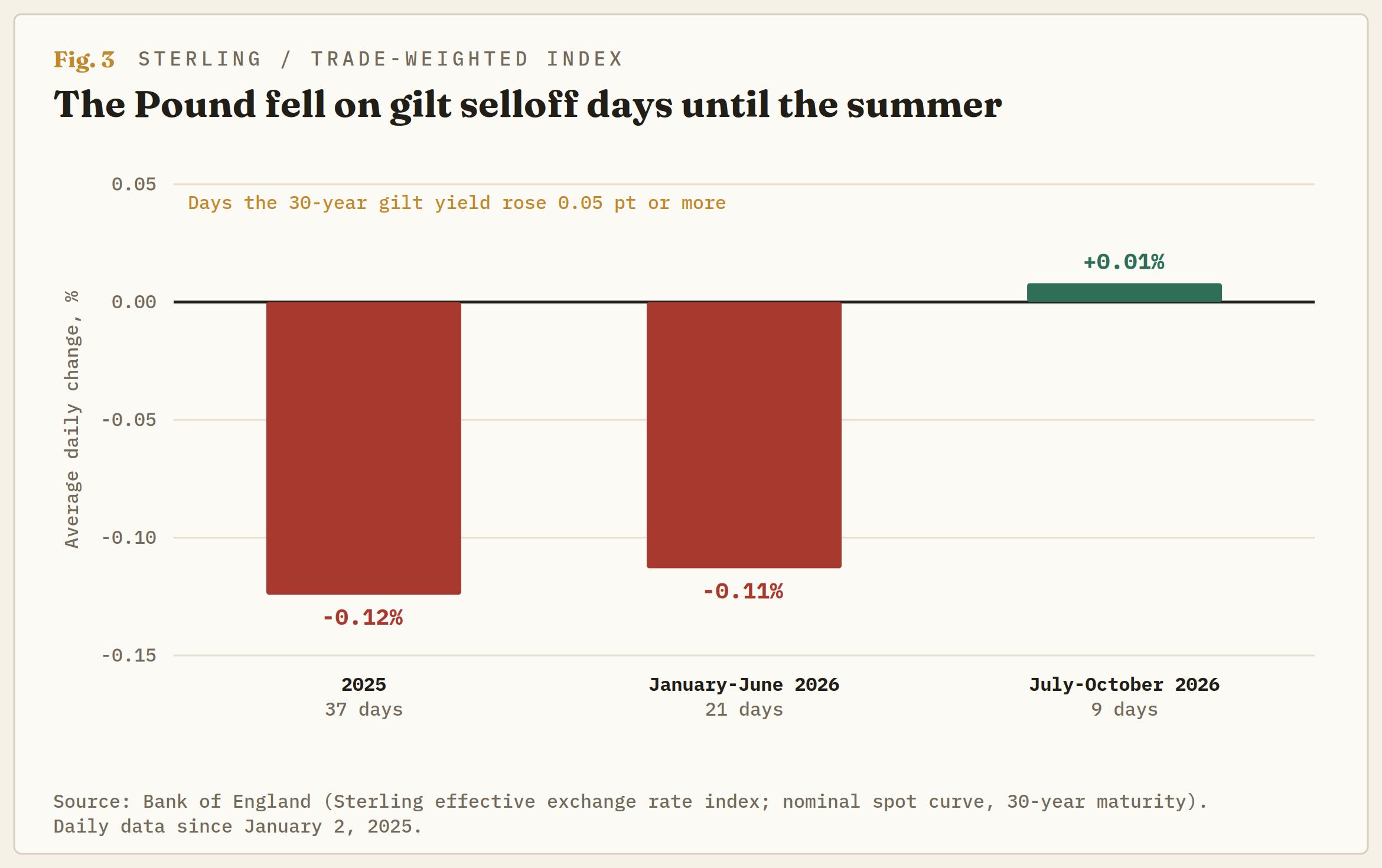
On September 2, 2025, the 30-year reached what was then its highest since 1998 on worries about the UK's own budget. The Pound fell 1.1% against the Dollar and 0.7% against the Euro that day. On May 15 the 30-year had its biggest one-day rise of 2026, 0.18 of a point, and the Pound fell about 1% against the Dollar and 0.6% against the Euro.
The trade-weighted Pound is measured against the currencies of the UK's main trading partners. It fell on 13 of the 21 days in the first half of 2026 when the 30-year rose by 0.05 of a point or more. On the nine such days since July it has been flat on average. On October 1, the day the 30-year went through 6%, the Pound lost about half a percent against the Dollar and rose against the Euro.
The Pound is strong against the Euro because UK rates are expected to rise
The part of the gilt selloff that helps the Pound is in two-year yields, which move with expectations for Bank Rate. The UK two-year has risen from 3.42% at the end of February to about 4.6%, and traders put the chance of a BoE rise on November 5 at 91%. They expect four quarter-point rises over the next 12 months, taking Bank Rate to 4.75% by September 2027, and a little over three from the Fed.
Higher UK rates mean investors earn more holding Pounds, and with the deposit rate of the European Central Bank (ECB) at 2.50%, the gap with the euro area is wide. It has widened since late September, as traders took ECB rises out of their bets during a selloff in French bonds. BoE Governor Bailey wrote with his September 17 vote that a long Middle East conflict and a growing risk of knock-on price rises would probably mean higher rates. He said the conflict appeared to be a long one, and voted to keep Bank Rate at 3.75%.
Against the Dollar it hasn't been enough, because US rates have been above the UK's 3.75% since the Fed's rise on September 16. GBP/USD has given back nearly nine-tenths of its rise from the June low to the August high and has traded in a narrow band just above 1.3200 for two weeks. It's possible the fall against the Dollar is the first sign of a British problem the gilt market hasn't priced yet. If it were, the Pound would be falling against the Euro too, and it has been rising.
The daily Stochastic Relative Strength Index (Stoch RSI), a momentum gauge on a 0-100 scale, was below 20, where a fall counts as stretched, from mid-September. It has since turned up, so the selling slowed before the price stopped falling. The 50-day exponential moving average (EMA), a smoothed average of recent daily prices, crossed below the 200-day in late September, and both are above the price. 1.3200 is the line.
The Budget comes eight days before the BoE meets
Higher interest costs and weaker growth have cut the government's headroom against its main fiscal rule, which requires taxes to cover day-to-day spending. Private estimates put it at about £12 billion, down from £23.6 billion at the March forecast. Headroom is the margin by which the forecasts can go wrong before the rule is broken, and about half of it has gone before a single forecast has. Chancellor Healey has been weighing whether to rebuild it with tax rises or accept a smaller margin.
If the Budget rebuilds the margin, gilts should keep moving with Treasuries and the Pound with rate expectations, which already have the BoE raising rates faster than the Fed. On that branch the base above 1.3200 holds, and a move through 1.3300 puts 1.3400 and the two moving averages back in reach. The risk there is a BoE hold on November 5 against 91% odds of a rise.
The selling turns British if the Budget runs thin and the UK's 20-year premium over the US widens back toward the half point it reached in May. The Pound should then start falling on gilt selloff days as it did on September 2, 2025 and May 15. A BoE rise wouldn't help much there, because investors who sell gilts over a budget sell the currency with them.
A quarter of a point between UK and US 20-year yields after October 28 marks the difference between a mostly American 1998 high and a British one. In GBP/USD that branch starts with a daily close below 1.3150.
Author

Joshua Gibson
FXStreet
Joshua joins the FXStreet team as an Economics and Finance double major from Vancouver Island University with twelve years' experience as an independent trader focusing on technical analysis.