The Iran war will eventually end. Tariffs won't. Here's the problem

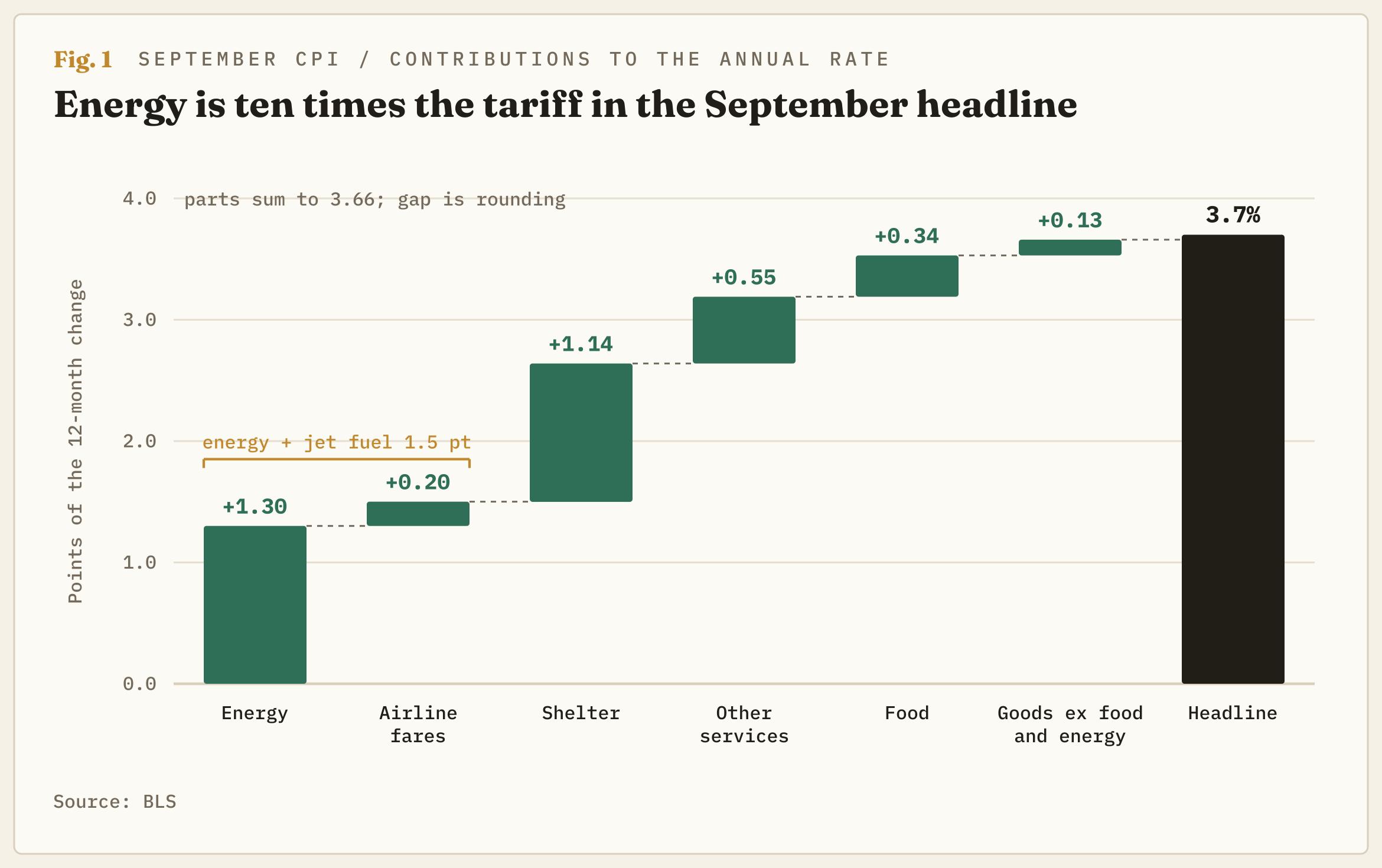
Two cost shocks are in the September Consumer Price Index (CPI), and they have different half-lives. Energy is up 20.4% on the year and accounts for about 1.3 points of the 3.7% headline, and that shock reverses when Oil does: Brent was back at its pre-war price on July 1 and above $100 again by the end of the month, after the ceasefire collapsed on July 8. The tariff lands in goods prices excluding food and energy, which account for about 0.1 points and have slowed from 1.0% in February to 0.7%, but the policy has been replaced every time it stopped and the price level it left doesn't come back down. The problem is that the end of the war takes the big number out of the headline and leaves the small one on the shelf.
The Dow Jones Industrial Average holds the shelves where both land. It is weighted by share price, so Home Depot (HD), which sells into the department paying the war's shock, carries two and a half times the weight of Walmart (WMT), which sells into the aisle paying the tariff hit. Dow futures are almost 6% below their August 5 record while S&P 500 futures are within 2% of theirs, and the gap is what those departments have cost.
Every tariff that stopped was replaced on the day it stopped
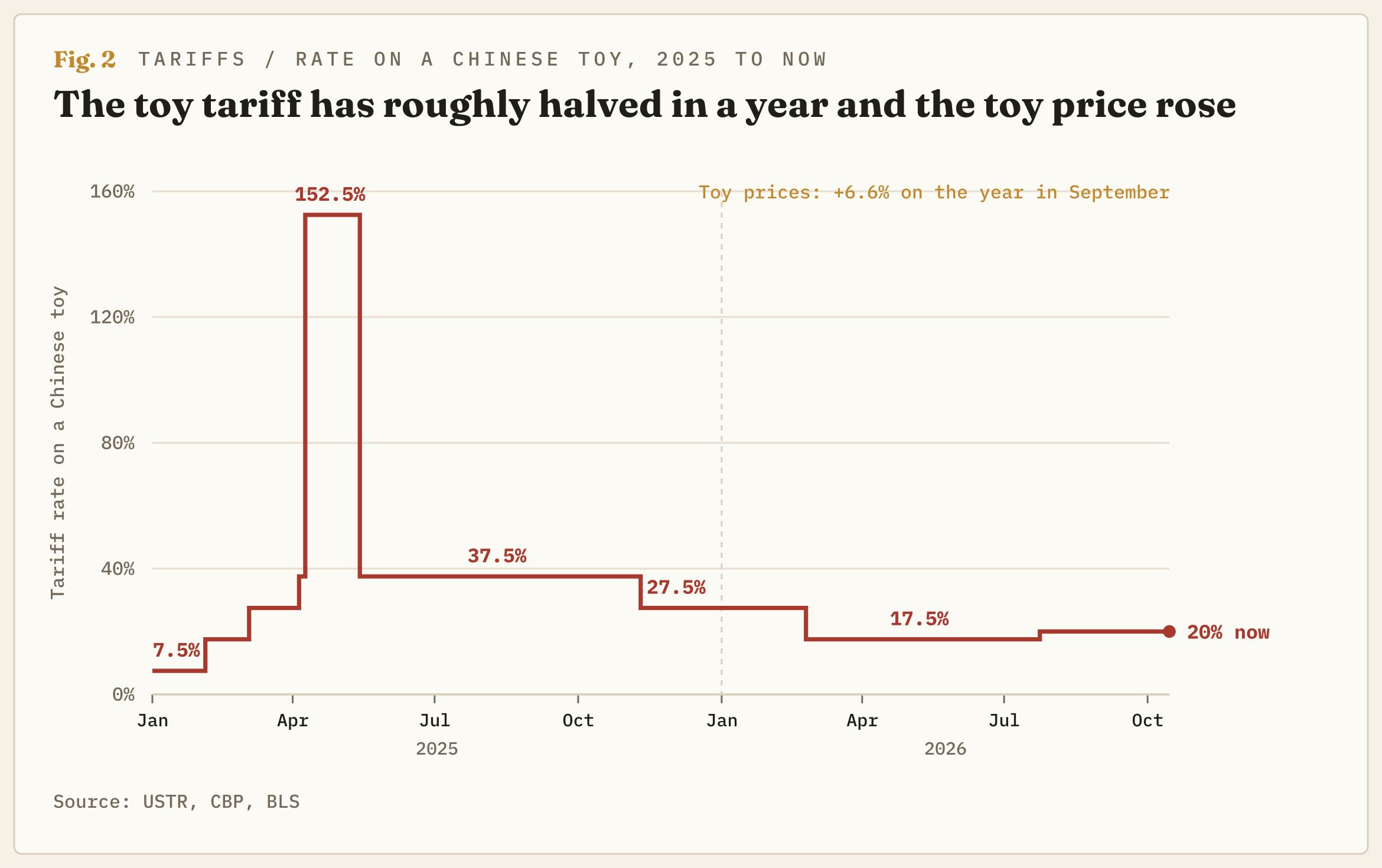
The Supreme Court held on February 20 that the emergency-powers law behind most of the 2025 tariffs never authorised tariffs at all, a 10% surcharge under a different statute began on February 24, and when that expired on July 24, a 12.5% Section 301 tariff on China began the same day. The 2019 Section 301 tariff of 7.5% on Chinese toys never left, so a Chinese toy carried 37.5% in September 2025 and carries 20% now, and the new layer has no expiry.
The court also decided who paid at the port, which was the importers, and ordered their money back. Treasury Secretary Bessent called the tariffs "a one-time price adjustment" in March 2025, and on the inflation rate he was right. A one-time price adjustment is one the shopper pays every time.
The toy aisle is where the permanent one stopped
Toy prices fell 2.3% in August and rose 4.2% in September, a pair that says the sample is small, and the annual rate, which smooths it, went from 2.3% to 6.6%. Boys' clothing went from 3.9% to 7.8% on the year and computers are up 9.7%, all against a goods average that fell. About four in five toys sold in the US are made in China, according to the Toy Association, and Walmart said toys led its general merchandise sales growth in the quarter to July, so the price went up and the volume went with it.
Mattel (MAT) said in February that its price increases would take full effect by mid-2026, so the September price is the first holiday price set under the old tariff, and the new 20% is what holds it there. President Donald Trump said on April 30, 2025, that children might have "two dolls instead of 30 dolls," and that the two "will cost a couple of bucks more." The shopper paying 6.6% more for the doll has 0.7% less real pay than a year ago, most of it gasoline, so the tariff set the price and the war set the budget.
The sofa department is waiting for the same thing as the Treasury
Furniture and bedding fell 0.8% in September and are down 2.4% on the year. Appliances are down 1.0% and televisions 1.9%. These carry the same 20% tariff as the toys, and their prices are falling because the thing that creates demand for them is a move, and nobody is moving. Freddie Mac has the 30-year mortgage at 7.40% as of October 8, up from 6.30% a year earlier, because the 10-year Treasury yield has risen a full point since the war began, and Treasury Secretary Scott Bessent says the yield goes back to mid-February levels when the war ends. The National Association of Realtors (NAR) has existing-home sales at an annual pace of 3.99 million in September, with August and September the two slowest months of the year.
Home Depot's last quarter shows what that looks like: sales at stores open at least a year rose 1.7%, the number of transactions fell 1.0%, and the average amount per purchase rose 2.8%, because repairs are up and moves are not. A household that doesn't move doesn't buy a fridge, so the importer that paid 20% at the port cuts the shelf price to clear the stock. The sofa department is waiting for the same event as the Treasury Secretary, and neither has a date for it.
The refund is paying the fuel bill
Customs has accepted $134.7 billion in refund claims, and Walmart received close to $2.9 billion of it in the quarter to July, Target (TGT) $994 million and Home Depot $685 million. Walmart said it put most of its refund into more than 11K temporary price cuts, groceries and general merchandise first, and in the same quarter put its extra fuel cost for the year at more than $2 billion. In the September CPI, grocery prices fell 0.1% in the month and are up 1.8% on the year, down from 2.2% a month earlier, and toys are up 6.6%. The refund went to the grocery aisle and the tariff stayed in the toy aisle.
The war's second shock hasn't reached the shelf yet. Diesel hit a record $6.53 a gallon on September 22 and trucked goods still read 1.8%. The part of the war already inside the core number is airline fares, up 22.4% on the year on jet fuel and Spirit's exit, which added more to core services since February than core services rose. Cleveland Fed President Beth Hammack said on October 12 that the pressures run "well beyond energy," and the part beyond energy that moved since February is jet fuel.
The insurance discount in core is a profit margin
Core inflation, which strips out food and energy, reads 2.6% partly because of two insurance lines the CPI has falling: health insurance by 9% on the year and motor vehicle insurance by 5%. The Bureau of Labor Statistics (BLS) can't price a health policy directly, so it measures what insurers keep after paying claims, which is their margin, with data about ten months behind. The CPI has health insurance 9% cheaper than a year ago because the insurers made less money selling it, while the average marketplace enrollee's premium payment rose 58% to $178 a month this year, according to KFF, the health policy research group.
The margin the index is still recording as collapsing has already turned. UnitedHealth (UNH), the Dow's sixth-largest weight at 4.4%, reported on October 13 that the share of premiums paid out as claims fell to 88.4% from 89.9% a year earlier and that adjusted profit per share rose to $4.69 from $2.92. Take the two insurance lines out and core inflation is nearer 2.9% than 2.6%.
Below the early-October low, the lean is lower
Dow futures have made a lower high in early September, another in mid-September and another on October 13, each short of the last, and twice bounced from the same low in the first ten days of October. The daily Stochastic Relative Strength Index (Stoch RSI), a momentum gauge, sits near the middle of its range and was rising slowly off that low when the CPI landed, so the release hit an index mid-bounce rather than stretched. The early-October low is the line.
The lean is lower against the S&P 500 while furniture and appliances keep getting cheaper and the mortgage rate keeps rising, because the Dow carries the department paying the shock that ends. The October CPI on November 10 is the test: groceries falling further says the refund is still winning against diesel, furniture and appliances turning positive on the month says the home-goods importers can raise prices again, and toys holding above 6% on the year says the holiday price is set. Home Depot reports on November 17 and Walmart on November 19. Brent back at its July 1 level and holding is what ends the lean, because the 10-year and the mortgage rate follow it; a daily close above the mid-September high ends the run of lower highs and the case is wrong; a daily close below the early-October low resumes the slide from the August 5 record. The end of the war is good for the sofa department and does nothing for the toy aisle, which is why the Dow gets its buyer back before the shopper does.
Author

Joshua Gibson
FXStreet
Joshua joins the FXStreet team as an Economics and Finance double major from Vancouver Island University with twelve years' experience as an independent trader focusing on technical analysis.

















