Australian Dollar Price Forecast: Hurt by data
- AUD/USD adds to Wednesday’s pullback, retreating below the 0.6900 level.
- The US Dollar trades on the back foot ahead of Chair Warsh’s speech.
- The Australian labour market report disappointed expectations (big time).

The Australian Dollar (AUD) has picked up a marked downward pace, causing AUD/USD to briefly break below the 0.6900 contention zone and hit fresh three-month lows on Thursday. The pair’s strong decline has followed the poor prints from the domestic labour market, which unexpectedly cooled beyond estimates in September.
The continuation of the bearish trend in spot has also come despite the resurgence of a marked pullback in the US Dollar (USD) amid declining US Treasury yields, higher-than-expected Producer Prices and auspicious prints from Retail Sales.
Looking at the broader picture, the pair remains vulnerable to further losses as long as it continues to trade below its 200-day SMA near 0.7040. However, the Reserve Bank of Australia’s (RBA) hawkish policy stance, in combination with still elevated domestic inflation, should cushion against any deep and sustained corrections…for now.
Australia’s economy holds up, but cracks are emerging
Australia’s economy continues to compare favourably with many of its G10 peers, supported by domestic demand and positive economic growth. Persistent inflation also supports the RBA’s cautious, data-dependent policy stance.
However, business activity seems to have lost some momentum after final data showed the Purchasing Managers’ Index (PMI) for Manufacturing cooling to 49.6 in September and easing to 51.9 when it comes to Services, from 52.0 and 53.2, respectively.
Trade data provided another positive, albeit humble, signal after August’s trade surplus came in at just A$0.495 billion, adding to the A$1.351 billion surplus registered in the previous month (revised from A$1.923 billion).
Growth figures were less encouraging, however. Indeed, the Gross Domestic Product (GDP) expanded by 0.4% QoQ in the second quarter of 2026, up from 0.3%, while annual growth came in at 2.1%, down from the previous 2.5% yearly expansion.
The labour market, however, disappointed investors in September after the Unemployment Rate held steady at 4.7% (August’s print was revised higher to 4.7% from 4.6%), and the Employment Change shrunk by 39.3K, reversing August’s 29.3K increase (revised from 39.5K).
Inflation seems to have lost some impulse after the most-watched Trimmed Mean came in at 3.6% over the last twelve months, despite the headline CPI ticking higher to 4.0% from a year earlier.
The Melbourne Institute’s Consumer Inflation Expectations measure reinforced those figures after ticking higher to 5.3% in October.
The figures leave the RBA’s inflation task incomplete. Policymakers expect inflation to return to target only in early 2028, keeping the emphasis on patience rather than an imminent policy pivot.
China steadies the ship but offers the Aussie little lift
China is providing stability for the Australian economy, but not the growth impulse that has supported the Australian Dollar during previous expansions.
The Chinese economy grew by 4.3% YoY in the April-June period, while Industrial Production growth regained traction, expanding by 5.2% YTD, and the trade surplus widened to $133.53 billion in September, supported by firm increases in both imports and exports. However, on the downside, consumer spending remained sluggish after Retail Sales rose by only 0.4 % from a year earlier.
In addition, business surveys presented a promising picture: the National Bureau of Statistics reported that the Manufacturing PMI improved to 50.1 in September (from 49.8), while the Services PMI improved to 50.2 (from 49.0). In the same direction, private measures like RatingDog remained in expansionary territory, with Manufacturing at 52.1 (from 51.5) and Services at 51.6 (from 51.4).
Disinflationary pressures seem to have taken a breather in September, with the CPI gaining 0.9% from a year earlier, up from 0.8%, while prices rose by 0.2% on a monthly basis. Producer Prices rose more than initially estimated by 5.0% over the previous twelve months, up from the 3.8% increase recorded in the previous month.
The People’s Bank of China (PBoC) left its Loan Prime Rates unchanged last month, maintaining the one-year rate at 3.00% and the five-year rate at 3.50%.
China is therefore neither providing a major boost nor creating a significant drag. Unless the data reveal a clearer acceleration or deterioration, its influence on AUD/USD is likely to remain limited.
The RBA tightens its grip as inflation digs in
In a unanimous decision, the RBA hiked its OCR by 25 basis points to 4.60% at its meeting in late September.
The RBA Minutes published earlier on Tuesday show a unanimous vote for more tightening. Indeed, all Board members voted for the 25 basis point rate hike, believing that excess demand was stronger than previously assumed and that the risk of persistently high inflation had increased. Furthermore, policymakers debated whether to hold rates for a moment but decided to take timely action to keep inflation expectations anchored.
Additionally, the RBA highlighted broad domestic cost pressures, higher unit labour costs, elevated oil prices and emerging inflation risks from the AI boom. Some indicators suggested financial conditions were only modestly restrictive, while models implied the neutral rate may have moved higher. The Board also warned that a rise in global neutral rates could weaken the Australian Dollar if domestic rates failed to follow.
Overall, the Minutes were clearly hawkish and leave further tightening firmly on the table, although policymakers remain mindful of falling house prices and the risk of slowing economic activity.
In the wake of the latest labour market data in Australia, markets now pencil in just over 9 basis points of tightening from the RBA by year-end.
AUD/USD bulls hit a technical roadblock
Baseline outlook
Thursday’s deterioration of the price action somewhat dents the pair’s medium-term outlook. While below the 200-day SMA, spot should face a steady chance of further declines. Against this backdrop, the resurgence of the downside bias should find initial support at the October floor at 0.6894 (October 15).
The resumption of the bullish bias will likely require a strong catalyst, namely a sustained improvement in risk appetite trends or renewed and persistent US Dollar weakness.
Upside scenario
A stronger risk-on environment should face the initial barrier at the key 0.7000 threshold, just ahead of the 200-day SMA, all preceding the weekly top at 0.7140 (September 21). North from here, a test of the 2026 high near 0.7280 should come into view.
Downside scenario
An additional deterioration in global risk sentiment, persistent strength in the Greenback, or renewed weakness in Chinese data could further fuel the ongoing selling mood.
Initial support is at the October valley of 0.6894 (October 15). A breach below the latter would increase the likelihood of a retest of the June bottom near 0.6860 (June 30).
Bearish conviction meets positioning risk
Commodity Futures Trading Commission (CFTC) data showed that bearish positioning in the AUD picked up sharply in the week ending October 6. Net speculative shorts increased to nearly 98.6K contracts, adding to the previous week’s decline. The four-week change was around -63.7K contracts, showing a strong and rapidly intensifying bearish trend.
Meanwhile, open interest jumped sharply to around 328.7K contracts. The increased participation and more aggressive net short positioning imply new bearish bets are being taken, rather than this move being just the unwinding of existing long positions. This points to a material increase in conviction behind the negative AUD outlook.
Further data showed speculative exposure falling to −30%, while its percentile declined to 47.1, indicating that exposure relative to open interest is not historically extreme under that measure. The Net Position Percentile, however, collapsed to 1.9 from 33.7, showing that outright speculative positioning has reached exceptionally bearish levels by historical standards.
Options markets broadly confirm the negative outlook, although the intensity of bearish repricing has moderated. As of October 14, AUD/USD’s one-month 25-delta risk reversal was at −0.960 volatility points, indicating that downside protection is still pricier than equivalent upside exposure. The reading is at the 31.5th percentile of its five-year distribution. This is consistent with a moderate downside skew.
But the speed of bearish repricing has slowed significantly. The change in one-month risk reversal was better at –0.206 volatility points from –0.536 on October 6, and the change in one week was slightly positive at +0.028. This means that while the general view is negative, demand for downside protection is no longer rising as fast.
Spot vs. options relationship also gives more insight: AUD/USD declined markedly over the past month, a move that historically would imply a deterioration of approximately −0.213 volatility points in the risk reversal. The actual change of −0.206 was almost identical, leaving a negligible positive residual. That residual ranks at 51.7th percentile of the historical out-of-sample distribution, suggesting that options markets are no longer pricing unusually aggressive downside risk relative to the currency's decline.
Taken together, futures and options markets continue to support a decisively bearish AUD outlook, although the underlying signals are becoming more nuanced. Speculative shorts have expanded rapidly, while options traders appear less inclined to increase downside protection beyond what spot weakness would normally justify.
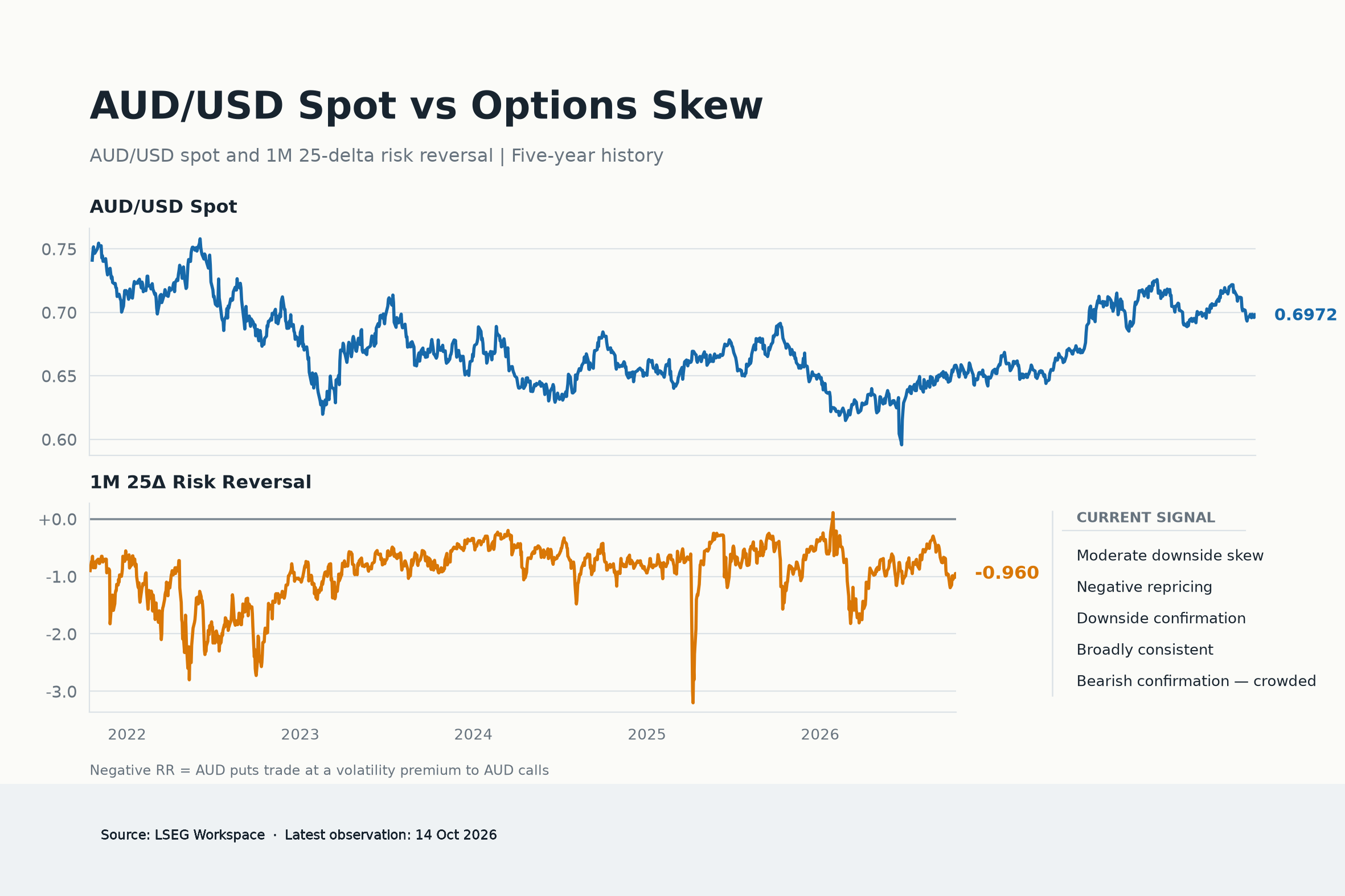
We can identify a bearish confirmation-crowded regime, with net positioning at the 2.3rd percentile of its five-year distribution and open interest at the 98.5th percentile.
Extra losses in the pair remain possible while bearish flows persist. But with speculative positioning getting more stretched by the day and options re-pricing becoming more normal, the downside trade has become more vulnerable to a sharp short-covering snap-back rally if market sentiment improves.
The next catalysts: China, the Fed and risk appetite
US Dollar dynamics, global risk sentiment, and geopolitical developments remain the main near-term drivers of AUD/USD.
In the meantime, investors are expected to closely follow Chinese data releases early in the next week, namely GDP figures, Retail Sales and Industrial Production, all ahead of the PBoC meeting, where the central bank is seen keeping its policy rates unchanged.
Beyond the immediate releases, the main risks include a sharper slowdown in China, a persistently cautious Fed, a deterioration in investor risk appetite or a change in the RBA’s current policy stance. Any of these developments could quickly alter the outlook for the Australian Dollar.
Technical landscape
In the daily chart, AUD/USD trades at 0.6911, maintaining a bearish near-term tone as price holds beneath the 100-day and 200-day simple moving averages (SMAs) clustered around 0.7040 and the 55-day SMA near 0.7078. The pair has retreated from the 0.7200s into the upper 0.6800s, with the Relative Strength Index (14) hovering near 33 and hinting at emerging oversold conditions, while the Average Directional Index (14) above 39 suggests the downtrend remains relatively strong despite the proximity to short-term demand.
On the topside, initial resistance is located at the 100-day SMA at 0.7041 and the 200-day SMA at 0.7042, followed by the 55-day SMA at 0.7078 and the nearby horizontal barrier at 0.7079; a sustained break above this cluster would open the way toward 0.7278 and 0.7283, ahead of the more distant 0.7661 region. On the downside, immediate support is seen around the recent trading area and horizontal level at 0.6833, with deeper cushions at 0.6660 and 0.6593, while a stronger extension of the decline would expose the lower structural floors at 0.6414 and 0.6373.
(The technical analysis of this story was written with the help of an AI tool. Know more.)
The Aussie’s dilemma: Strong foundations, hostile winds
Some dark clouds continue to hover around the AUD’s near-term outlook.
Australia’s domestic backdrop compares favourably with that of many advanced economies, and the RBA is in no hurry to abandon its hawkish stance. These factors should somewhat contain the bearish impulse.
The recovery nevertheless remains vulnerable to renewed strength in the Greenback, persistent geopolitical uncertainty and a Chinese economy that is stabilising rather than accelerating.
The 200-day SMA remains the key level for the medium-term outlook. Holding above it preserves the constructive structure, but a convincing break above 0.7200 is necessary to further extend the bull run.
However, such a move would require the resumption of the downward trend in the Greenback, stronger demand for risk-sensitive assets, additional cooling in US inflation, or a (less likely) dovish shift from the Fed.
Until then, external forces are likely to exert more influence over the Australian Dollar than domestic fundamentals.
Employment FAQs
Labor market conditions are a key element to assess the health of an economy and thus a key driver for currency valuation. High employment, or low unemployment, has positive implications for consumer spending and thus economic growth, boosting the value of the local currency. Moreover, a very tight labor market – a situation in which there is a shortage of workers to fill open positions – can also have implications on inflation levels and thus monetary policy as low labor supply and high demand leads to higher wages.
The pace at which salaries are growing in an economy is key for policymakers. High wage growth means that households have more money to spend, usually leading to price increases in consumer goods. In contrast to more volatile sources of inflation such as energy prices, wage growth is seen as a key component of underlying and persisting inflation as salary increases are unlikely to be undone. Central banks around the world pay close attention to wage growth data when deciding on monetary policy.
The weight that each central bank assigns to labor market conditions depends on its objectives. Some central banks explicitly have mandates related to the labor market beyond controlling inflation levels. The US Federal Reserve (Fed), for example, has the dual mandate of promoting maximum employment and stable prices. Meanwhile, the European Central Bank’s (ECB) sole mandate is to keep inflation under control. Still, and despite whatever mandates they have, labor market conditions are an important factor for policymakers given its significance as a gauge of the health of the economy and their direct relationship to inflation.
Author

Pablo Piovano
FXStreet
Born and bred in Argentina, Pablo has been carrying on with his passion for FX markets and trading since his first college years.

















