The impact of real interest rates on FX

The rapid rise in inflation is one of the significant issues of the last two years for businesses and societies worldwide. It is also a critical measure of analysis for the trading decisions of investors and traders. To tame the rapid rise in inflation, central banks pursued a policy of aggressive interest rate hikes.
Short-term real interest rates
The rise in interest rates saw short-term interest rates move positively for all developed countries, including the US, UK, Switzerland, and Eurozone countries. Short-term interest rates, formally known as the "money market rate" and the "T-bill rate", are the rates at which short-term borrowing is done between financial institutions or the rate at which short-term government securities are issued or traded in the market.
Despite their rise and the positive returns, they offer, given the continued persistence of high inflation, as seen in the charts below, Real Short-Term Interest Rates are consistently negative for most major European economies but not for the US.
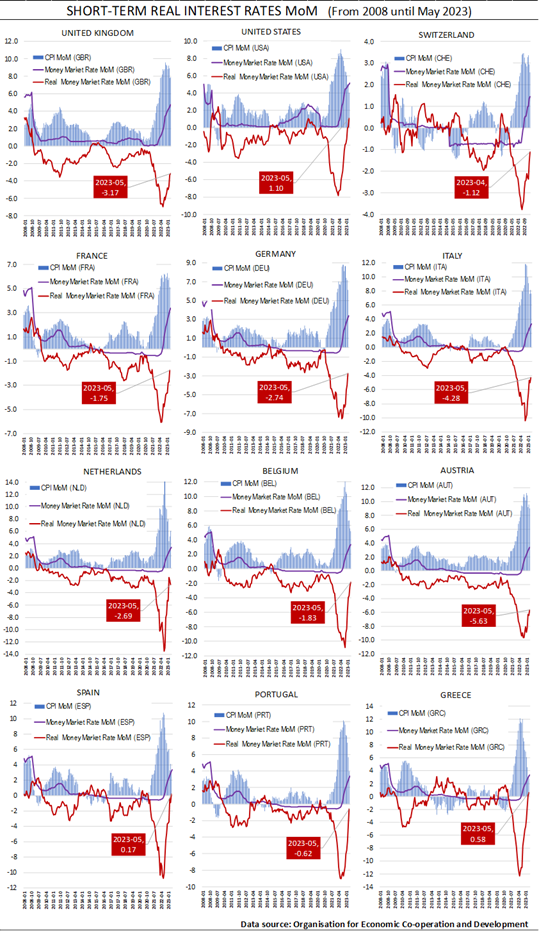
Real interest rates refer to interest rates adjusted for inflation representing the real return on investment. So, the real interest rate in Austria in May was -5.63% in Italy, it was -4.28% in the UK -3.7% in Germany -2.74% in France -1.75% and in Switzerland -1.12%. Meanwhile, in the US, real interest rates were positive as they stood at +1.10% in May.
It is crucial for forex traders to be aware that short-term real interest rates can have a significant impact on the foreign exchange (FX) markets.
The impact on the FX market
Higher short-term real interest rates, such as higher real US interest rates, tend to make the dollar more attractive to investors. When a country's interest rates are higher than other countries, it creates a higher return on investment for investors holding that currency. As a result, there is increased demand for the currency, leading to an appreciation of its value relative to other currencies.
In fact, when short-term real interest rates rise, this encourages capital inflows from foreign investors seeking higher returns. These investors can convert their funds into the currency at higher interest rates, increasing demand for that currency and potentially causing it to appreciate. Conversely, when short-term real interest rates fall, it can lead to capital outflows as investors seek better opportunities elsewhere, potentially weakening the currency.
In addition, short-term real interest rates can affect carry trade strategies. Carry trade involves borrowing in a currency with low-interest rates and investing in a currency with higher interest rates. Higher short-term real interest rates make the carry trade more attractive as the interest rate differential and potential profit increase. This increased demand for the higher-yielding currency can lead to its appreciation.
Higher real interest rates can also be seen as a measure to control inflation, thus can boost confidence in the currency's stability and attracting foreign investors by strengthening the currency.
Target of central banks
Central banks closely monitor the course of short-term real interest rates. As it determines their actions and policies, including interest rate decisions, significantly impacting foreign exchange markets. The FED succeeded in curbing inflation and driving real interest rates into positive territory. It remains to be seen whether the UK and Eurozone central banks will succeed in achieving the same goal so as to avoid any pressure on their currencies that may come from the realm of negative real interest rates.
Author
Nikolaos Akkizidis
LegacyFX
Mr Nikolaos Akkizidis is an economist, with 20+ years of experience in multiple roles in the financial sector.

















