The House budget bill: Let reason prevail

_XtraSmall.jpg)
On the Congressional front, the big news this week has had to do with the Republican effort to pass a budget bill in the House. So far, nothing has passed, so some compromises and adjustments will inevitably happen. In any case, these major provisions seem to be at the taking-off point:
-638832083218789995.png)
By all reports, it appears that the Republicans have a consensus making the extension of the tax cuts their highest priority. Passage of a single, unified bill is problematic, however, because one faction of the Republican caucus wants to cut federal spending to sharply lower the deficit, and another faction won’t support the spending cuts to safety net programs necessary to accommodate the deficit hawks. From the perspective of an independent observer, it seems obvious to me that the most reasonable course of action should be reconsideration of the plans to make the Trump tax cuts permanent.
Just so we know what we’re talking about, the table below shows the tax brackets and income ranges that were introduced with the 2017 Tax Cuts and Jobs Act (TCJA):
-638832082822247303.png)
If Congress fails to act, these brackets will revert to those that had previously been in effect:
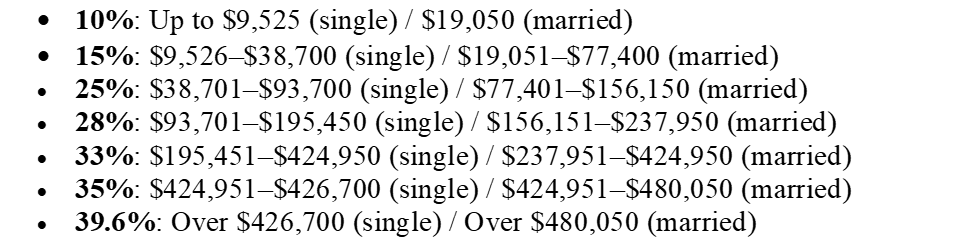
Is this the hill that Republicans want to die on? With all these parameters to work with — i.e., the various brackets themselves and each of the corresponding income ranges — the idea that making the structure imposed by TCJA sacrosanct seems crazy to me. Republicans and Democrats alike appreciate that we can’t afford to make these tax cuts permanent in isolation — i.e., without offsetting spending elsewhere. The fact that scaling back on these tax cuts seems to be off the table, however, looks like an indefensible choice.
While many view Republicans and Democrats as being on different sides with respect to being for and against tax cuts, respectively, I believe that to be an erroneous characterization. I think most Democrats would be in favor of tilting the system in such a way as to narrow the income and wealth gap; and this outcome could be accomplished with targeted tax cuts that I expect most Democrats would favor. For instance, the first three or four tax brackets and income ranges from TCJA could be maintained, but the remaining tax brackets and income ranges could be adjusted to be more in line with what they had been before the cuts were enacted. And would it really be so terrible to introduce an even higher marginal tax bracket of, say, 43% for incomes above $2 million? (I offer that suggestion as another potential point of compromise.)
The failure to agree to such a common-sense accommodation is testimony to the priority that the Republicans have for enriching those at the top of the economic pyramid. It’s telling and it’s deplorable. Making the structure of the TCJA permanent seems likely to damn virtually all of us either to dangerously unsustainable federal deficits or to living in a country where those who depend on federal assistance to meet their basic living requirements are faced with having those benefits withdrawn — all to assure that rich people can get even richer. Where’s the humanity in that?
Author
Ira Kawaller
Derivatives Litigation Services, LLC
Ira Kawaller is the principal and founder of Derivatives Litigation Services.