|

The “green” electricity revolution is well on its way
In 2019, the European Union (EU) adopted a very ambitious Green Deal, setting a 2050 climate neutrality target for the 27 member states. Since then, the Fit for 55 legislative package (in 2021) has been introduced, followed by the series of REPowerEU directives (in 2023) detailing the process to speed up reducing greenhouse-gas emissions (to at least twice the current pace). The main focus has been on developing renewable energies, whose share is set to double within six years, accounting for 42.5% of end-energy use by 2030.

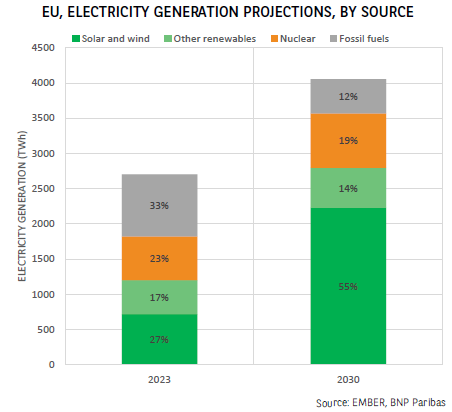
We are seeing a revolution with electricity at its heart. In order to drive the transformation of usages (such as the gradual phasing out of internal combustion engine vehicles and the replacement of oil and gas boilers with heat pumps), the sector will have to significantly increase its production (by around 50%) by 2030, based on demand projections from the EMBER institute1. At the same time, the very nature of this production will have to change, so that EU’s electricity generation will mainly rely on solar and wind power (at 55% in 2030, compared to the current level of 27%, see chart).
fxsoriginal

Recent trends are encouraging. Since the outbreak of the war in Ukraine, “green” investments have accelerated, with solar and wind power largely (and probably permanently) replacing gas in EU electricity generation2. This breakthrough has been achieved with a stable or even slightly reduced production volume (around 2,800 terawatt hours per year for a decade) and will now need to be entrenched with the increasing electricity demand, which will involve considerable investments. Under the (low or high) scenarios used, wind and photovoltaic production capacities should be increased by a factor of 2.5 to 3 by 2030 if the EU wants to achieve its roadmap.

Download The Full Eco Flash

Author

BNP Paribas Team

BNP Paribas Team

BNP Paribas

BNP Paribas Economic Research Department is a worldwide function, part of Corporate and Investment Banking, at the service of both the Bank and its customers.


More from BNP Paribas Team
Share:

Markets move fast. We move first.

Orange Juice Newsletter brings you expert driven insights - not headlines. Every day on your inbox.

By subscribing you agree to our Terms and conditions.

Editor's Picks

EUR/USD bounces toward 1.1750 as US Dollar loses strength

EUR/USD returned to the 1.1750 price zone in the American session on Friday, despite falling Wall Street, which indicates risk aversion. Trading conditions remain thin following the New Year holiday and ahead of the weekend, with the focus shifting to US employment and European data scheduled for next week.

GBP/USD nears 1.3500, holds within familiar levels

After testing 1.3400 on the last day of 2025, GBP/USD managed to stage a rebound. Nevertheless, the pair finds it difficult to gather momentum and trades with modest intraday gains at around 1.3490 as market participants remain in holiday mood.

Gold trims intraday gains, approaches $4,300

Gold retreated sharply from the $4,400  area and trades flat for the day in the $4,320 price zone. Choppy trading conditions exacerbated the intraday decline, although XAU/USD bearish case is out of the picture, considering growing expectations for a dovish Fed and persistent geopolitical tensions.

Cardano gains early New Year momentum, bulls target falling wedge breakout

Cardano kicks off the New Year on a positive note and is extending gains, trading above $0.36 at the time of writing on Friday. Improving on-chain and derivatives data point to growing bullish interest, while the technical outlook keeps an upside breakout in focus.

Economic outlook 2026-2027 in advanced countries: Solidity test

After a year marked by global economic resilience and ending on a note of optimism, 2026 looks promising and could be a year of solid economic performance. In our baseline scenario, we expect most of the supportive factors at work in 2025 to continue to play a role in 2026.

Crypto market outlook for 2026

Year 2025 was volatile, as crypto often is.  Among positive catalysts were favourable regulatory changes in the U.S., rise of Digital Asset Treasuries (DAT), adoption of AI and tokenization of Real-World-Assets (RWA).













