The Fed’s no-exit ramp: Debt, Dollar debasement, and the case for Gold [Video]
![The Fed’s no-exit ramp: Debt, Dollar debasement, and the case for Gold [Video]](https://editorial.fxsstatic.com/images/i/KevinWarshFED4-14526.png)
Federal Reserve Chair Kevin Warsh used his Jackson Hole speech last Friday to project a tough-on-inflation posture. But despite the market’s sharp reaction, the Fed has not changed policy—and Mike Maharrey argues that reality matters far more than the rhetoric.
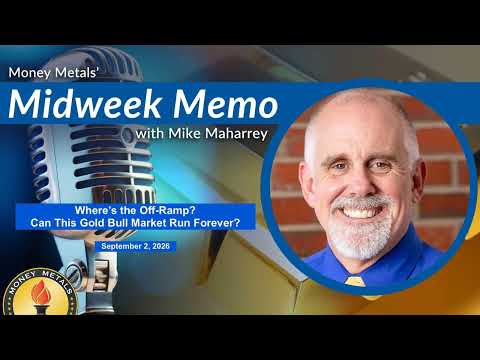
In this episode of the Money Metals Midweek Memo, Maharrey compared the Fed’s predicament to missing an exit on a highway. The longer a driver is forced to keep going in the wrong direction, the more difficult and frustrating the eventual turnaround becomes. For central bankers, he said, the missing off-ramp is America’s massive debt burden.
Warsh has repeatedly emphasized price stability and a willingness to use interest rates to achieve the Fed’s mandate. Yet the federal funds rate has remained in a 3.5% to 3.75% range since December 2025.
Maharrey’s central question was straightforward… if inflation remains well above the Fed’s 2% target, why has the central bank continued to talk about rate hikes instead of actually delivering one?
Jackson Hole rattles markets, but policy has not changed
Warsh’s Jackson Hole remarks were widely interpreted as hawkish. He said the Fed’s 2% price-stability target, measured by the Personal Consumption Expenditures Price Index, is “a firm, fixed target,” and stressed that short-term interest rates are the central bank’s predominant policy tool.
He also said inflation had cooled somewhat but that the data did not show underlying trends had “meaningfully improved.” Former Jerome Powell adviser and Johns Hopkins economist Jon Faust told the Associated Press that Warsh had conveyed he would support raising rates if necessary.
Markets responded immediately. Gold fell more than 3%, silver dropped more than 4%, the NASDAQ fell nearly 139 points, bonds sold off, Treasury yields moved higher, and the dollar weakened. Speculation resurfaced that the Fed could raise rates as soon as its September meeting.
But Maharrey emphasized that Warsh never explicitly said the Fed would hike rates, offered no timeline, and announced no policy change. The market, he argued, reacted to “open-mouth operations”—the Fed chair’s words—rather than a concrete move by the Federal Open Market Committee.
Forty trillion reasons to avoid higher rates
The obstacle to rate hikes, Maharrey argued, is the nearly $40 trillion national debt. Servicing that debt is already costing the federal government more than $1 trillion per year, leaving policymakers with little room to tolerate significantly higher borrowing costs.
Through July of fiscal 2026, federal spending totaled $6.28 trillion, a 3.3% increase from the same period a year earlier. Maharrey said the persistence of rising spending, despite political promises of cuts, shows that Washington has little appetite for meaningfully confronting the debt problem.
The Treasury has also tried to push down long-term borrowing costs through bond-market intervention, Maharrey noted, but those efforts have not produced the desired result. Meanwhile, the government’s debt is only one part of a much larger debt overhang that includes heavily indebted consumers, high credit-card interest rates, leveraged corporations, and strains in private credit.
That creates a policy trap. The Fed may need higher rates to restrain inflation, but it also needs lower rates to keep the debt-ridden economy from cracking. In Maharrey’s view, genuinely tight policy could expose the fragility of an economy reliant on easy money.
He argued that this leaves the Fed with a difficult choice. A rate hike could push the economy toward a deep recession or a financial crisis. A rate cut, by contrast, would likely encourage more inflation and further dollar devaluation. Maharrey said he believes a cut is more likely than a hike during this cycle, although he acknowledged that Warsh could still choose to follow through on his hawkish language.
The debasement trade and a potentially long Gold bull market
Short-term price moves in gold and silver can be driven by war headlines, oil-price volatility, and shifting expectations about Fed policy. Maharrey urged investors to look past that noise and focus on the underlying fundamentals - mounting debt, currency debasement, and a gradual move away from the dollar.
He cited Ned Davis Research Chief Alternative Strategist John LaForge, who said gold prices could continue rising until governments learn how to deal with their debt problems. “The longer we let it go, and we don’t pay this stuff back, and we keep piling all these debts up, the higher gold prices can go,” LaForge said in a recent Kitco News interview.
LaForge said he sees multiple years of higher prices ahead because global political leaders do not appear willing to address the debt problem. He also described gold as one of the few “bearer assets” that can be held outside the credit system—an asset without a counterparty that must perform or avoid default.
Maharrey said that distinction helps explain why central banks have continued accumulating gold. A gold bar is widely recognized as payment across borders and financial systems, while national currencies carry the added complication of exchange rates, political risk, and issuer credibility.
LaForge also said gold may be entering the early stages of a broader commodity “super cycle.” Maharrey agreed, arguing that the primary long-term driver is not that gold itself is becoming more expensive, but that government currencies are buying less over time.
A million Dollars does not buy what it used to
To illustrate the effects of inflation, Maharrey turned to the game show Who Wants to Be a Millionaire?, which first aired in August 1999 with Regis Philbin as host. The show remains on the air today, now hosted by Jimmy Kimmel, but the meaning of its $1 million prize has changed considerably.
According to figures cited in the episode, the United States had roughly 7.64 million millionaires by net worth in 1999. By 2025, that number had climbed to 23.6 million. Yet Maharrey argued that the increase does not necessarily mean Americans are three times more prosperous.
Instead, he said purchasing power has eroded so much that it now takes roughly $2 million to buy what $1 million could have bought when the show debuted. Under the Fed’s 2% inflation target, a dollar loses at least 10% of its purchasing power every five years, and that loss compounds over time.
Maharrey’s conclusion was that inflation is not a temporary accident but an embedded feature of the modern monetary system. The government can create dollars, but it cannot create gold or silver. That is why, he argued, precious metals remain a useful hedge against persistent currency debasement, debt accumulation, and the policy choices likely to follow.
Gold and silver may face volatile pullbacks, particularly when markets anticipate higher rates. But Maharrey said both potential paths for the Fed remain supportive for metals over the long term. If the Fed cuts, the result could be more inflation and a weaker dollar. If it hikes and damages the debt-heavy economy, the eventual response could still be renewed easing, stimulus, and monetary expansion.
To receive free commentary and analysis on the gold and silver markets, click here to be added to the Money Metals news service.
Author

Joshua D. Glawson
Money Metals Exchange
Joshua D. Glawson is a writer on such topics as philosophy, politics, economics, finance, and personal development. He graduated with a Bachelor in Political Science from the University of California Irvine. His website is JoshuaDGlawson.com.

















