The Fed won’t cut rates soon – bad news for your mortgage loan

The recent surge in US Treasury bond yields after Moody’s cut the credit rating of the United States (US) sovereign debt could be a wake-up call for financial markets, the kind of canary in the coal mine that ends up being remembered as a turnaround signal. But for the Average Joe, there’s something more down-to-earth about this: expensive mortgage loans are here to stay.
Despite months of falling interest rate expectations in the US, markets may be realizing that interest rates will not fall anytime soon, which is creating upward pressure on mortgage rates and thus making mortgage loans more expensive.
Even with many of the major central banks around the world cutting their benchmark rates, the US Federal Reserve (Fed) has kept its benchmark interest rate – the Fed Funds rate – steady for its last three meetings. The Fed last cut interest rates in December, making it 100 basis points in three rate cuts for 2024.
Markets expected more cuts. At the start of the year, the odds of an interest rate cut in the first half of 2025 were at 75%, according to CME Fedwatch data – right now these odds (for the remaining H1 meeting in June) are at a meager 2%.
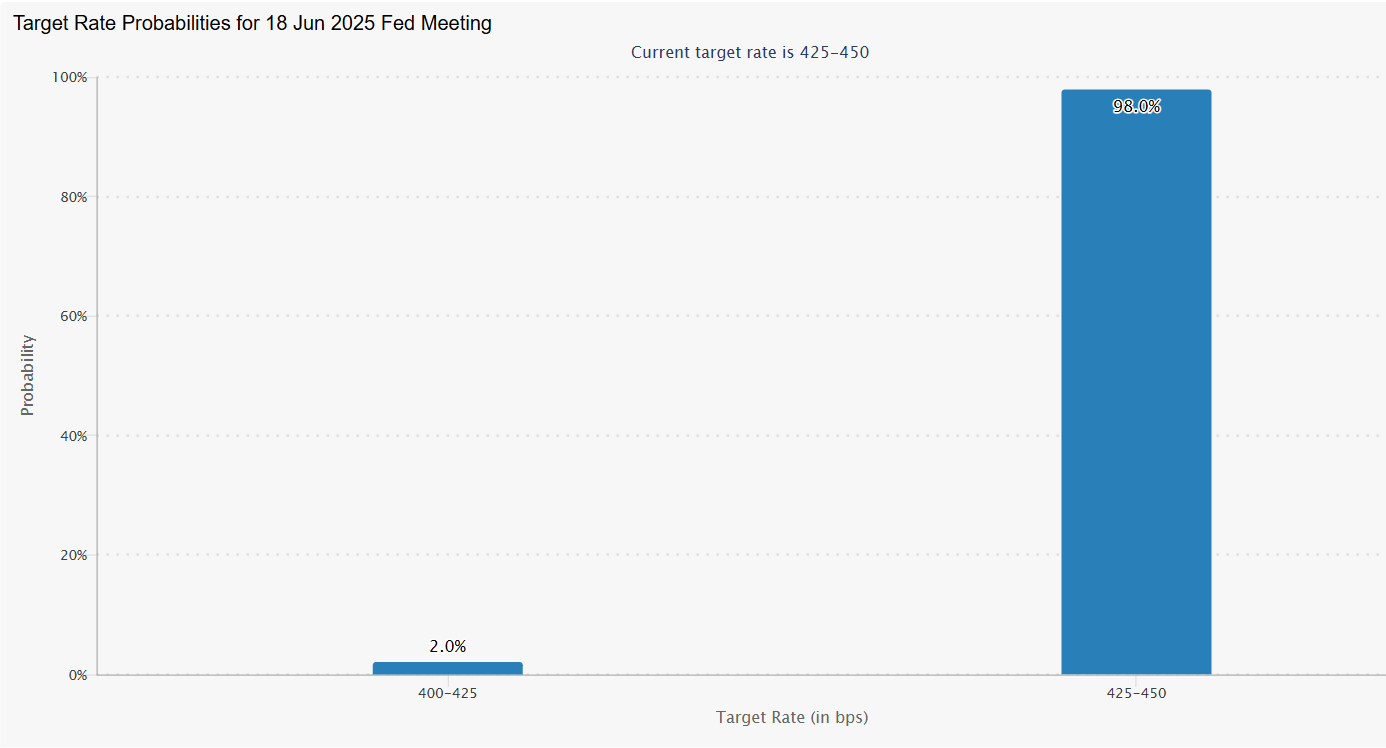
Interest rate probabilities for June 18 Fed meeting (source: CME Fedwatch Tool)
Markets are currently pricing in the first Fed interest rate cut to arrive in September. But even doubts about timing have started looming, as the odds for keeping the rates at current levels in September have risen from 1% on May 1 to the current 31%. That is a market-moving jump.
What is the correlation between Fed interest rates and US Treasury yields?
Macroeconomic theory usually explains well the relationship between the Fed Funds rate and short-term Treasury yields – those represented by bills on maturity dates up to one year.
Mid and long-term Treasury assets (notes up to 10-year maturity dates and bonds from 10 years and beyond) typically have a wider variation, especially during periods of unusual economic conditions or shifting market expectations.
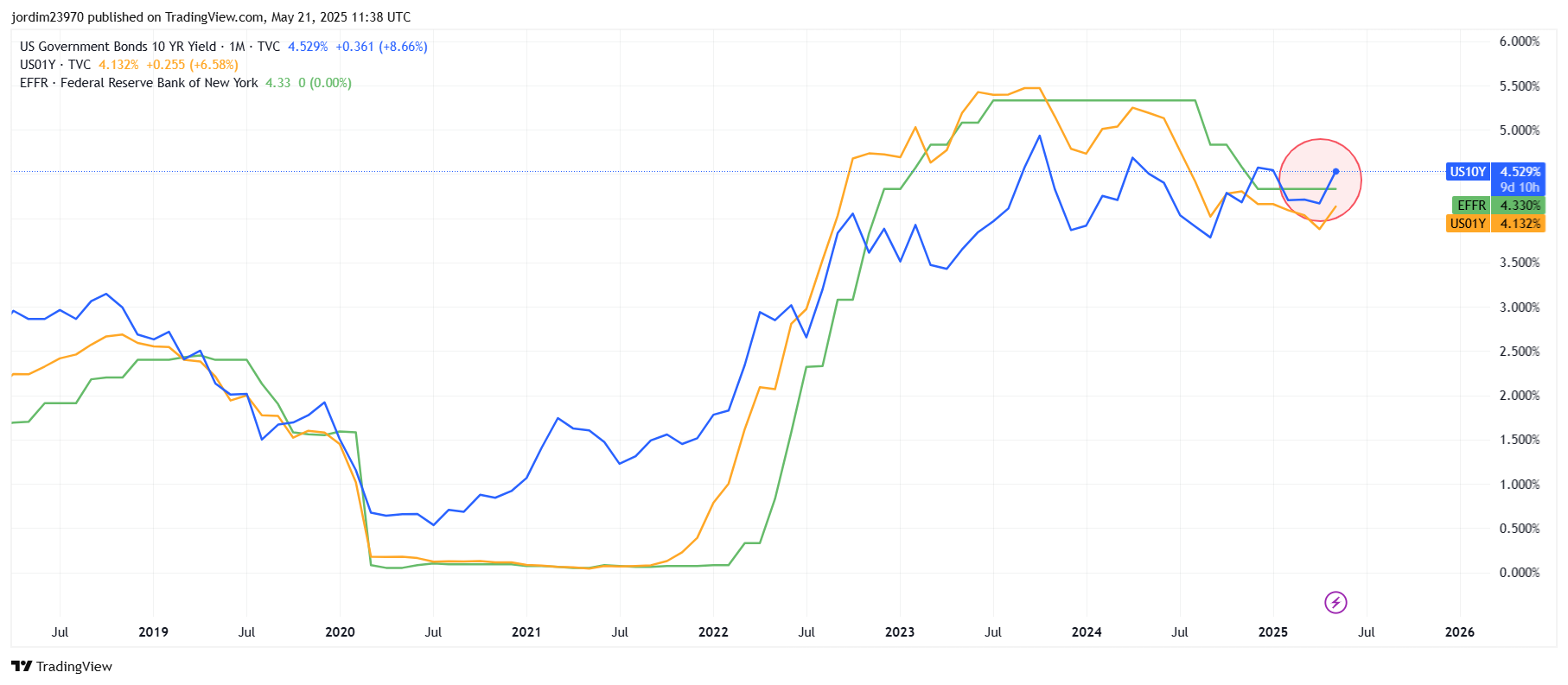
US Treasury 1-year yield, 10-year yields, and Effective Fed Funds Rate correlation chart
This is well shown in the chart above. The US Treasury 10-year yield (blue line) is usually less sensitive than the 1-year yield (orange line) to the changes in the Fed interest rates (in green). Markets have been in a high-correlation phase since 2022, when the Fed was raising interest rates at every meeting.
The recent 10-year bond yield surge, triggered by the Moody’s credit downgrade, has created a crossover with the Fed Funds rate, in what could be the anticipation of higher interest rates.
What are Federal Reserve officials saying about future interest rates?
Federal Reserve officials are not turning down these higher interest rate expectations. We are in the midst of a busy Fedspeak week, and the discourse has been mostly hawkish.
Atlanta Fed President Raphael Bostic said on Monday that the Fed needs to be more certain about the economic outlook to be comfortable about how monetary policy should shift. Bostic added that “further instability in the Treasury market would add to uncertainty. Adding even more uncertainty would cause further delays in policy changes as the Fed seeks more clarity.”
Bostic has long held a neutral tone, according to FXStreet’s FedTracker, an AI-fueled tool that analyzes public speeches from Federal Reserve officials in a dovish-to-hawkish 0-10 scale. His recent words shifted his tone to a more hawkish one, coming at 6.0 (more hawkish on the scale) compared to a 5.4 average.
Alberto Musalem, President of the St. Louis Fed, a traditionally more hawkish speaker (with a 5.8 average score on the FedTracker), followed on the same tone, saying on Tuesday that the Fed's monetary policy is currently “well-positioned.”
FXStreet’s Fed Sentiment Index, a measure that gauges all Fed public appearances, has spent the last two months above 110, well into hawkish territory, showing the current hawkish shift in the Fed policy.

FXStreet’s Fed Sentiment Index
How does the Fed policy affect mortgage loans?
Mortgage rates are highly dependent on the rates set by the Fed. Commercial banks borrow and lend their excess reserves to each other at that level, so any change in Fed Funds rate expectations decisively affects commercial interest rates for mortgages and loans.
Moody’s downgrading of the US sovereign debt, the subsequent rise in US Treasury yields, and a rise in the median Fed interest rate expected in the near future are a cascade of events that may punish the real estate market by making mortgage loans more expensive.
On Monday, the US mortgage market reacted with a pickup in its rates to the Moody’s US debt downgrade. 30-year and 15-year fixed rates have risen this week to the highest levels since April 11, currently at 6.99% and 6.35% respectively, according to Mortgage News Daily data.
“The average mortgage lender had to account not only for the market movement in Friday’s closing minutes (after Moody’s downgrade was released), but also for the additional weakness seen on Monday,” Matthew Graham, chief operating officer at Mortgage News Daily, told CNBC.
The 30-Year fixed rate mortgage average published by the Federal Reserve of Saint Louis weekly on Thursdays, is currently at 6.81%, having treaded water between 6.5% and 7.1% during 2025. The rate doesn’t include the latest swings in the US bond market.
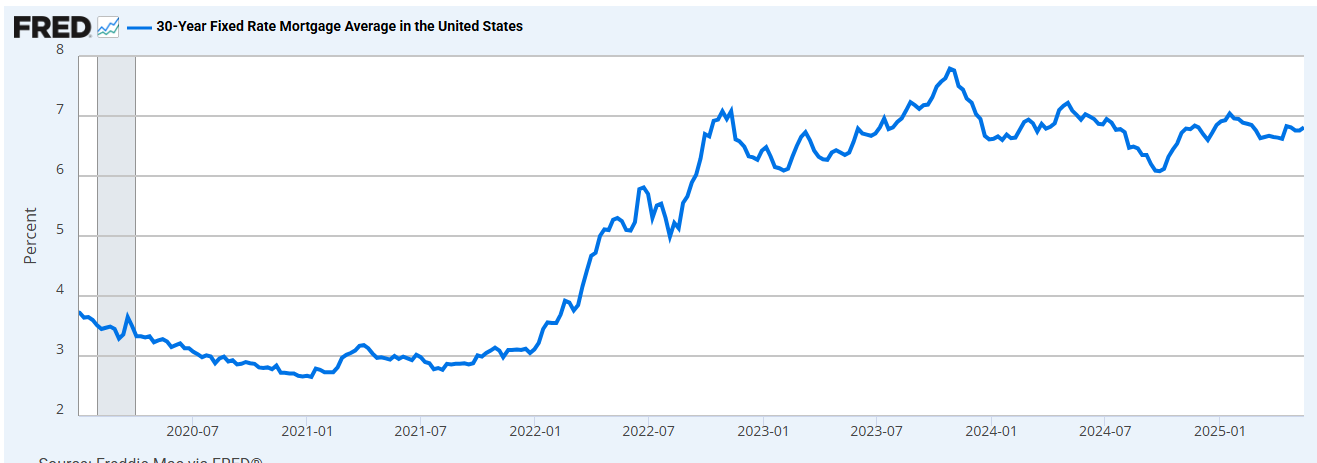
30-year fixed rate mortgage average (source: St. Louis Fed)
Mortgage Bankers Association (MBA) rate data, the benchmark measurement in the US mortgage market, has also shown some stabilization right below the 7% mark in the last couple of weeks.
Both metrics could continue their long-term uptrend above that level in the coming months if macroeconomic uncertainty continues and the Federal Reserve keeps delaying the long-awaited interest rate cuts.
If this trend persists, it looks like the only way for mortgage rates is up.
Author

Jordi Martínez
FXStreet
Jordi Martínez is the Editor in Chief at FXStreet, leading editorial operations at the company, before being promoted to the role in 2023, he worked in several editorial positions at FXStreet, including roles as Senior Editor and