The Fed in September: Quicksand at the zero bound
- Fed adds a year to the Projection Materials, zero rates extend to the end of 2023.
- Economic outlook improves: GDP, employment and inflation.
- Equities mixed, Treasuries unchanged and dollar falls despite modestly better economic prospects.
- Why are the Projection Materials four years?

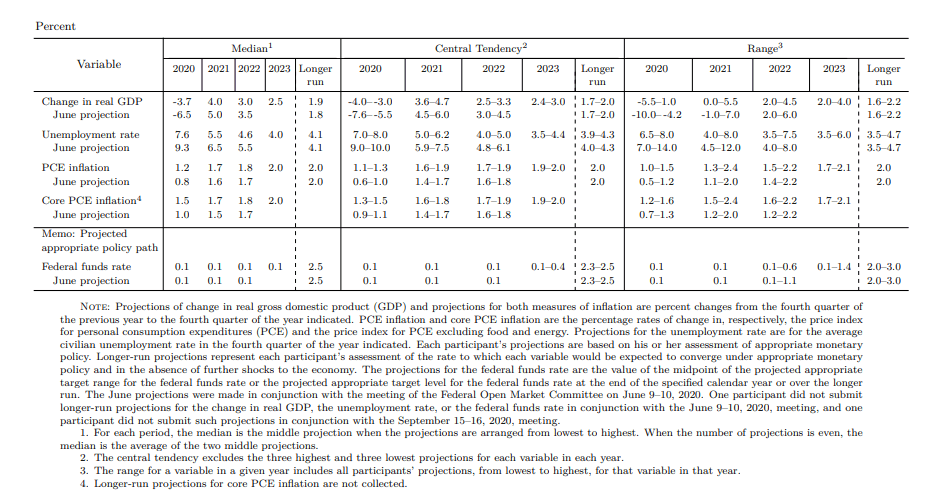
The Federal Reserve elaborated on last month’s policy shift to inflation averaging at Wednesday’s FOMC meeting, and even though its own predictions show a quickening recovery the fed funds rate is now expected to remain at the zero bound through the end of 2023.
Projection materials
Economic projections from the governors, the second set since the pandemic arrived in March, improved. The economy is now expected to contract 3.7% this year. In June the prediction was for a 6.7% annualized decline. Unemployment at the end of the year dropped to 7.6% from 9.3% and core PCE inflation should be 1.5% by December instead of 1.0%.
This was the first time the bank had pushed its forecasts out to a fourth year. Despite the addition 12 months all but four of the governors expected the fed funds rate to be unchanged at that terminus.
“These changes clarify our strong commitment over a longer time horizon,” Chairman Jerome Powell noted at his news conference following the announcement.
The FOMC statement included an official version of the new inflation policy.
“The Committee seeks to achieve maximum employment and inflation at the rate of 2 percent over the longer run. With inflation running persistently below this longer-run goal, the Committee will aim to achieve inflation moderately above 2 percent for some time so that inflation averages 2 percent over time and longer-term inflation expectations remain well anchored at 2 percent.”
Market response
Equities were mostly lower with the S&P 500 shedding 0.46%, 15.71 points and the Nasdaq losing 1.25%, 139.83 points. The Dow salvaged a 36.78 point gain, 0.13% after having been up over 300 points in the hour following the Fed announcement.
Treasuries were unchanged across the yield curve with less than a basis point gain or loss in yields for terms from 3 months to 30 years.
The dollar slipped in all of the major pairs except the euro which fell below 1.1800 for the first time in a week. Initial dollar gains faded as equities gave up their burst of optimism from the improving near term outlook and settled on the Fed’s lengthening view for the necessity of zero rates.
 Zero rates and the US economy
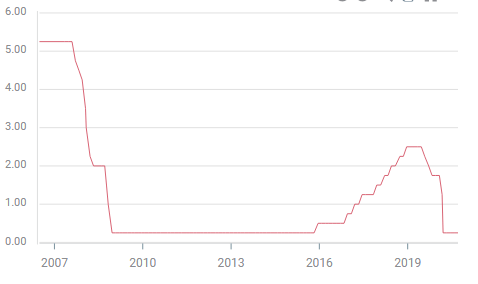
The Fed’s move to near permanence for zero interest rates came as the US is showing signs of shaking off the impact of the from the economic shutdowns in March and April.
Fed funds
Employment has expanded for four months and though retail sales missed expectations in August coming at 0.6% on a 1% forecast the six month averages, including the two closed months, of 0.87% in sales and 1.28% in the control group are the best half year in over a decade.
Retail sales

It bears repeating the collapse in consumption in the shutdown was followed by an even stronger burst of spending that did not just recover the lost months but put the consumer economy at the forefront of the revival.
Chairman Powell’s summary caution was again notable in his estimate of the banks role in supporting the economy. “I would not say we are out of ammo. We have lending, the balance sheet and forward guidance. There is still plenty more we can do. We do think our rate stance will provide powerful help to the economy.”
One question that was not asked of Mr. Powell. What was the logic of the additional year of economic projections?
Could it have been needed to avoid making 0.1% in the "Longer run" category seem like lower rates forever?
Author

Joseph Trevisani
FXStreet
Joseph Trevisani began his thirty-year career in the financial markets at Credit Suisse in New York and Singapore where he worked for 12 years as an interbank currency trader and trading desk manager.