|

The extremely uneven Manufacturing recovery in pictures

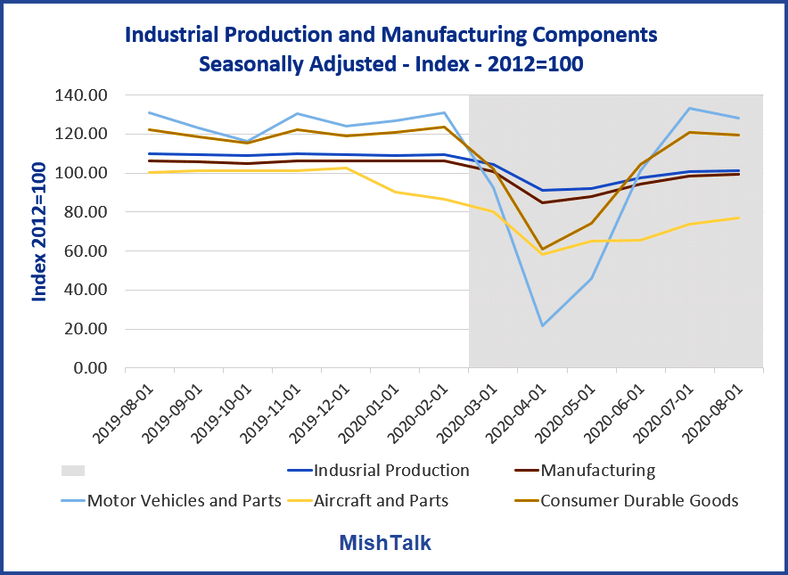
The recovery in industrial production has slowed. A sector outlook shows one huge problem.

One Huge Problem

Auto production took the steepest hit but it has since recovered. 

Aircraft and aircraft parts production fell off a cliff and cannot get back up.

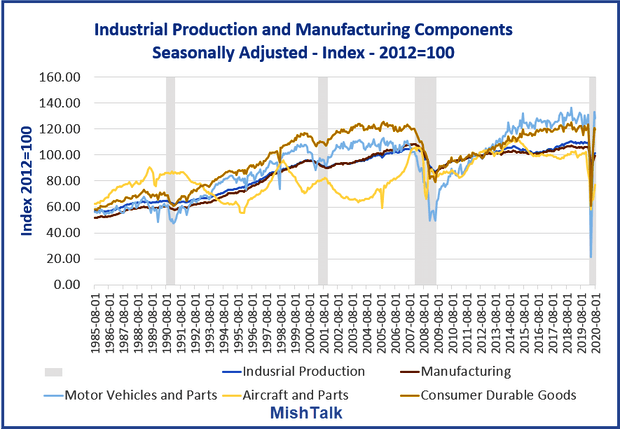
Industrial Production Components 1985-Present 
Cyclical Industries

The long-term chart shows the hugely cyclical nature of the aircraft industry, often unrelated to recessions.

Recoveries for autos and aircraft can be lengthy. But in this case, auto production recovered quickly based on the Fed's Industrial Production report this morning.

For more details and charts, please see Huge Miss in Industrial Production Output vs Expectations.

Index Levels Don't Tell the Full Story

Neither Index levels nor percentage moves tell the full story. The pertinent numbers are the actual values of production components. 

Manufacturers' Value of New Orders
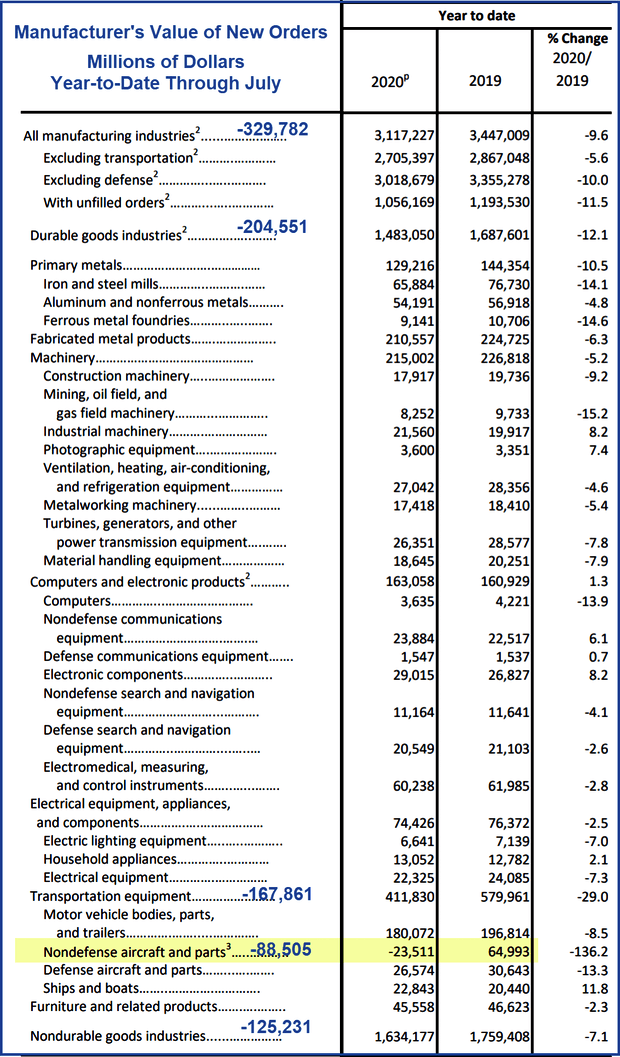
The above image is the right hand portion of Table 2 in the Monthly Report On Manufacturers’ Shipments, Inventories and Orders for July 2020.

Year-to-Date Synopsis Through July

  • Manufacturing down $329.782 billion. Of which durable goods were down $204.551 billion and non-durable goods were down $125.231 billion.
  • Transportation was down $167,861 billion. Aircraft accounted for $88.505 billion of the loss. The negative year-to-date number is order cancellations.
  • $88.505 billion is is over half of the transportation loss and 43% of the durable goods loss. 

One Huge Problem and Lots of Small Ones

Aircraft is the huge problem but nondurable goods, primary metals, and machinery are more than big enough to matter. 

How Long Will It Take For the Airline Industry to Recover?

It's possible autos have stabilized but I do expect another swoon down as the recovery stalls.

Aircraft is another matter. 

For details and discussion, please see How Long Will It Take For the Airline Industry to Recover?

Author

Mike “Mish” Shedlock's

Mike “Mish” Shedlock's

Sitka Pacific Capital Management,Llc

More from Mike “Mish” Shedlock's
Share:

Editor's Picks

EUR/USD flirts with daily highs, retargets 1.1900

EUR/USD regains upside traction, returning to the 1.1880 zone and refocusing its attention to the key 1.1900 barrier. The pair’s slight gains comes against the backdrop of a humble decline in the US Dollar as investors continue to assess the latest US CPI readings and the potential Fed’s rate path.

GBP/USD remains well bid around 1.3650

GBP/USD maintains its upside momentum in place, hovering around daily highs near 1.3650 and setting aside part of the recent three-day drop. Cable’s improved sentiment comes on the back of the Greenback’s  irresolute price action, while recent hawkish comments from the BoE’s Pill also collaborate with the uptick.

Gold clings to gains just above $5,000/oz

Gold is reclaiming part of the ground lost on Wednesday’s marked decline, as bargain-hunters keep piling up and lifting prices past the key $5,000 per troy ounce. The precious metal’s move higher is also underpinned by the slight pullback in the US Dollar and declining US Treasury yields across the curve.

Crypto Today: Bitcoin, Ethereum, XRP in choppy price action, weighed down by falling institutional interest 

Bitcoin's upside remains largely constrained amid weak technicals and declining institutional interest. Ethereum trades sideways above $1,900 support with the upside capped below $2,000 amid ETF outflows.

Week ahead – Data blitz, Fed Minutes and RBNZ decision in the spotlight

US GDP and PCE inflation are main highlights, plus the Fed minutes. UK and Japan have busy calendars too with focus on CPI. Flash PMIs for February will also be doing the rounds. RBNZ meets, is unlikely to follow RBA’s hawkish path.

Ripple Price Forecast: XRP potential bottom could be in sight

Ripple edges up above the intraday low of $1.35 at the time of writing on Friday amid mixed price actions across the crypto market. The remittance token failed to hold support at $1.40 the previous day, reflecting risk-off sentiment amid a decline in retail and institutional sentiment.