|

The Eurozone first-quarter GDP rises 2.5% y/y

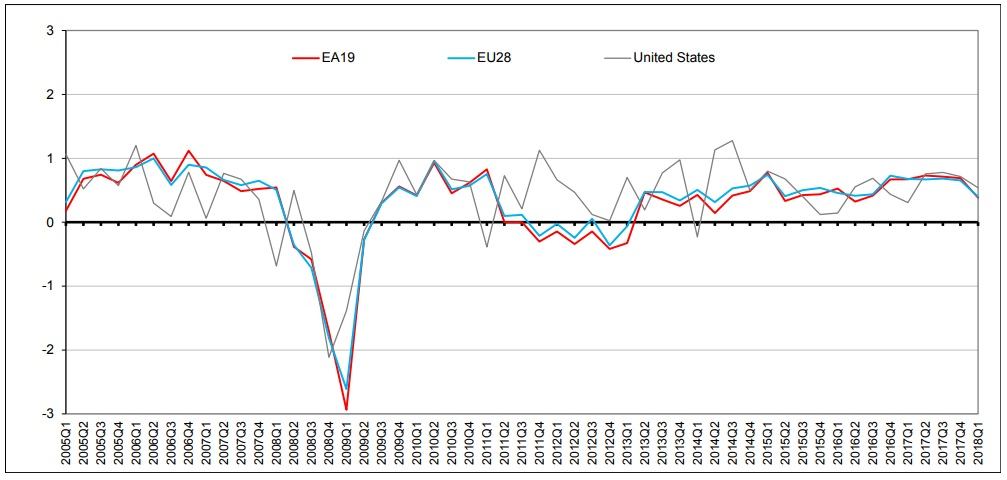
  • The Eurozone first-quarter GDP rose 0.4% over the quarter while rising 2.5% over the year.
  • Household consumption was the largest upward contributor to GDP followed by the change in inventories and investment.

The first quarter seasonally adjusted GDP rose 0.4% over the quarter in the Eurozone, decelerating from 0.7% in the final quarter of 2017, the Eurostat, the European statistical authority reported on Thursday.

“Household final consumption had a positive contribution to GDP growth in both the euro area of  +0.3% and the contribution from the gross fixed capital formation was also positive with +0.1% contribution. The contribution of the external balance to GDP growth was negative,” the Eurostat wrote in the report.

Looking at the regional distribution of the GDP growth in the European Union, the emerging market economies' growth rate was higher compared with the traditional countries of Western Europe. The highest growth rate over the year was recorded in Latvia that rose 5.1% y/y, with Poland and Slovenia following at 5.0% y/y.  

Denmark was the only country in the European Union to report a negative GDP growth rate of 0.5% y/y with the United Kingdon coming out second with 1.2% y/y GDP rise. Both countries are though outside of the Eurozone. Out of the Eurozone countries, the lowest GDP growth rate of 1.4% y/y was made by Italy and 1.5% y/y by Belgium. 

Looking at the industries, the largest positive contributor to GDP growth in first-quarter in the Eurozone in terms of added-value creation was the communication and information technology sector rising 3.8% over the year followed by professional services with the gross added value rising 3.4% in the first quarter.

GDP growth rates on the quarterly basis in the European Union, the Eurozone, the US
Author

Mario Blascak, PhD

Mario Blascak, PhD

Independent Analyst

Dr. Mário Blaščák worked in professional finance and banking for 15 years before moving to journalism. While working for Austrian and German banks, he specialized in covering markets and macroeconomics.


More from Mario Blascak, PhD
Share:

Editor's Picks

GBP/USD defends 1.3300 after strong UK PMI data

Following Thursday's sharp decline, GBP/USD clings to small gains above 1.3300 in the American session on Friday, supported by the upbeat UK Retail Sales and July PMI data. Nevertheless, the pair's upside remains capped as investors cling to a cautious stance amid a further escalation of tensions in the Middle East. The US July PMI data failed to trigger relevant price action.

EUR/USD remains below 1.1400 after mixed US PMIs

EUR/USD pressures daily lows below the 1.1400 mark in the American session on Friday. Mixed S&P Global PMIs, as manufacturing output contracted while services activity expanded in July, triggered no relevant market reaction. The focus remains in Middle East developments and inflation-related concerns.

Gold holds above $4,050 but momentum still missing

Gold builds on its modest intraday bounce and climbs above the $4,050 level on Friday, hitting a fresh daily high amid a modest US Dollar pullback. The fundamental backdrop, however, warrants some caution before confirming that the pullback from an over two-week high, touched on Wednesday, has run its course and positioning for any meaningful upside.

Ethereum: Derivatives interest in ETH improves, but signs of caution remain

Ethereum is hovering slightly below the $1,900 level, down 3% on Thursday following a slight expansion in derivatives interest. The top altcoin's open interest has increased to 14.60 million ETH, marking a 600K ETH increase over the past two days and its highest level since June 7.

XRP retreats as ETF interest cools
Ripple (XRP) slides toward the short-term $1.10 support on Friday, as broader crypto market sentiment weighs on crypto assets. The sell-off mainly stems from fears of inflation in the United States (US) amid the ongoing war in the Middle East and rising Oil prices.
US Dollar mid-year outlook: Exceptional currency, exceptional risks?
The US Dollar enters the second half of 2026 in a markedly different position from a year ago. The King currency has recovered, reflecting persistent US inflation, changing expectations for Fed policy, geopolitical tensions and renewed demand for defensive assets.