The Euro was already leaning before the survey hit

The eurozone PMI came in at 49.5 this morning, and on the face of it that looks like a recovery. It isn’t. Anything under 50 still means business activity is shrinking, just shrinking a little slower than before. After April and May both printed in contraction, this rounds out a weak quarter for the bloc, and most of those survey responses landed before the Middle East deal was even signed. So the small tick up is less a turning point and more a softer landing on the way down.
The more interesting bit is what the survey said about prices. Energy costs were already easing ahead of the US-Iran deal, and that fed straight through. Manufacturers and services firms both saw input costs rise more slowly, and both passed on smaller price increases than they did in May. Now that the deal has pushed energy substantially lower, that cooling has room to run, assuming it holds. As a net energy importer, the eurozone gets a genuine terms-of-trade lift out of cheaper energy, which is the part most desks will skip over this morning.
Here is the logic that matters for the euro. Soft growth plus cooling inflation hands the ECB cover to sit on its hands. A central bank that doesn’t need to tighten forcefully is a central bank offering less yield support underneath its currency, and FX trades on rate differentials more than almost anything else. So the data leans dovish, and dovish ECB means one less reason to defend the euro on dips. That is the fundamental read. It doesn’t create a move on its own, it just removes the friction that would otherwise fight one.
Which brings us to the chart, because the chart was already telling this story before the survey crossed.
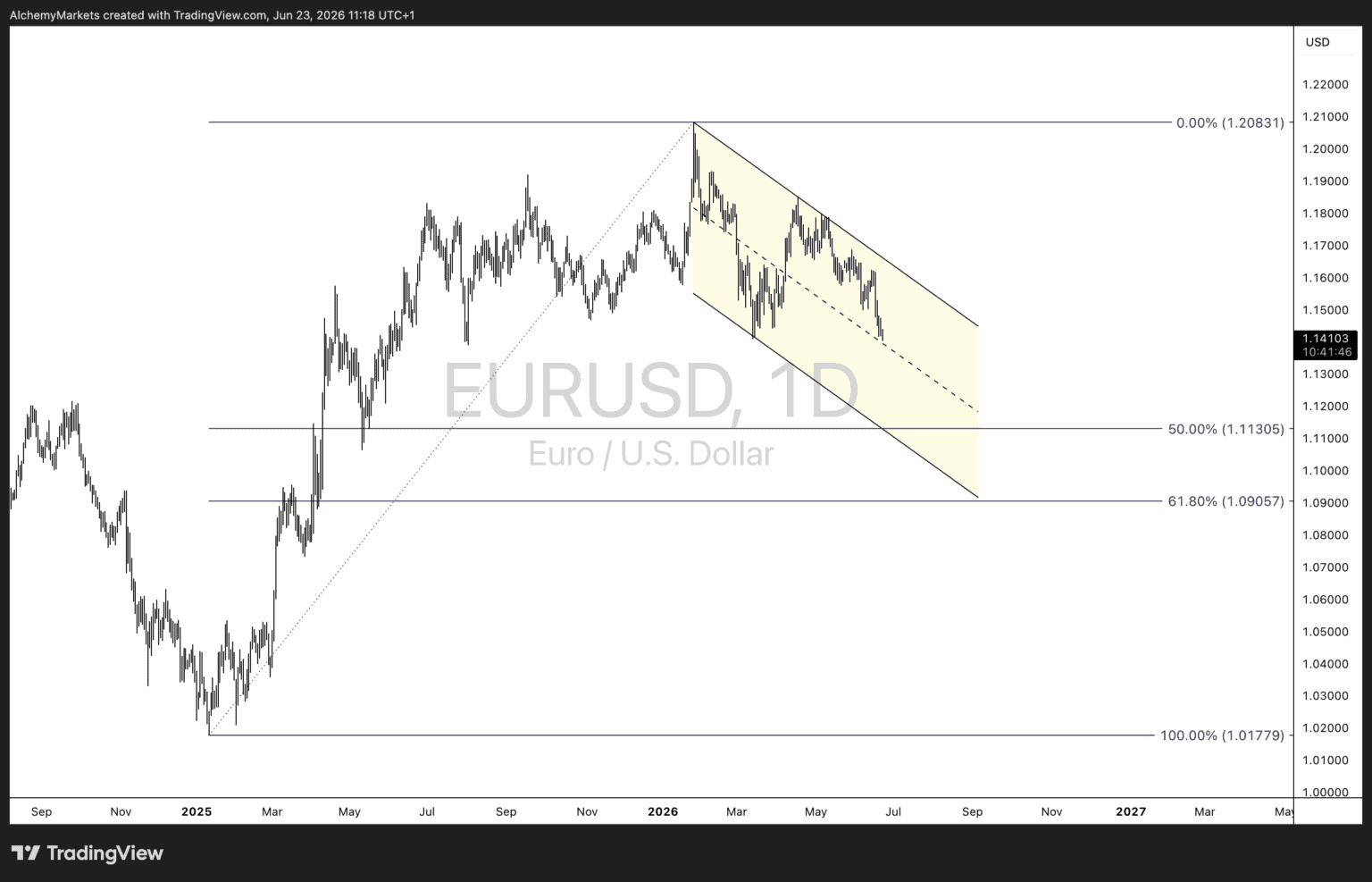
EUR/USD is trading around 1.1408, sitting in the lower half of a descending channel that has been running clean since the 1.2083 high. Price hasn’t been bouncing off the channel midline, it has been pressing toward the floor, which tells you sellers are still in control of the structure. The dotted line below at the 50% retracement, 1.1130, is where it gets interesting. That level lines up with horizontal support that has mattered before, and the channel projection drifts into that same zone over the coming weeks. When a Fibonacci level and a horizontal floor and a channel boundary all point at the same patch of price, that patch becomes a magnet worth watching.
So the structure and the fundamentals are saying the same thing, which is what you want to see. The channel was tilted lower before the PMI, and the survey just handed it a reason to keep its slope. The one caveat to keep front of mind is the dollar. This is as much a USD-strength story as a euro-weakness one, and that channel only carries price toward the confluence zone if the greenback stays firm. If the Fed narrative softens, the euro can hold the midline and the whole picture stalls.
The takeaway is simple. The chart was leaning before the news crossed, and the news gave it permission to keep leaning. Where it goes from here is a confluence zone away, and the dollar gets the final say.
Author

Zorrays Junaid
Alchemy Markets
Zorrays Junaid has extensive combined experience in the financial markets as a portfolio manager and trading coach. More recently, he is an Analyst with Alchemy Markets, and has contributed to DailyFX and Elliott Wave Forecast in the past.