The Daily Fix – Waiting for confirmation of the Trump trade tariffs

Having turned somewhat bearish on the USD on Friday, price action suggests altering this stance again and holding a neutral bias for now -that is, until we can see a more compelling picture materialise.
With the USD index gaining 0.4% on Friday, we find Thursday’s close below the neckline of the multi-month head and shoulders patterns negating this set-up for now, with price testing, and failing to find resistance at the former neckline at 94.65. The USD index was even a whisker from printing a bullish outside day reversal, but the bulls didn’t quite have the impetus, where a close above 94.96 would have shown that the bulls had regained full control.
EURUSD and USDCNH were at the heart of FX moves on Friday and will remain so through this week, with EURUSD coming off the highs of $1.1722 and closing at session lows of $1.1658. The likes of GBPUSD, USDJPY and AUDUSD came along for the ride, with the view on Friday to fade AUDUSD rallies into 0.7200 proving to be on the money. The yuan was offered on news that Donald Trump is still eyeing tariffs on $200b of Chinese imports despite providing China with a seat at the table for trade talks, which is in no way surprising, and according to media reports, we should hear confirmation of this either today or tomorrow. As the WSJ reports, these tariffs should start at 10%, which if correct is somewhat of a positive for risk assets given the market was probably leaning towards 25%.
That said, while the devil is in the detail and any goodwill towards the level of taxation could be unwound with further news flow that China is looking to skip the trade talks with the US, intending to disrupt US manufacturing supply chains. USDCNH has to be on the radar through this week.
This morning’s G10 FX open has been sanguine and limited moves have been seen, even in GBPUSD which has been treated to a number of GBP positive headlines on Brexit. Importantly, these headlines seem to be aimed at the addressing the Irish border debate which is the crucial sticking point. However, for those wanting to play GBP, then arguably taking the USD out of the equation and playing GBP against the cross, such as long GBPAUD, seems prudent and the upside target of 1.8500 remains.
My neutral bias on the USD is reflective of the technical set-up, and of course price action, but also if we look at EURUSD on the daily chart we can see price continuing to oscillate around the 5-day exponential moving average, currently seen at 1.1628. This short-term average is presently tracking sideways, highlighting the lack of trend, where close in price above $1.1710, or below $1.1530 is required to negate this neutral stance and the trading bias would shift accordingly. This may have implications for other G10 crosses too, so the idea to hold and wait for the price to guide and dictate a bias holds true here.
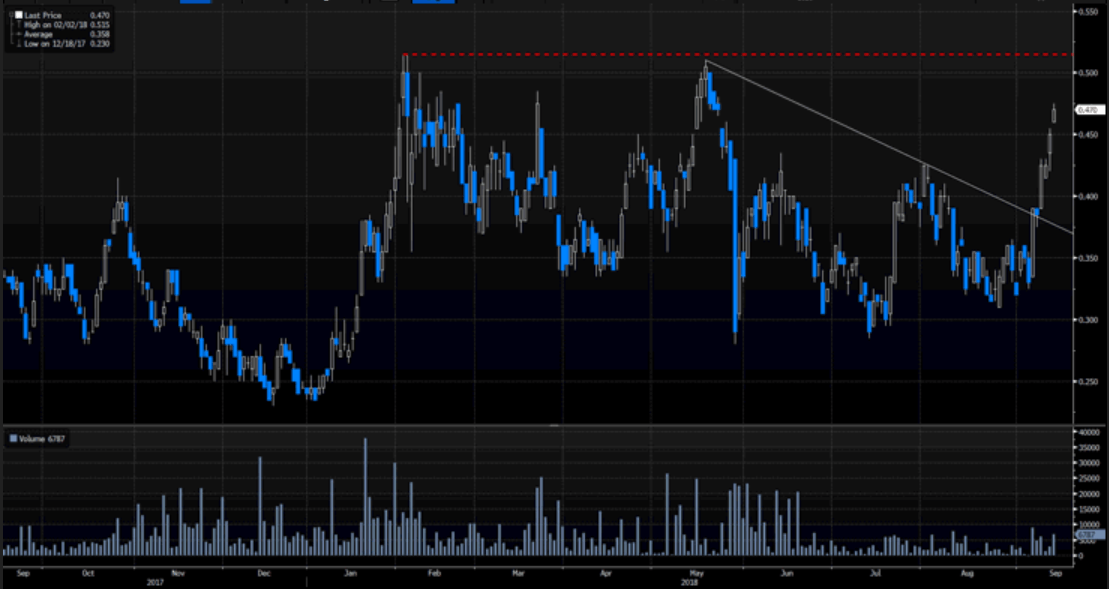
Fundamentally, it feels as though USD pullbacks will be limited given the moves building in the US rates and bond market. Last week’s key speech by Fed governor Lael Brainard seems to have finally resonated with traders, and we can see the Eurodollar December 2020 futures contract pushing up two basis points (bp) relative to the December 2018 contract and eight on the week (see the Bloomberg chart below). In effect, the rates traders are in the process of a hawkish repricing of interest rate expectations in the US, and in this two-year period rates markets are now pricing 47bp of hikes, with a potential test of 51bp (the 2018 highs) on the cards.
Source: Bloomberg)
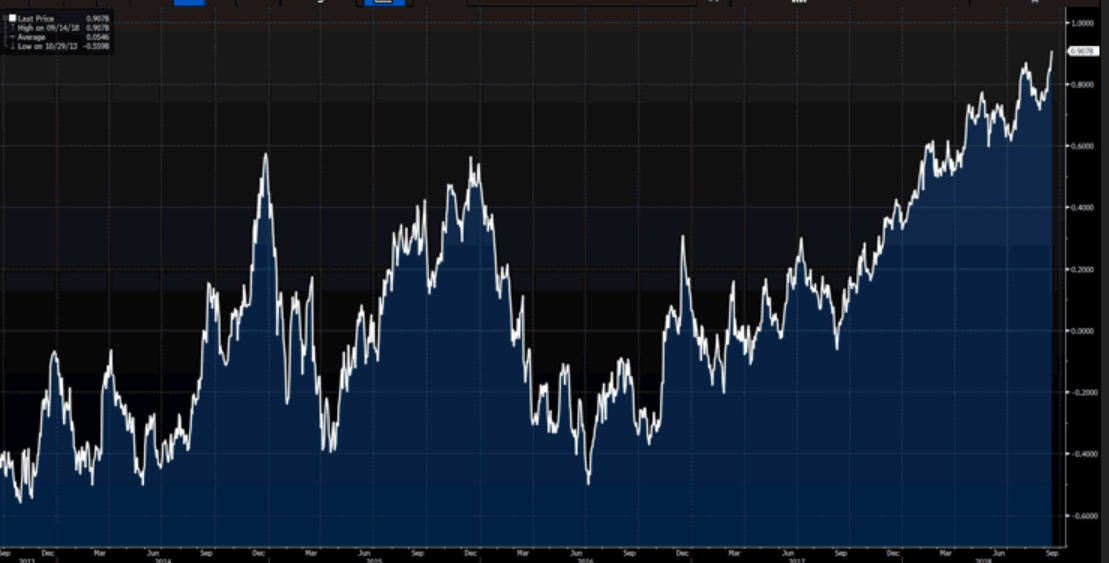
There has been a decent amount of attention on US nominal bond yields, where the 5-year Treasury has broken out to a new cycle high at 2.90%, while the 10-year Treasury is testing its cycle high of 3.01% (closing at 2.99%). If we adjust yields for inflation expectations, we see ‘real’ Treasury yields are also breaking out to new highs, and this is undoubtedly a USD positive as the attractiveness of a higher ‘real’ return increases. It is no surprise then that US financials outperformed as a sector in the S&P 500 on Friday, while REITs underperformed, as bond proxies around the world are going to find short sellers easy to come by here. Holding exposures to gold or emerging markets is tough in an environment of rising ‘real’ rates, although downside moves on Friday’s session were muted, reflecting a modest USD move.
(US 5-year ‘real’ Treasury)
(Source: Bloomberg)
The interesting dynamic here is US data on Friday was hardly encouraging for USD inflows, with the August retail sales control group gaining 0.1% versus expectations for 0.4%. Fine, July’s retail numbers were revised higher, but on the whole, this was a soft print, although US Q3 GDP is still tracking above 3%. We also saw a reasonable industrial production print at 0.4% in August, with capacity utilisation pushing up from 77.9% to 78.1% and consumer sentiment pushing to a six-month high of 100.8.
The muted open to G10 FX this morning is extended to the futures open, with WTI and S&P 500 finding small sellers. The focus is on confirmation of the US tariffs, with little in the way of data to drive in the coming 24 hours, with the exception of European inflation due at 19:00AEST (consensus is for a headline print of 2%). Moves in S&P 500 futures will have an impact on moves in the ASX 200 and Nikkei 225 on open, but as things stand the open looks to be constructive, notably in Japan where the Nikkei 225 gained 3.5% on the week and appeared to have broken out of the multi-month trading range of 23,00 to 22,000.
Author

Chris Weston
Pepperstone
Chris Weston recently joined Pepperstone as Head of Research.