The big banks do not see inflation reaching the target next year


Outlook: Today we get the usual weekly jobless claims, Oct industrial production, the NAHB housing market index, the Philadelphia and Kansas City Fed surveys, and late in the day, the TICS report on capital flows. Because housing is a big contributor to inflation, the NAHB index might be useful, but it’s a stretch to say the Fed is watching it. We also get no fewer than six Fed gov speeches. Some may try to make hay out of jobless claims, but don’t be fooled—weekly data is unreliable and the expected gain (about 220,000) is nothing special.
The soft landing idea has gotten a stranglehold on the markets. We might see sentiment slide toward recession, but nobody is talking about those bumps in the road—except the Feds.
We need to remember that whatever the underlying trends in the economy, the soft-landing narrative is possible only because energy prices are tame. If we had oil at $100 instead of $80, traders would not be betting on the first rate cut by May. And one nitwit has March (see below).
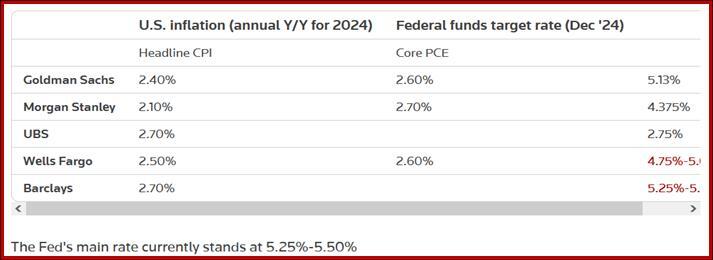
The big banks do not see inflation reaching the target next year, and yet forecast a drop in rates—except Goldman (small drop) and Barclay’s (no drop at all). See the dandy chart from Reuters. UBS expects headline inflation at 2.75% and Fed funds also at 2.75%. As noted before, this violates the Taylor Rule unless expected inflation is practically zero.
Sentiment can be frighteningly fickle. Take the British pound. It soared along with every other currency on the US CPI data, but then gave a big chunk of it back when the UK’s own inflation data came in better than expected. On the daily chart, it stuck its head above the cloud, but then withdrew it like a turtle.
This raises two questions. First, does the experience of the US and UK mean the euro and other currencies will suffer the same fate when they release lower inflation data? Is it now a race to the bottom? Gee, doesn’t that mean the dollar’s comeback when the bottom is reached?
The second question is the timeframe question. On the daily chart, we expect the pound to fall back, then surge, fall back and surge again, fall back and surge again until it reaches the 62% retracement line at 1.2721. How big are the fallbacks? Generally about one third of the surge, and to measure each surge, it’s helpful to go to the 240-minute chart. But that’s only if the breakout is the real deal in the first place.
We got kerfuffled last week on that issue. What if fresh events come along to dampen sentiment about the UK even further? It is, after all, on the brink of recession. You can get led into seeing a reversal based on an outsized fallback that is itself a false breakout. This is what drives some to trade only the hourly (!). Even worse, what if it just goes sideways? Technical tools are not very good at narrow-ranging markets.
Then there’s the yen, which fell back again and by more than the others on exactly the same news stories. Well, the yen is an exception because its central bank has a policy that is exceptional and that in turn is based on an exceptional economic history—deflation lasting decades and a stock market following suit.
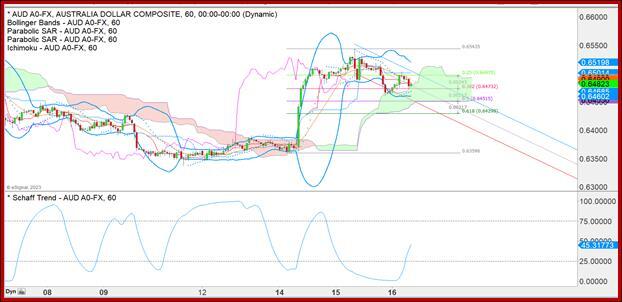
Finally, our canary in the coalmine, the AUD, jitterbugged around labor market data that maybe shows some cooling, but honestly, the chart rules. We believe it shows a corrective dip to as far as 0.6452, the 50% retracement, or 0.6429, the 62% retracement, before recovering.
Fun tidbit: On Twitter: “It takes an average 8 months from the last Fed hike to the first Fed cut. So March.” This is on the same wavelength as “We can’t explain how such-and-such happened. It had to have been aliens from outer space.”
Forecast: We are surprised that the corrective pullback after the giant breakout move has arrived so early, but we must believe it will likely persist before the breakout move direction is recovered. Because it’s so early—premature, even—it may be short-lived. We still need to watch for clues, including renewed upward momentum. While Fibonacci retracement lines are theoretical bunk, so many folks believe in them that they must be heeded (and are effective more often than chance would allow). This is not a dollar comeback. It’s temporary. In the end, there will be a dollar comeback, but it’s not visible on the horizon yet.
This is an excerpt from “The Rockefeller Morning Briefing,” which is far larger (about 10 pages). The Briefing has been published every day for over 25 years and represents experienced analysis and insight. The report offers deep background and is not intended to guide FX trading. Rockefeller produces other reports (in spot and futures) for trading purposes.
To get a two-week trial of the full reports plus traders advice for only $3.95. Click here!
This is an excerpt from “The Rockefeller Morning Briefing,” which is far larger (about 10 pages). The Briefing has been published every day for over 25 years and represents experienced analysis and insight. The report offers deep background and is not intended to guide FX trading. Rockefeller produces other reports (in spot and futures) for trading purposes.
To get a two-week trial of the full reports plus traders advice for only $3.95. Click here!
Author
Barbara Rockefeller
Rockefeller Treasury Services, Inc.
Experience Before founding Rockefeller Treasury, Barbara worked at Citibank and other banks as a risk manager, new product developer (Cititrend), FX trader, advisor and loan officer. Miss Rockefeller is engaged to perform FX-relat