The Bank of Canada Preview: Canada set to follow US pattern and hike rates even with inflation decelerating
- The Bank of Canada is widely expected to raise the target rate by 25 basis points to 1.75% on Wednesday, October 24.
- The Bank of Canada is expected to cheer trade deal as it removes key uncertainty and to highlight graduality as a common approach to future rate hikes.
- The upgraded growth outlook should enable the Bank of Canada to deliver further three rate hikes in 2019.

The Bank of Canada is widely expected to hike the overnight target rate by 25 basis point to 1.75% as it decides on monetary policy and releases its Monetary Policy Report on Wednesday, October 24 at 14:00 GMT. Supported by the strength of the Canadian economy, a successful USMCA deal and inflation stubbornly above 2% inflation target, the Bank of Canada Governor Stephen Poloz and Deputy Governor Carolyn Wilkins will have an easy job to justify the decision at the subsequent press conference.
“We are Canada's central bank and we work to preserve the value of money by keeping inflation low and stable,” states the mission of the Bank of Canada. Digging in its last monetary policy decision, the importance of the core inflation measure is highlighted by the Bank of Canada saying: “the Bank’s core measures of inflation remain firmly around 2%, consistent with an economy that has been operating near capacity for some time.”
The line-up for the Bank of Canada hiking rates is almost perfect. The economy is in Bank’s own view operating near full capacity, the employment is rising and the headline inflation is well above the target. Moreover, the US Federal Reserve has already hiked rates in September, so now it is the time for the Bank of Canada to follow.
Canada's headline inflation decelerated to 2.2% y/y in September compared with expectations of a 2.7% increase. The Bank of Canada core inflation measure decelerated to 1.5% y/y in September compared with expectations of a 1.8% y/y increase.
Moreover, Canada’s total retail sales fell -0.1% m/m in August while 0.3% monthly increase was expected by the market and core retail sales excluding car sales fell -0.4% over the month in August.
Should the Bank of Canada be consistent with its own mission of “preserving the value of money by keeping inflation low and stable,” the overnight target rate in Canada should go up, as the headline inflation is slightly above the inflation target.
The FX market has already priced in the Bank of Canada October rate hike and failure to deliver the rate hike is seen having a detrimental effect of Canada’s Dollar that is trading at around 1.3100 ever since last Friday’s inflation miss.
Moreover, the Bank of Canada is expected to slightly increase its growth forecast tomorrow, so the three additional rate hikes in 2019 are the central scenario for the market. With the rate hike of 25 basis points and upgraded macroeconomic forecast, the USD/CAD should stick to 1.2900-1.3150 range.
Inflation in Canada since September 2013
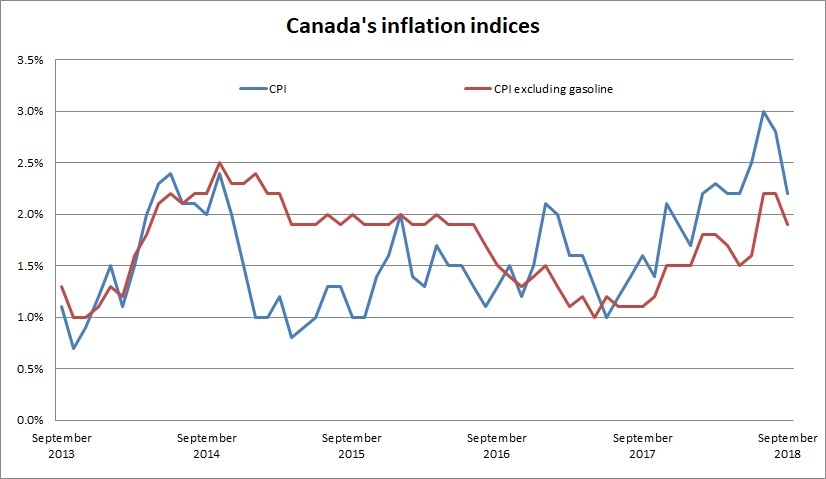
Source: Statistics Canada, Chart: FXStreet
Author

Mario Blascak, PhD
Independent Analyst
Dr. Mário Blaščák worked in professional finance and banking for 15 years before moving to journalism. While working for Austrian and German banks, he specialized in covering markets and macroeconomics.