|

NZD/USD technical analysis: Ascent pauses but confidence remains intact

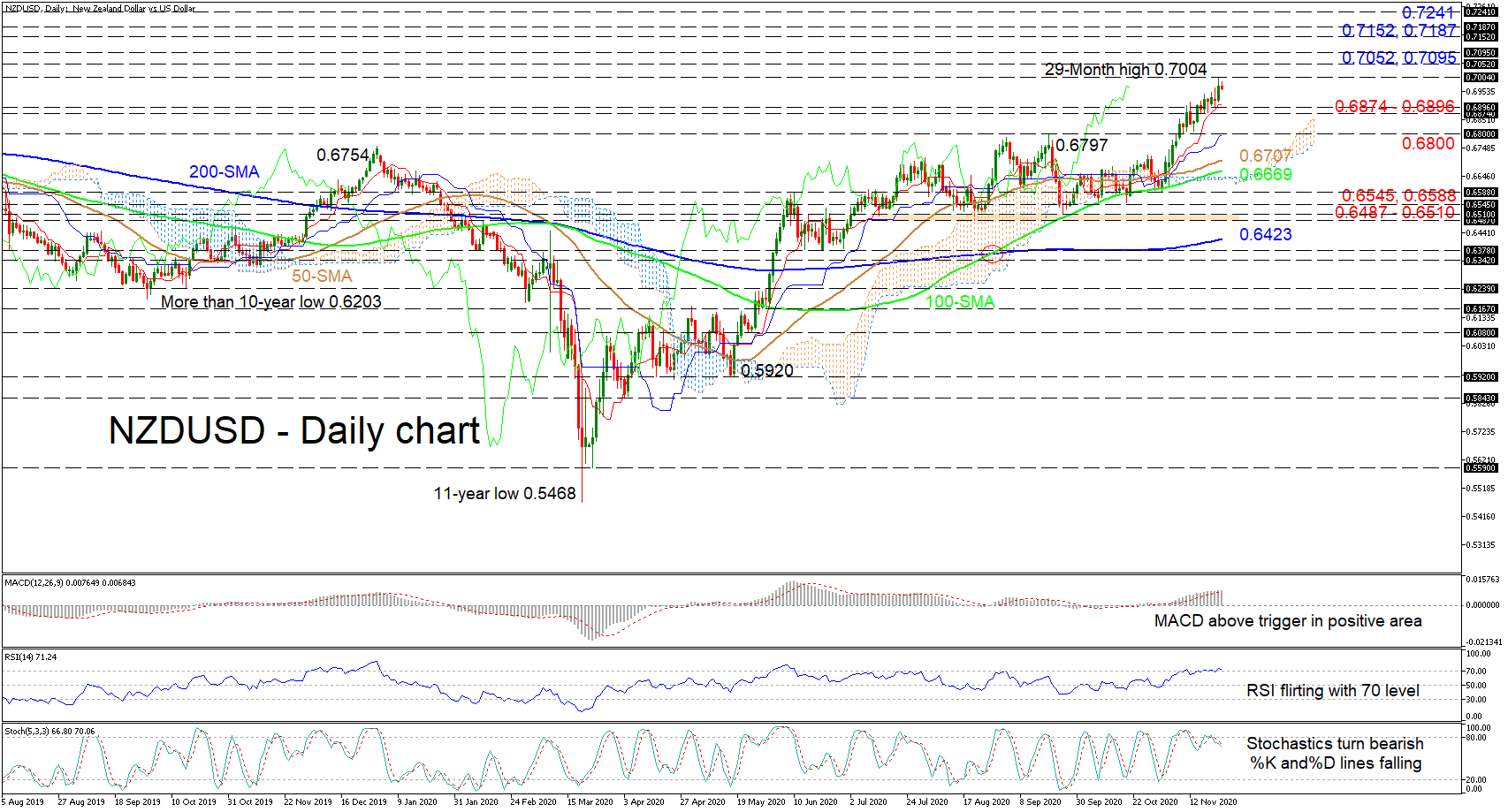
NZDUSD is sustaining its bullish demeanour despite sentiment slowing to a degree, after reaching a 29-month high of 0.7004. The Ichimoku lines are preserving the pair’s positive bearing, while the rising simple moving averages (SMAs) are defending the bullish structure.

The short-term oscillators reflect some waning in positive momentum. The MACD, some distance north of the zero line, is flattening above its rising red trigger line, while the RSI, merely above the 70 mark, is pointing southwards. Moreover, the stochastic oscillator has turned bearish, promoting a retracement in the price.

Continuing to climb, the pair may revisit the multi-month high of 0.7004 before early resistance develops from the 0.7052 peak, from June 2018, and the 0.7095 neighbouring barrier. Maintaining the hike, the pair may jump towards the inside swing lows of 0.7152 and 0.7187 respectively, from March 2018. Another leg higher may then hit the 0.7241 obstacle from April of 2018.

In a negative scenario, downside limitations may first come from the red Tenkan-sen line and the 0.6874-0.6896 support band. Dipping past this, the bears may encounter the key 0.6800 handle where the blue Kijun-sen line currently resides. A deeper pullback may then meet the 50- and 100-day SMAs at 0.6707 and 0.6669 respectively. Should the pair sink further below the Ichimoku cloud, the 0.6588 and 0.6545 troughs could step up to the plate, while the 0.6487-0.6510 support base below may get ready to defend negative tendencies.

Summarizing, the short-to-medium-term bullish picture remains robust above the SMAs, the 0.6874-0.6896 boundary and the tilting key 0.6800 level.
NZDUSD

Author

Anthony Charalambous, CFTe

Anthony Charalambous joined XM in 2019 and specializes in preparing daily technical analysis, using his years of trading experience to provide detailed forecasting for all major asset classes such as forex, indices, commodities and equities.


More from Anthony Charalambous, CFTe
Share:

Editor's Picks

EUR/USD weakens to near 1.1900 as traders eye US data

EUR/USD eases to near 1.1900 in Tuesday's European trading hours, snapping the two-day winning streak. Markets turn cautious, lifting the haven demand for the US Dollar ahead of the release of key US economic data, including Retail Sales and ADP Employment Change 4-week average.

GBP/USD stays in the red below 1.3700 on renewed USD demand

GBP/USD trades on a weaker note below 1.3700 in the European session on Tuesday. The pair faces challenges due to renewed US Dollar demand, UK political risks and rising expectations of a March Bank of England rate cut. The immediate focus is now on the US Retail Sales data. 

Gold sticks to modest losses above $5,000 ahead of US data

Gold sticks to modest intraday losses through the first half of the European session, though it holds comfortably above the $5,000 psychological mark and the daily swing low. The outcome of Japan's snap election on Sunday removes political uncertainty, which along with signs of easing tensions in the Middle East, remains supportive of the upbeat market mood. This turns out to be a key factor exerting downward pressure on the safe-haven precious metal.

Bitcoin Cash trades lower, risks dead-cat bounce amid bearish signals

Bitcoin Cash trades in the red below $522 at the time of writing on Tuesday, after multiple rejections at key resistance. BCH’s derivatives and on-chain indicators point to growing bearish sentiment and raise the risk of a dead-cat bounce toward lower support levels.

Follow the money, what USD/JPY in Tokyo is really telling you

Over the past two Tokyo sessions, this has not been a rate story. Not even close. Interest rate differentials have been spectators, not drivers. What has moved USD/JPY in local hours has been flow and flow alone.

Bitcoin Cash trades lower, risks dead-cat bounce amid bearish signals

Bitcoin Cash (BCH) trades in the red below $522 at the time of writing on Tuesday, after multiple rejections at key resistance. BCH’s derivatives and on-chain indicators point to growing bearish sentiment and raise the risk of a dead-cat bounce toward lower support levels.