Taiwan’s 2025 trade surplus nearly doubles amid AI-driven demand

Heavy demand from the AI race proved a boon for Taiwan's trade in 2025, with its trade surplus nearly doubling to $157bn. Tech exports have given a major boost to economic growth in 2025, overshadowing softness in other parts of the economy.
Exports see a slight miss in December but close out the year strong nonetheless
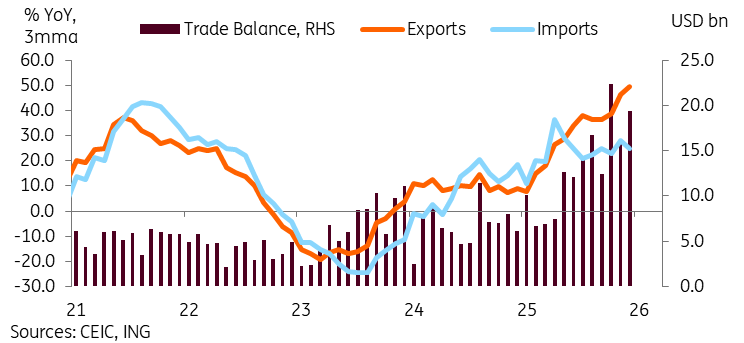
Taiwan's December exports grew by 43.4% year-on-year, down from November's 56.0% YoY growth. While December's growth rate came in slightly lower than market forecasts, it remained a very impressive reading nonetheless. Overall, exports grew by 34.9% YoY in 2025, for a total of USD640.7bn.
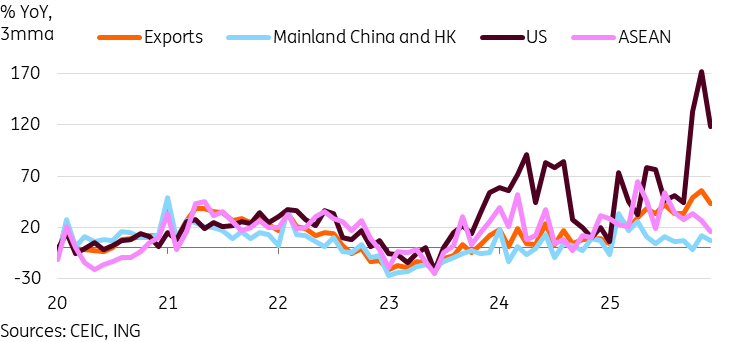
By export destination, exports to the US represented 30.9% of Taiwan's total exports in 2025, and became the market with one of the fastest levels of growth at 78% YoY. Other markets which saw explosive export growth in 2025 included Malaysia, up 89.6% YoY, and Mexico, up 178.0% YoY. In contrast, exports to Mainland China and Hong Kong grew a relatively modest 13.2% YoY, while exports to Japan grew 16.2% YoY in 2025.
By product, Information, Communication and Audio-video Products saw the strongest growth of 89.5% YoY. Semiconductor exports grew by 27.2% YoY in 2025, which ended up beating 2021 for the fastest pace of growth over the past decade. These categories helped buoy the overall export growth of the machinery and electrical equipment category (which represents over 80% of Taiwan's total exports) to 48.3% YoY.
The other categories generally saw comparatively weak export growth, with many, such as plastics, chemicals, minerals, and agricultural products, experiencing declines in exports in 2025.
Exports to the US were the dominant factor behind Taiwan's explosive export growth
Imports also saw strong growth in 2025, but primarily all in tech-related categories
Taiwan's December imports grew by 14.9% YoY, down sharply from November's 45.0% YoY growth, and falling well short of market forecasts. Overall, imports grew by 22.6% YoY over 2025, totalling $483.6bn.
Taiwan's imports were heavily concentrated in the tech-related supply chains. Machinery and electrical equipment imports rose 49.0% YoY in 2025, and the proportion of total imports surged from 48.0% in 2024 to 58.3% in 2025. This broader category, including electronic parts (37.8%), machinery (39.2%), electrical machinery (28.8%), and Information, Communication and Audio-Video Products (105.1%), generally saw very strong import growth over the year.
Similar to the export story, growth in other categories was generally rather lacklustre by comparison. Other outperformers included Optical & Precision Instruments (35.9%) as well as gold (57.0%) imports, but many other categories also saw low single-digit or negative import growth on the year.
Trade surplus hits all time high in 2025
The sum of the above resulted in Taiwan's trade surplus surging to $157bn in 2025, which in turn has been the biggest boost to economic growth in 2025.
With continuing strong guidance and earnings results from TSMC, and markets generally shaking off the AI bubble concerns from late 2025, it appears that strong demand is set to continue into the start of 2026. Whether or not this persists throughout the year will play a major role in Taiwan's growth trajectory in 2026, as the economy looks increasingly unbalanced and reliant on this narrative.
Our baseline case sees strong growth continuing for most of the year, but some moderation is likely to be in play given the less supportive base effect from a historic 2025.
The tech race has sent Taiwan's trade surplus to a new record high in 2025
Read the original analysis: Taiwan’s 2025 trade surplus nearly doubles amid AI-driven demand
Author

ING Global Economics Team
ING Economic and Financial Analysis
From Trump to trade, FX to Brexit, ING’s global economists have it covered. Go to ING.com/THINK to stay a step ahead.