Sweden’s Riksbank cuts rates for a third time as economic concerns build


The latest Riksbank decision is unambiguously dovish and tells us that policymakers are increasingly concerned about economic growth. There’s no reason to doubt the central bank’s forecast for at least two more rate cuts this year. The currency is, however, being driven more by external inputs right now.
The Riksbank has doubled down on the need for rate cuts
The latest decision from Sweden’s Riksbank should leave nobody in any doubt that it is currently the most dovish central bank within the developed markets. The Riksbank has cut rates by 25 basis points for the third time this year, but more importantly, is telling us that the job is nowhere near finished.
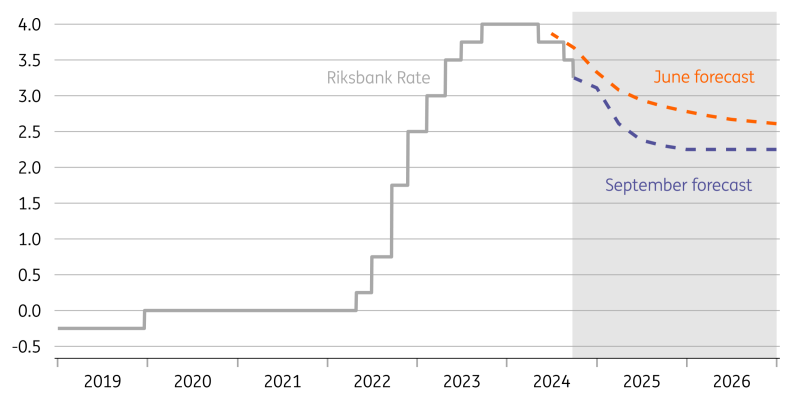
The policy rate now stands at 3.25% and the Riksbank has indicated it could take rates down by a further percentage point over the next year, and it looks like we could easily get there before spring 2025. Remarkably, policymakers have said today that rates could be cut in 50 basis point increments later this year if needed.
The context here is that Sweden’s economy has been battered by previous rate hikes more than most, owing to its greater share of variable-rate debt. Growth is weak and inflation is more benign than elsewhere.
The flipside of Sweden’s particular sensitivity to interest rates, however, is that these rate cuts should work through more quickly too. And there are hints of a cyclical recovery in some parts of the economy, notably housing.
The Riksbank predicts a more pronounced recovery in 2025, but what’s striking is that it thinks policy needs to lean in a “more expansionary direction” to ensure that happens. “Expansionary” is not a word you hear uttered by many central banks these days. We agree that further economic recovery in Sweden is highly contingent on swiftly delivering rate cuts.
The bottom line is that the Riksbank will likely cut by at least 50 basis points across the final two meetings of the year. But remember that because Sweden has got a head start on the easing cycle, it is likely to reach its terminal rate of 2-2.5% much earlier than most.
The Riksbank has lowered its path of expected interest rates
Source: Riksbank, Macrobond
FX: SEK displaying its resilience
Despite the more dovish tone by the Riksbank, SEK did not drop after the announcement. It appears that the FX market isn’t as focused on domestic rates as it is the growth story at this stage. In a way, the Riksbank’s early cuts and openness to 50bp could imply the Swedish economy is on track to perform better in the medium run than the eurozone. Crucially, however, high-beta currencies like SEK are primarily responding to external inputs, and the 50bp Fed cut earlier this month has made the environment more accommodative for the krona.
EUR/SEK 1-month historical volatility is at the lowest since June, and while the US election can definitely trigger wider moves, October may prove to be another quiet month for the pair. We think 11.30 should continue to be the anchor amid noise fluctuations in EUR/SEK before the US vote.
Read the original analysis: Sweden’s Riksbank cuts rates for a third time as economic concerns build
Author
ING Global Economics Team
ING Economic and Financial Analysis
From Trump to trade, FX to Brexit, ING’s global economists have it covered. Go to ING.com/THINK to stay a step ahead.

















