|

Sweden: Higher global price pressure and 'chipflation' now visible in Swedish inflation

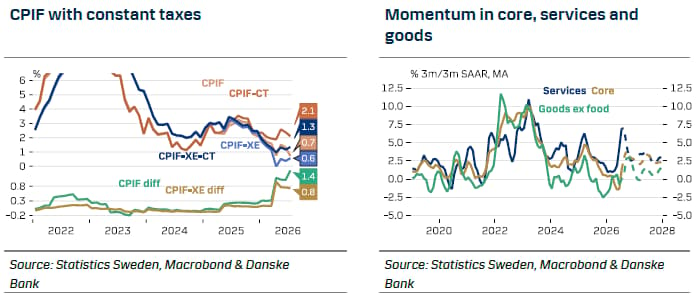
July final inflation confirmed the flash estimate with revisions only to the second decimal. CPIF-XE came in at 0.60% (flash 0.60%), CPIF 0.73% (flash 0.75%) and CPI 0.18% (flash 0.21%). From July, an additional tax cut on fuel was introduced and CPIF is now 1.4 percentage points lower than it otherwise would have been because of this. Hence, CPIF would have been 2.1% instead of 0.7% had it not been for the tax cuts. CPIF-XE would have been 1.3%. It is worth noting that monthly public transport ticket prices were cut in half from July, with an estimated effect on inflation of around 0.1 percentage points, which is not considered a tax effect by Statistics Sweden and therefore not controlled for in CPIF-XE-CT and CPIF-CT. The July details confirmed that the upside surprise in goods prices was broad based and likely reflecting the high global prices seen during the spring. Prices on IT equipment surged month-over-month as result of rising input prices on for example memory chips.
Chart

Download The Full Sweden: Inflation forecast

Author

Danske Research Team

Danske Research Team

Danske Bank A/S

Research is part of Danske Bank Markets and operate as Danske Bank's research department. The department monitors financial markets and economic trends of relevance to Danske Bank Markets and its clients.


More from Danske Research Team
Share:

Editor's Picks

GBP/USD hits fresh three-month highs above 1.3550

GBP/USD stretches north and refreshes three-month highs above 1.3500 in the European session on Monday. The prevalent US Dollar selling bias favors bullish traders and suggests that the path of least resistance for the pair remains to the upside.

EUR/USD extends gains above 1.1600 on USD weakness

EUR/USD extends its advance above 1.1600 in European trading hours on Monday. The US Dollar resumes its downside amid weaker-than-expected US economic data, shifting Fed expectations and fading geopolitical risk premium.

Gold looks to build strength above $4,400 amid fading Fed hike bets

Gold builds on Friday's bounce from the $4,300 neighborhood and attracts some follow-through buyers at the start of a new week. The commodity is now looking to extend momentum above the $4,400 mark, though it remains below the highest level since June 5, touched last Thursday, amid mixed fundamental cues.

Pepe defends a key support amid mixed retail demand

Pepe is up nearly 2% after a 10% decline last week, showing signs of a mild recovery, while broader crypto market risk appetite remains weak. PEPE derivatives data point to a mixed outlook, as Open Interest declines while funding rates turn positive. Technically, PEPE must hold above its $0.00000255 support floor to avoid a downside of over 10%.

Why the Fed replaced the Treasury buyers who left

When Japan moved to defend the Yen, the arrangement that drew the attention was the Federal Reserve's repo facility for foreign monetary authorities, which lets an approved foreign central bank raise dollars by temporarily handing Treasuries to the Fed rather than selling them into the market. The logic was elegant. Japan gets dollars, the Treasury market avoids a forced seller, and American long rates are spared. Coverage treated it as the mechanism that made the intervention work.

Why is Crude Oil priced for a reopening the ships haven't made?
Fourteen vessels crossed the Strait of Hormuz on Tuesday. Before the war, the count ran near 120 a day. In the sessions since the waterway was publicly declared open, Brent has drifted back to $87 and West Texas Intermediate (WTI) to $81, both a little lower again on Wednesday, with daily momentum on each unwound from the top of its range in late July to the low twenties now.