Surging inflation and tariff shocks drive Gold toward breakout zone


Investors are turning to gold (XAUUSD) as a safe-haven asset amid surging inflation and escalating trade tensions. President Trump’s aggressive tariff policies, including a 200% tax on pharmaceutical imports, have triggered global market fears. Meanwhile, hotter-than-expected US inflation data has added pressure, challenging the Fed’s stance on interest rates. Despite elevated Treasury yields, gold remains supported by a pause in the US Dollar rally and growing investor caution. Technically, a bullish inverse head-and-shoulders pattern suggests a potential breakout toward $3,450 if gold clears key resistance at $3,367.
Trump’s aggressive tariffs and sticky inflation boost Gold’s safe-haven appeal
Investors are once again seeking refuge in gold as a safe-haven asset. President Trump’s escalating trade measures have intensified fears of global economic disruption. His latest announcements include a steep 200% tariff on pharmaceutical imports and penalties on more than 20 countries. These measures have heightened market anxiety. These aggressive policies are seen as inflationary and have shaken investor confidence.
Compounding the uncertainty, US inflation data released this week came in hotter than expected. Headline CPI rose by 0.3% in June, the most significant increase in five months. The year-over-year rate climbed to 2.7% from 2.4% in May, while core inflation also ticked higher to 2.9%. These figures suggest that inflation pressures remain persistent, challenging the Federal Reserve’s goal of price stability.
Fed officials are reacting cautiously to the inflationary outlook. Boston Fed President Susan Collins highlighted the difficulty of policymaking in this uncertain environment. She warned that tariffs may push inflation to 3% by the end of 2025. Dallas Fed President Lorie Logan supported holding interest rates higher for longer, arguing that an early rate cut could backfire. Treasury yields remain elevated, typically dampening gold’s appeal. However, the US Dollar has paused after its recent surge, giving gold some room to recover as demand for safe assets increases.
Gold forms bullish inverse head-and-shoulders pattern
The gold chart below shows a strong bullish setup. A clear inverse head-and-shoulders pattern is visible. This classic formation suggests a potential trend reversal to the upside. Three distinct troughs, with the middle one being the deepest, form the head. The neckline resistance lies around the $3,367 level.
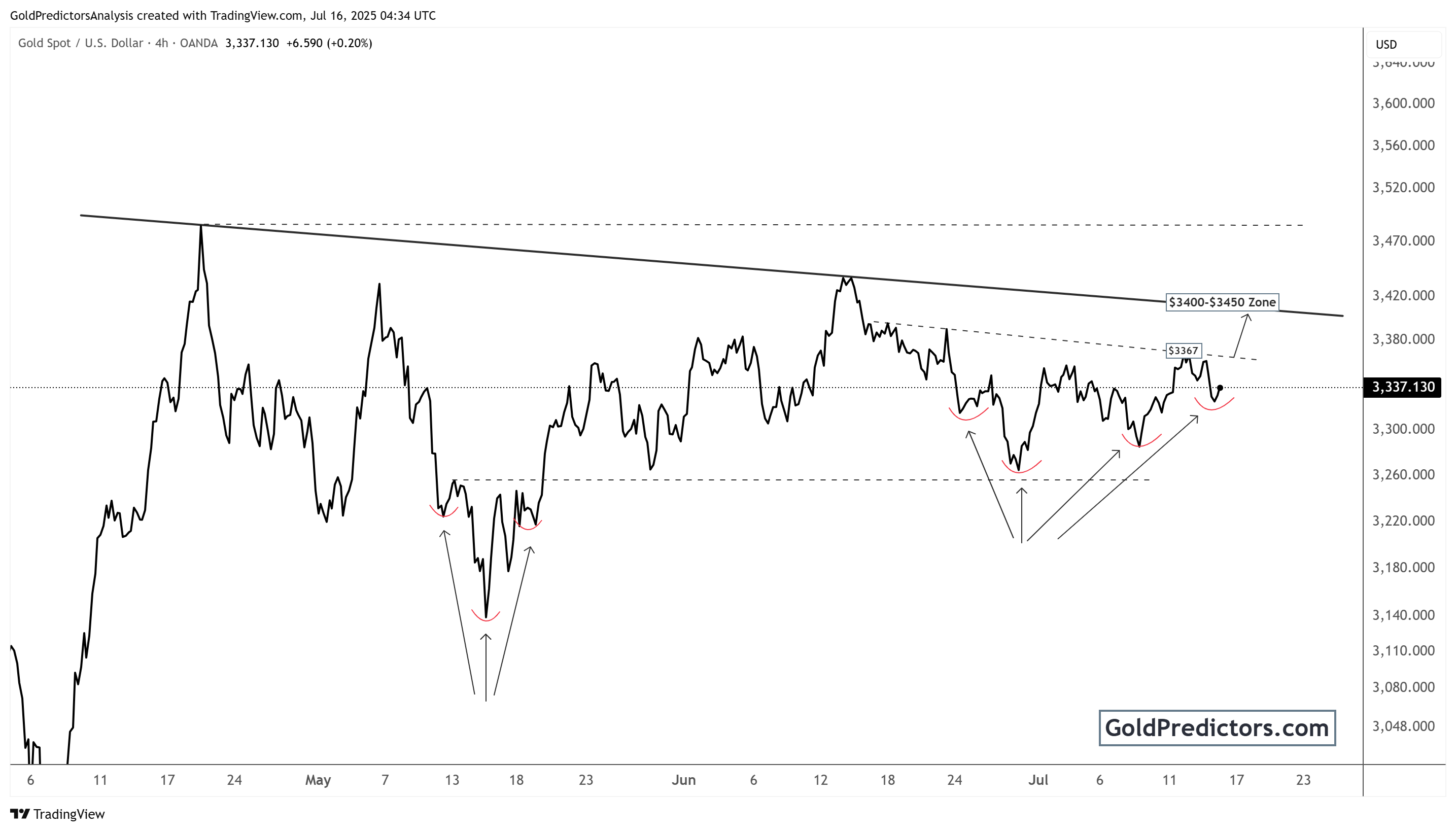
Gold is currently consolidating just below this neckline at $3,337. A breakout above $3,367 could confirm the pattern and trigger fresh buying interest. The next target lies between $3,400 and $3,450. This area also aligns with the upper boundary of the broader descending resistance trendline drawn from May highs.
Additionally, minor upward trendlines support the recent higher lows, adding to the bullish case. The pattern remains valid as long as gold holds above the $3,260 support zone. Traders should watch for volume confirmation on any breakout. A move above $3,367 with strong momentum would increase the probability of reaching the $3,450 target zone.
Conclusion
Gold is gaining ground as geopolitical risks and hawkish Fed policy keep markets on edge. While the US Dollar remains firm, technical patterns point to a possible breakout. With investors cautious and safe-haven demand rising, gold may soon test higher resistance levels near $3,400–$3,450. However, uncertainty around inflation and interest rates could keep price action choppy in the near term.
Unlock exclusive gold and silver trading signals and updates that most investors don’t see. Join our free newsletter now!
Unlock exclusive gold and silver trading signals and updates that most investors don’t see. Join our free newsletter now!
Author
Muhammad Umair, PhD
Gold Predictors
Muhammad Umair is a financial markets analyst and investor who focuses on the forex and precious metals markets.

















