Stocks and Bitcoins: Where do we go from here?
_XtraSmall.jpg)
Economists are way better at explaining the past than they are at predicting the future, particularly with regard to how prices behave. Looking backwards, the justification for prices having risen or fallen is easy: Excess quantities demanded pushed prices higher; excess quantities supplied pushed prices lower. The problem with predictions, however, is that of timing. Prices are influenced by myriad factors — often with opposing consequences — and it’s difficult to assess which factors will be overriding and when. On a pragmatic level, following any price perturbation, analysts can never be sure if the price change they’ve witnessed reflects the start of a new trend or if it’s noise, whereby the price change will shortly be reversed.
Actors in financial markets are confronted with this concern all the time; and, quite obviously, different people react differently to the same set of facts. In the face of a market downturn, some people view the drop in prices as a buying opportunity; some view that same price drop as being the precursor of more to come, and they sell. Depending on the individual circumstances of the players, the proper course of action might differ for different players. Different people have different risk tolerances, and those risk tolerances have a critical bearing on the way decisions get made.
I’ve been thinking about this dichotomy largely with two markets in mind: The US equity market and the Bitcoin market. Both of these markets are down from previous highs. As of this writing, the S&P500 index has fallen by almost 16% from its peak in December of last year. The drop in the price of Bitcoin has been sharper. Bitcoin prices peaked in November 2021, with a price of $64,400. Today, it’s down by almost 50%. The key question in both of these markets is, “where do we go from here?”
I should preface the further discussion with the caveat that in terms of the immediate future, I don’t know where these respective prices are going — and neither does anyone else. Prices in these markets typically vacillate within the course of a day. Quite literally, nothing would surprise me in terms of what might happen over the next couple of days or even weeks. That acknowledgement, however, doesn’t constrain me from taking a longer-term view.
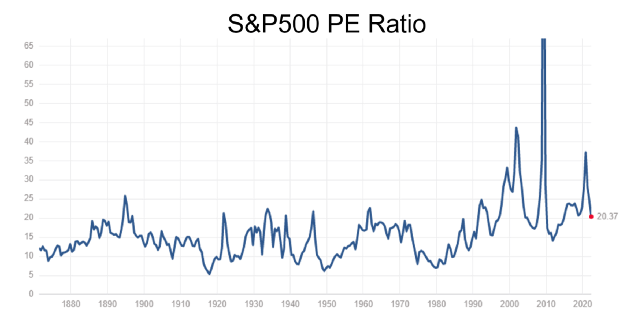
First, with respect to a diversified stock portfolio (as opposed to individual stocks) … Without getting too much into the weeds, the best indicator of whether stock prices are unsustainably high or low may be the price-to-earnings ratio (PE ratio). Buyers of stock should recognize that they’re investing in productive assets that generate earnings. Ideally, one should prefer buying a given stream of earnings at a lower price relative to a higher price. These days, the PE ratio for the S&P500 index is about 20. Whether that PE reflect stocks being cheap or expensive is a matter of perspective As reflected in the following chart, the current level is high compared to what it had been prior to, say, the 1990’s, suggesting stocks may be somewhat expensive; but over the more recent history, the PE ratio might be categorized as being comparatively low, suggesting that stocks may actually be cheap.
(Source: https://www.multpl.com/s-p-500-pe-ratio)
Given the earlier history, it’s not out of the question that stock market values could fall by even as much as another 50 percent, but I expect few analysts to be anywhere near this pessimistic. It seems much more likely that while some further price declines could very well occur, we’re probably not all that far away from reaching a bottom. At the same time, the case for unbridled optimism seems tenuous, at best.
Meanwhile, what can be said about Bitcoin? From my perspective, nothing good. In contrast to the stock market, buyers of Bitcoin aren’t getting anything productive. The only appreciation they’ll realize comes from some other sucker buying into this quasi-Ponzi scheme at some higher price. Marketers have been at least somewhat successful at selling these hopes and dreams to people who had been attracted to this market by the storied histories of the newly made Bitcoin billionaires. This pitch is undoubtably much harder to make in the face of the disastrous price history of recent months. Moreover, given the concurrent broad declines in the stock market, as well, the volume of aggregate discretionary cash available for speculation in Bitcoin (or anything else, for that matter) may not be what it had been in the recent past. Things could easily change if and when another sustained price uptrend develops, which could happen; but there’s little reason to expect such a reversal in sentiment to occur for Bitcoin before a good portion of this recent price decline gets reversed or is otherwise forgotten.
Back to the question of where we go from here … It’s understandable that stock market investors would be wary about the prospect of further declines; but given (a) indicators of stock market value, (b) the dearth of attractive alternative investments available, and (c) the plethora of academic evidence challenging the efficacy of active market timing strategies, staying in stocks doesn’t seem unreasonable, especially for those with an extended investment horizon. The longer that horizon, the greater the likelihood that these recent declines will be reversed. On the other hand, if I were sitting on a pile of Bitcoin, I’d be very, very scared. The risk/reward prospects for Bitcoin seem to me to be exceedingly unfavorable, and I don’t see this assessment changing anytime soon. If you happen to be committed to this speculation, you could get lucky; but my guess is that it’s more likely that you’ll end up looking like a dupe.
Author
Ira Kawaller
Derivatives Litigation Services, LLC
Ira Kawaller is the principal and founder of Derivatives Litigation Services.