|

S&P500: Neptune Vibrations

Chaos Clinic for 5/1/2020
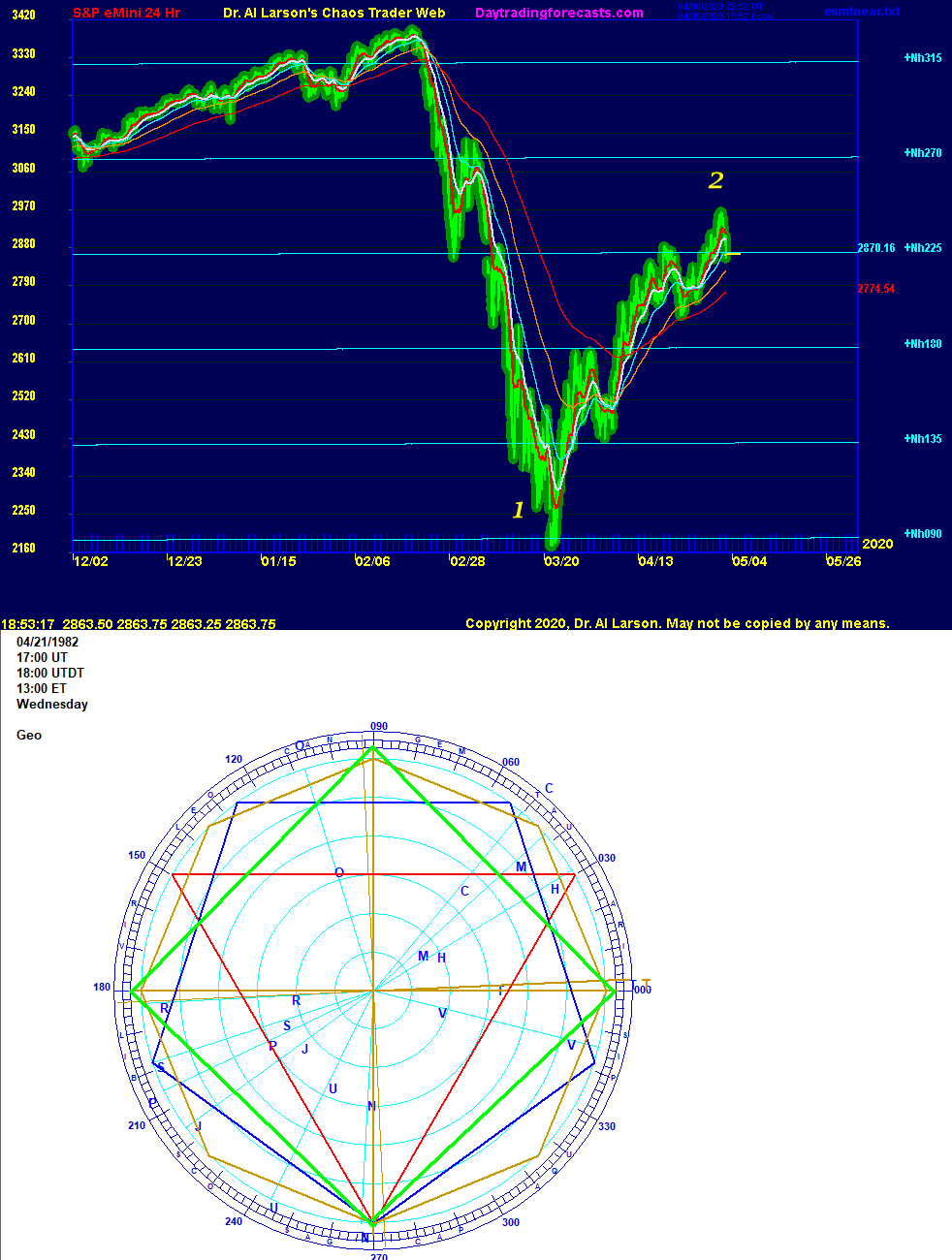


The top chart shows a plasma chart of the S&P, overlayed with heliocentric Neptune flux lines.

The flux lines are plotted every 45 degrees using a Wheel of 1800 scale. This scale is 5 times the Wheel of 360 scale that existed before COVID-19.

Markets have a "fractal fuzziness." Underlying that is a harmonic structure based on integer ratios. This shows up in this chart in the retracement ratios. The move 2 retracement was .642, a bit beyond the Fibonacci .618.

But in terms of the Neptune levels, the decline was down 5, up 3, the ratio of two integers, 3 and 5. The Fibonacci series is a seriesof intergers, starting with 1,2,3,5, and 8. So a a 3:5 ration fits. Energy adds together in integer ratios.

So why would Neptune electric field flux show up so strongly in the S&P? The answer is in the second chart, which is a natal ephemeris wheel for the S&P.

Neptune is very near the cardinal 270 degree position. Using this as a common point, there are harmonic relationships with several other natal planets.

Natal Sun is trine natal Neptune (red). Mars and Moon are square to it (green). Venus, Chiron, and Saturn are pentile to Neptune (blue). And Mercury is octile to Neptune. This octile creates frequency doubling with the square. Frequency doubling is a precursor to Chaos.

On the top chart, the Nh+315 level is 180 degrees to natal Mercury. The low of Nh+090 is natal Moon. The current Nh+225 is Mh+090. The intermediate level of bNh+135 is Mh+000, while the Nh+180 is both Tn+090 and Rn+270. So with the help of the plasma chart, which helps show the "fractal fuzz" and the ephemeris, the harmonic structure underlying the chaos is revealed.

The top chart looes like moves 1 and 2 of 7 in a down Chaos Clamshell.

This content was published on Dr. Al Larson's Chaos Clinic which you can attend each Friday for free.

Dr. Al Larson has developed a complete Chaos Model of Markets, four unique courses that let you become a Certified Chaos Trader, some very unique eMylar fractal pattern overlays, and tools that permit forecasting individual stocks and markets years in advance. You can also sign up for a free weekly email, and attend a free Chaos Clinic on Fridays. To learn more, click on the author's profile.

Be sure to sign up for the free weekly email! 

Author

Dr. Al Larson, PhD

Dr. Al Larson, PhD

MoneyTide.com

Dr. Al Larson holds a Ph.D. in Electrical and Computer Engineering from the University of Wisconsin. He is a 1964 Distinguished Graduate of the U. S. Air Force Academy.


More from Dr. Al Larson, PhD
Share:

Markets move fast. We move first.

Orange Juice Newsletter brings you expert driven insights - not headlines. Every day on your inbox.

By subscribing you agree to our Terms and conditions.

Editor's Picks

EUR/USD edges higher to mid-1.1600s; looks to US PCE Price Index for fresh impetus

The EUR/USD pair attracts some dip-buyers during the Asian session on Friday and recovers a part of the previous day's retracement slide from the 1.1680 region, or the highest level since October 17. Spot prices currently trade around mid-1.1600s and remain on track to register gains for the second straight week.

GBP/USD: Constructive view prevails above 1.3300 ahead of US PCE inflation data

The GBP/USD pair trades on a flat note near 1.3330 during the Asian trading hours on Friday. Traders prefer to wait on the sidelines ahead of the key US inflation report later on Friday. The US delayed Personal Consumption Expenditures Price Index report for September could offer some hints about the US interest rate path.

Gold flat lines above $4,200 mark; looks to US PCE Price Index for some meaningful impetus

Gold struggles to capitalize on the overnight bounce from the $4,175 area, or the vicinity of the weekly trough, and oscillates in a narrow trading range during the Asian session on Friday. Traders now seem reluctant and opt to move to the sidelines ahead of the September Personal Consumption Expenditures Price Index, or the Federal Reserve's preferred inflation gauge. 

Pi Network: Bearish streak nears critical support trendline

Pi Network edges lower on Friday for the third consecutive day, approaching a local support trendline. The on-chain data suggests an increase in supply pressure as Centralized Exchanges experience a surge in inflows. Technically, the pullback in PI risks further losses, as the Moving Average Convergence Divergence indicator is flashing a sell signal. 

Why the Fed may cut rates in December: Understanding the policy shift

The Fed has gone through a noticeable policy swing in recent months - from initiating a rate cut, to signaling a potential pause, and now shifting once again toward another cut in December. This has created understandable confusion among traders and investors trying to interpret the Fed’s reaction function.

XRP edges lower despite record on-chain activity and steady ETF inflows

Ripple is trading under pressure at the time of writing on Thursday, after bulls failed to break the short-term resistance at $2.22. The reversal may extend toward Monday’s low of $1.98, especially if risk-off sentiment persists in the broader cryptocurrency market.












