S&P to review Romania’s rating

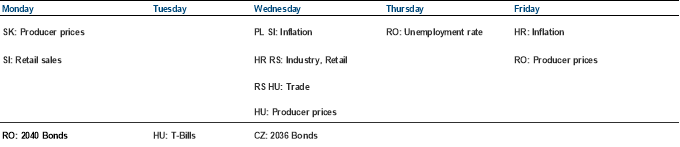
This week, the focus will be on inflation globally and within the region. September flash inflation will be released in the Eurozone and in the US on Friday. Several CEE countries will also show their inflation development, namely Poland and Slovenia (due Wednesday), alongside Croatia and Slovakia (due Friday). The ongoing conflict in the Middle East, with no resolution in sight, is keeping commodity prices elevated. As a consequence, growing fuel prices are pushing headline inflation up. The most interesting country within the region to watch will be Poland, as the likelihood of CPI hitting 4% in September is high and such an outcome would fuel speculation on monetary tightening there, with the central bank meeting scheduled for the following week. As far as price development is concerned, producer prices are due this week in Slovakia, Hungary and Romania. Other than that, retail sales growth for August will be published in Slovenia, Croatia and Serbia, and we expect growth to moderate slightly. Industry in Croatia and Serbia is expected to post solid growth. Trade data will be published in Serbia and Hungary. Last, but definitely not least, we have the S&P review of Romania’s rating and outlook on Friday, after the market closes. Our baseline is no change of the rating, but the downgrade risk is material. We believe that S&P will likely wait and see how the 2027 budget bill looks and how the political situation unfolds before acting. An unscheduled review if things go south is always on the table. Regarding the political situation, a vote for Muresan is scheduled for September 29. The baseline remains that he will nota gather enough votes. PSD has been clear in their communication that they do not support this nomination. President Nicusor Dan keeps reiterating that snap elections is a scenario he would rather avoid.
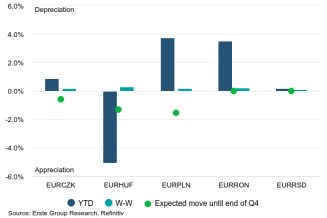
FX market developments
CEE currencies have been weakening against the euro throughout the week, but recovered slightly on Friday. CEE currencies have been facing increasing pressure from rising risk aversion connected to developments in the US-Iran conflict in the Middle East. Constantly changing expectations regarding the monetary policy outlook on major markets also play a role (we now expect a rate hike in December in both the Eurozone and US). In the region, ongoing tensions related to the war in Ukraine add to the pressure, as a Russian military helicopter violated Polish airspace on Wednesday, September 23. As result, Poland's zloty hit its lowest level since the start of 2024 (EURPLN at 4.37) and the Czech crown touched a five-month low (EURCZK at 24.4) in the middle of the week. The EURHUF also moved up toward 365, although the Hungarian forint remains supported by local developments in monetary policy (change of the inflation target and an easing cycle pause). Finally, the Hungarian central bank left the ley policy rate unchanged in September at 5.5%. The central bank also announced that it will lower its inflation target from 3% to 2.5% from January 2028, retaining the 1 percentage point tolerance band around the target. Based on the relatively hawkish messages, the prospects of rate cuts seem off the table for the coming months; we thus adjusted the interest rate outlook accordingly and expect stability of rates until 2Q27.
Bond market developments
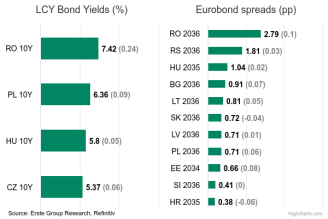
The bond market has been strongly influenced by expectations regarding monetary policy as investors price in several rate hikes both in the US and in the Eurozone, reflecting ongoing tensions in the Middle East. The 10Y US Treasuries moved toward 5.1%, while German yields touched 3.6% (a roughly 15-basis point increase throughout the week). Long-term yields in the region also increased in most of the countries, though domestic reasons also had an impact on the long end of the curve. In Hungary, adjustments in the inflation target helped to keep the yield increases contained. In Romania, on the other hand, pressure ahead of the rating review has been rising and the 10Y yield reached this year's high at 7.6%. The upcoming S&P decision will be an important factor shaping further development on the bond market. Regarding bond auctions, Poland successfully placed a series of bonds and Slovakia held the syndication of EUR 2.5bn of 10Y bonds (priced 77 basis points vs. MS). Slovakia has the financing plan fulfilled already. This week, Romania and Hungary have auctions scheduled.
Author

Erste Bank Research Team
Erste Bank
At Erste Group we greatly value transparency. Our Investor Relations team strives to provide comprehensive information with frequent updates to ensure that the details on these pages are always current.