South Korean inflation rises due to base effect, keeping BoK rates on hold next week


South Korean inflation rose in June, but remains within the Bank of Korea’s target range. We expect the BoK to leave rates unchanged until housing prices and increases in household debt stabilize.
Inflation broadly remains within the Bank of Korea's target range
South Korea’s consumer price index (CPI) inflation rose 2.2% year on year in June (up from 1.9% in May and slightly above the 2.1% market consensus). This was mostly due to a base effect. On a monthly comparison, inflation remained unchanged. Core inflation, excluding food and energy, held steady at 2.0% for a second consecutive month in line with market consensus.
Recent increases in global oil prices haven't been transferred to consumers yet, while prices of fresh food eased. On the other hand, we saw a price pick up in manufactured food and eating out services. Going forward, gasoline prices are expected to rebound, along with subway fees (in the Seoul metropolitan area), potentially boosting inflation.
Nevertheless, both headline and core inflation should remain around 2% for the foreseeable future, reducing inflation concerns for the central bank and allowing more focus on financial stability.
Inflation has been stabilized at around 2%
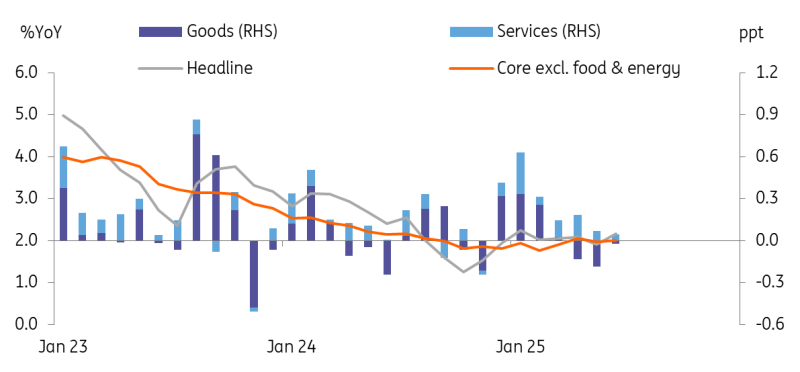
Source: CEIC
BoK watch
At next week’s 10 July BoK meeting, markets largely anticipate no policy action. In his guidance, Governor Rhee is expected to adopt a more hawkish stance in response to the recent increase in housing prices and household debt. Despite the government's implementation of measures such as a mortgage limit of up to 0.6 billion KRW and the tightening of loan-to-value and debt-service ratio rules to mitigate the overheated housing market in Seoul, these measures will be effective after a few months' delay. Consequently, the BoK is expected to exercise caution regarding financial instability in the near term and delay its interest rate cut until October.
Read the original analysis: South Korean inflation rises due to base effect, keeping BoK rates on hold next week
Author
ING Global Economics Team
ING Economic and Financial Analysis
From Trump to trade, FX to Brexit, ING’s global economists have it covered. Go to ING.com/THINK to stay a step ahead.