Soft March CPI strengthens case for rate cuts in China


CPI inflation failed to rebound above the zero threshold in March as price pressures persist across the board. Combined with a sharp escalation of tariffs, this sets up a suitable window for the People's Bank of China to resume monetary policy easing
Deflationary pressures remain significant
CPI inflation rose slightly from -0.7% year-on-year to -0.1% YoY in March, coming in softer than forecasts as we saw broad-based price pressures across the economy.
Both food and non-food inflation slowed in month-on-month terms, bringing the YoY inflation rates to -1.4% and 0.2% respectively.
In food inflation, the biggest drags on inflation were fresh vegetables (-6.8%) as well as beef (-10.8%) and mutton (-5.4%). Pork prices (6.7%) continued to be the main support for food inflation but have been declining in sequential terms for several months now. The pork cycle has been on a downturn, with sequential price declines in five of the past six months, but trade disruptions could throw a wrench in the cycle.
In non-food inflation, we can see the impact of price competition in many categories. The transportation facility category including cars was down to -4.0% YoY. The communication facility category which covers various electronics remained positive at 1.4% YoY but saw a third straight month of sequential price declines. Rents remained in negative inflation for a twelfth consecutive month at -0.1% YoY, but eked out a slight MoM gain of 0.1% and could be soon returning above the zero bound.
To no one's surprise, PPI inflation remained negative for the 30th consecutive month as well amid falling raw material prices.
As tariffs on US agricultural products come into effect, it's possible this could begin to pressure food prices higher, perhaps most notably through the pork cycle which has historically had significant exposure to US soybean imports. It's uncertain at this point if China will be able to source these imports from other areas without experiencing a notable price hike.
However, non-food prices will likely face further pressure, as US tariffs will worsen the overcapacity issues and likely prompt further price competition as exporters previously selling to the US market will need to find new buyers.
A question is if this year's measures to boost domestic demand will help restore inflation to a healthier trajectory. While this makes sense on an intuitive level, currently policy support for consumption is mostly focused on the trade-in policy, which in essence subsidises consumption through providing discounts and as such should do little to move price levels higher. It's possible that if consumption-support policies are expanded toward general use consumption vouchers, or if we see minimum wage hikes or tax bracket adjustments, these would be more conducive to moving inflation higher.
Price pressures persist as CPI and PPI inflation both remained negative

Weak inflation read and mounting tariff pressure should prompt PBOC easing
In light lower-than-expected inflation in the first quarter, as well as an escalation of tariffs which will worsen the overcapacity problem and intensify price competition, we are downgrading our 2025 CPI inflation forecast from 0.7% to 0.0% YoY.
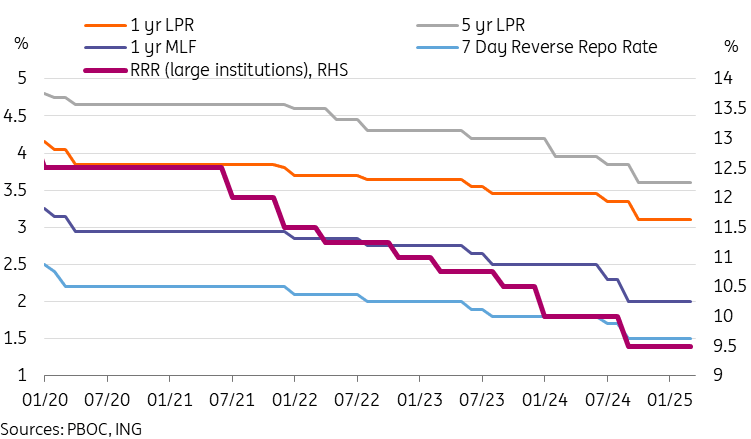
At the Two Sessions, policymakers vowed a "moderately loose" monetary policy stance, and noted that we'd see timely cuts in interest rates and required reserve ratios. With inflation still failing to break above zero, and the economy facing new challenges this year as the trade war has quickly escalated to full throttle, we think we are now in a favourable period for the People's Bank of China to provide further easing beyond the open market operations that they have been conducting in the past weeks.
Given last year's experience, we think it is more likely we could see a bundled package of monetary policy easing, as last year's piecemeal measures had a smaller impact in stabilising market confidence. Our forecasts have looked for 30bp of cuts to the 7-day reverse repo rate, and 100bp of RRR cuts, and we expect this could be front loaded in the second or third quarter. If trade tensions persist or if there are signs that domestic demand has not picked up sufficiently through the year, it's possible to see more aggressive easing as well.
PBOC could soon cut rates and RRR to support the economy
Read the original analysis: Soft March CPI strengthens case for rate cuts in China
Author
ING Global Economics Team
ING Economic and Financial Analysis
From Trump to trade, FX to Brexit, ING’s global economists have it covered. Go to ING.com/THINK to stay a step ahead.

















