Silver's two-speed market: New York refills while Shanghai pays up

New York's silver vaults are refilling, which looks bearish, and yet the tightness didn't vanish, it just moved to Shanghai, where buyers now pay roughly 11% over the world price.
Silver has spent the last two weeks looking like a market that lost its story. The metal sits near $61.50, gold trades around $4,150, and the gold-silver ratio has settled near 67. Silver is down about 13% from its end-2025 close near $71 and roughly 49% below the January 29 all-time high of $121.62, though still up close to two-thirds from a year ago. On the surface, that is a soft tape, and the headline that keeps circulating makes it look softer still: the silver held in New York's futures warehouses is going up, not down.
That is the puzzle worth sitting with. At Golden Meadow®, the work behind the Silver Catalyst newsletter starts from a simple fact that has not changed. The market is in its sixth consecutive annual deficit, a shortfall of 46.3 million ounces per Metals Focus and the Silver Institute. If demand is outrunning supply for the sixth year running, why would the vaults be filling back up? The answer is that the shortage did not go away. It changed address.
The West rebuilds while the East pays up
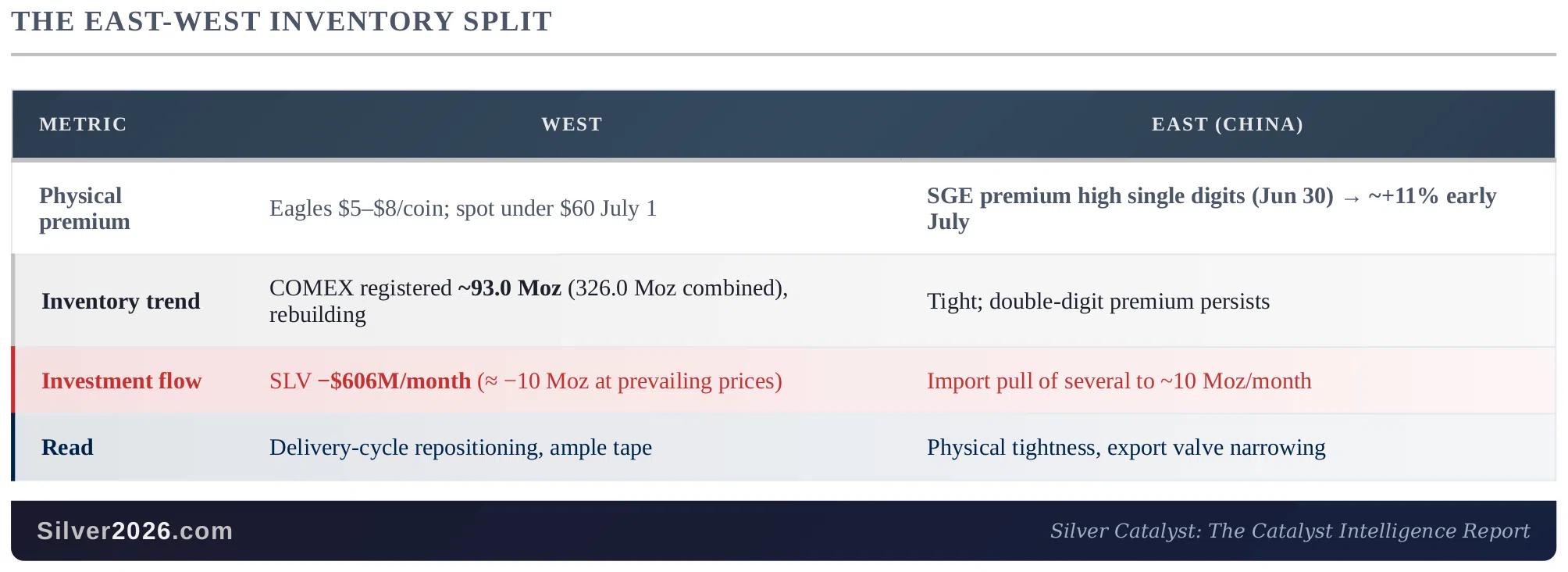
Start with the number that spooks people. Silver held in COMEX warehouses that is actually pledged to settle futures contracts, the category exchanges call "registered," climbed to about 93.0 million ounces on the July 6 report, against 233.0 million ounces of "eligible" metal (stored in the same vaults but not offered for delivery) for a combined 326.0 million ounces. Registered stock was near 82 million ounces in mid-June, so the deliverable pool has climbed by about 11 million ounces in three weeks. Read on its own, a rising deliverable pile looks like loosening.
It is not fresh metal arriving from mines. It is repositioning inside the system ahead of the active July delivery month, with eligible metal being reclassified into registered so it can settle contracts. The pool that traders watch is expanding on paper, and that is the part the West sees.
The East sees something else. On the Shanghai Gold Exchange, silver traded at a premium of high single digits over the international price at the June 30 benchmark fixes, and that gap widened to roughly 11% by early July. A premium that large is a standing incentive to pull metal toward China, though it has to be read net of local taxes, currency, and import costs rather than treated as pure scarcity. Even discounted for those, a double-digit premium is the market's clearest live signal of where physical silver is genuinely tight.
The two pictures are not contradictory. They describe one market with two speeds. Western holders are comfortable letting metal move into deliverable inventory because their own demand is soft: the largest silver exchange-traded fund, SLV, saw net outflows of about $606 million over the past month, roughly 10 million ounces of investment selling at current prices, and US retail stayed quiet, with 2026 American Silver Eagle premiums down around $5 to $8 a coin. Chinese buyers, meanwhile, are paying up to secure the physical metal. Layer on Beijing's July 1 move to enforce strategic-mineral export controls, under which silver is reportedly licensed, and the direction of travel sharpens: metal is being kept inside China while the West treats it as ample.
Sources: CME: Silver Warehouse Stocks | MetalCharts: Shanghai Silver Premium | ETF Database: SLV Fund Flows | Morgan Lewis: China Export-Control Enforcement
What this means to silver investors
The most useful thing to understand about a structural deficit is that it does not require every vault to drain every month. It requires demand to exceed supply over the year. In the meantime, metal sloshes between regions, and a market can look loose in one place while it is tight in another. That is exactly what is happening now.
So the lesson is not to read a rebuilding New York warehouse as a loosening market. Silver's headline price is set on Western paper, where funds and traders move fast and can step aside for a stretch, while the physical shortage tends to show up first in Eastern demand and premiums. The two can point in opposite directions for months, and the vault build is a symptom of that split, not a refutation of the deficit.
None of this is a forecast about where the price goes next, and it is worth being honest about the other side. The Western outflows and the soft retail bid are real, premiums can compress as quickly as they widened, and a regional gap can persist longer than anyone expects. But the longer-term case for silver has never rested on any single week's vault report. It rests on a supply-demand balance that has run short for six years, and on the fact that the marginal buyer of physical metal increasingly sits in the East. If you want to see how silver has traded in 2026 against that backdrop, the divergence between paper and physical is the throughline.
A rebuilding vault in New York and an 11% premium in Shanghai are the same story told from two sides. The West is where silver is priced. The East is where the shortage is showing.
Want free follow-ups to the above article and details not available to 99%+ investors? Sign up to our free newsletter today!
Author

Przemyslaw Radomski, CFA
Gold Price Forecast
Przemyslaw Radomski, CFA (PR) is a precious metals investor and analyst who takes advantage of the emotionality on the markets, and invites you to do the same. His company, Sunshine Profits, publishes analytical software that any
















