Silver selloff deepens as US PPI lifts Fed hike expectations
XAG/USD is down sharply in today’s session, with the precious metal losing more than 4% following another failed attempt by buyers to break above $68.00. Price tested a low around $63.87 before recovering slightly to trade around $64.68 at the time of writing.
US Producer Price Index data has not been the biggest driver of market moves in recent times. However, in an environment where investors increasingly expect the Federal Reserve to raise interest rates in September because of surging oil prices and lingering geopolitical tensions, today’s PPI report became more important.
Headline PPI increased by 0.4% month-on-month in August, in line with market expectations. However, annual producer inflation accelerated to 5.4% from 4.8% in July, while energy prices increased by 4.2%. Core producer prices, which exclude food and energy, rose by 0.2% on the month.
The report did not beat the headline monthly expectation, but the increase in annual inflation and continued pressure from energy prices gave the market another reason to price in a Federal Reserve rate hike next week.
The probability of a 25-basis-point September hike increased to around 70% after the report, from approximately 62% before its release. The US dollar strengthened, Treasury yields initially moved higher and precious metals came under pressure.
Silver fell by approximately 4.2%, while gold declined by more than 1%. EUR/USD and GBP/USD also traded lower as the US dollar emerged as one of the strongest currencies in the market.
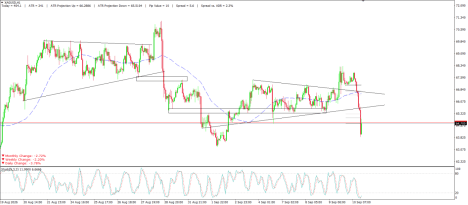
Buyers pushed above the upper boundary of the ascending structure and the resistance around $66.85 yesterday, supported by the rising 50-period moving average. The move appeared to open the possibility of further gains if dollar weakness continued.
However, that breakout has now failed. Silver has erased all the gains recorded since September 4 and moved back below the previous resistance area.
Sellers are currently in control, with the former support region around $65.69–$65.70 now acting as resistance. A short-term recovery is underway, but buyers may struggle to extend it unless price can reclaim this region.
A rejection from $65.70 would keep sellers in control and increase the risk of another test of the session low around $63.87. A sustained break below that level would confirm that the bearish momentum remains intact.
The upcoming US CPI report remains important, both for the September interest-rate decision and the Federal Reserve’s policy direction for the rest of the year. A stronger-than expected CPI print would reinforce expectations for a September hike and could increase the possibility of further tightening later in the year.
Such an outcome would likely support the US dollar and Treasury yields, creating additional pressure on silver and other non-yielding precious metals.
A softer inflation report, however, could reverse part of today’s market reaction by reducing expectations for aggressive tightening. That could allow silver buyers to extend the current recovery and attempt to reclaim the $65.70 resistance region.
The market will also be watching for renewed political pressure on the Federal Reserve. President Trump has continued to argue for lower interest rates, even as inflation concerns and the strength of recent economic data have increased market expectations for tighter monetary policy.
In the meantime, sellers remain in control despite the stochastic oscillator moving into oversold territory. This oversold reading increases the possibility of a temporary retracement, but it does not by itself confirm that the decline has ended.XAG/USD is down sharply in today’s session, with the precious metal losing more than 4% following another failed attempt by buyers to break above $68.00. Price tested a low around $63.87 before recovering slightly to trade around $64.68 at the time of writing.
US Producer Price Index data has not been the biggest driver of market moves in recent times. However, in an environment where investors increasingly expect the Federal Reserve to raise interest rates in September because of surging oil prices and lingering geopolitical tensions, today’s PPI report became more important.
Headline PPI increased by 0.4% month-on-month in August, in line with market expectations. However, annual producer inflation accelerated to 5.4% from 4.8% in July, while energy prices increased by 4.2%. Core producer prices, which exclude food and energy, rose by 0.2% on the month.
The report did not beat the headline monthly expectation, but the increase in annual inflation and continued pressure from energy prices gave the market another reason to price in a Federal Reserve rate hike next week.
The probability of a 25-basis-point September hike increased to around 70% after the report, from approximately 62% before its release. The US dollar strengthened, Treasury yields initially moved higher and precious metals came under pressure.
Silver fell by approximately 4.2%, while gold declined by more than 1%. EUR/USD and GBP/USD also traded lower as the US dollar emerged as one of the strongest currencies in the market.
Buyers pushed above the upper boundary of the ascending structure and the resistance around $66.85 yesterday, supported by the rising 50-period moving average. The move appeared to open the possibility of further gains if dollar weakness continued.
However, that breakout has now failed. Silver has erased all the gains recorded since September 4 and moved back below the previous resistance area.
Sellers are currently in control, with the former support region around $65.69–$65.70 now acting as resistance. A short-term recovery is underway, but buyers may struggle to extend it unless price can reclaim this region.
A rejection from $65.70 would keep sellers in control and increase the risk of another test of the session low around $63.87. A sustained break below that level would confirm that the bearish momentum remains intact.
The upcoming US CPI report remains important, both for the September interest-rate decision and the Federal Reserve’s policy direction for the rest of the year. A stronger-than expected CPI print would reinforce expectations for a September hike and could increase the possibility of further tightening later in the year.
Such an outcome would likely support the US dollar and Treasury yields, creating additional pressure on silver and other non-yielding precious metals.
A softer inflation report, however, could reverse part of today’s market reaction by reducing expectations for aggressive tightening. That could allow silver buyers to extend the current recovery and attempt to reclaim the $65.70 resistance region.
The market will also be watching for renewed political pressure on the Federal Reserve. President Trump has continued to argue for lower interest rates, even as inflation concerns and the strength of recent economic data have increased market expectations for tighter monetary policy.
In the meantime, sellers remain in control despite the stochastic oscillator moving into oversold territory. This oversold reading increases the possibility of a temporary retracement, but it does not by itself confirm that the decline has ended.
Author

Olalekan Akinola
Independent Analyst
Olalekan Akinola is a financial-markets analyst and writer with five years of experience covering forex, commodities, and global macroeconomic developments.