Silver Price Forecast: Fed decision could trigger a XAG/USD slump toward $64
XAG/USD Current price: $79.36
- The Middle East war is likely to impact central banks’ decisions.
- Market participants anticipate a hawkish shift by the Federal Reserve.
- XAG/USD pressures immediate support at $77.60, break lower exposes $64.
Silver traders are engaged in what so far seems a lost battle to take XAG/USD back towards record highs. The precious metal is stuck at lower levels, and trading around the $80 mark for a second consecutive day, indifferent to the market’s mood swings.
Sentiment has improved a bit on Tuesday, or at least did not deteriorate further due to the Iran war. Stock markets turned positive after a soft start, and kept demand for the Greenback in check, although Wall Street suffered a setback after an optimistic start. The US Dollar (USD) partially lost the market’s favor in anticipation of the Federal Reserve (Fed) monetary policy announcement on Wednesday, which will include fresh economic projections.
The looming announcement weighs on the Greenback, as market players anticipate a chaotic situation in the Fed’s headquarters: Chair Jerome Powell is on its way out, voting members are split, President Donald Trump longs for much lower interest rates, and soaring oil prices anticipate inflation will run higher, much higher than the Fed’s 2% goal in the upcoming months.
True, the Fed is likely to hold rates unchanged and lean hawkish. In an ideal scenario, that should be bullish for USD. But we are far from an ideal world.
Possible Silver reaction to Fed announcement
Regarding precious metals’ behaviour, market players will assess not only the Fed’s decision on the USD, but also how the market’s sentiment unfolds afterwards. But for Silver, it seems a lose-lose scenario.
An extrinsically hawkish Fed will immediately boost demand for the USD versus major rivals. Also, if the Summary of Economic Projections (SEP) includes upward revisions to inflation prospects, and be sure it will, the Greenback will go up.
Excessively concerned Federal Open Market Commission (FOMC) members could initially trigger demand for Silver and Gold, but beware of quick retracements once the market digests the news.
A split vote will be no surprise and probably be the least concerning part of the event. It’s no news, and something for the upcoming Chairman, Kevin Warsh, to deal with.
The Fed would have to deliver an extremely dovish decision, such as cutting rates, to put significant and sustained pressure on the USD, quite an unlikely scenario.
XAG/USD Technical Outlook
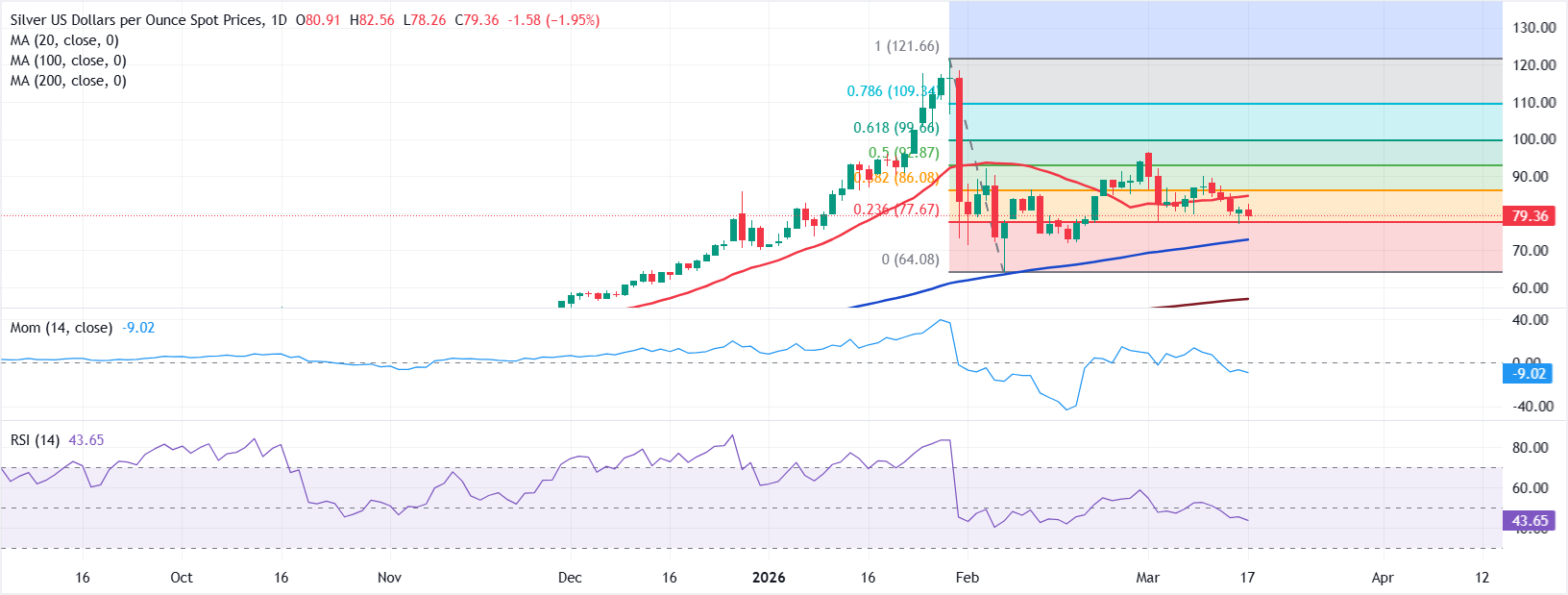
The XAG/USD pair is trading a handful of pips above the 23.6% Fibonacci retracement of the $121.66 - $64.08 decline, with the immediate support level in the $77.60 area. A break below it exposes the February 17 low around $72.00, while below the latter, there’s nothing in the way until the bottom of the range. Resistance, on the other hand, comes at the 38.2% retracement at $86.08, while the next Fibonacci resistance comes at $92.87. As long as Silver remains below the 61.8% retracement just ahead of the $100 psychological mark, the risk will remain skewed to the downside.
Other than that, technical readings in the daily chart show XAG/USD is mildly bearish as price holds below the 20-day Simple Moving Average (SMA) near $84.70 while remaining above the rising 100- and 200-day SMAs. The Momentum indicator aims south below 0 and weakens, indicating fading buying pressure after the recent rebound from the mid-$70s. Finally, the Relative Strength Index (RSI) indicator is around 44 with a downside tilt, reflecting increased selling interest.
(The technical analysis of this story was written with the help of an AI tool.)
Fed FAQs
Monetary policy in the US is shaped by the Federal Reserve (Fed). The Fed has two mandates: to achieve price stability and foster full employment. Its primary tool to achieve these goals is by adjusting interest rates. When prices are rising too quickly and inflation is above the Fed’s 2% target, it raises interest rates, increasing borrowing costs throughout the economy. This results in a stronger US Dollar (USD) as it makes the US a more attractive place for international investors to park their money. When inflation falls below 2% or the Unemployment Rate is too high, the Fed may lower interest rates to encourage borrowing, which weighs on the Greenback.
The Federal Reserve (Fed) holds eight policy meetings a year, where the Federal Open Market Committee (FOMC) assesses economic conditions and makes monetary policy decisions. The FOMC is attended by twelve Fed officials – the seven members of the Board of Governors, the president of the Federal Reserve Bank of New York, and four of the remaining eleven regional Reserve Bank presidents, who serve one-year terms on a rotating basis.
In extreme situations, the Federal Reserve may resort to a policy named Quantitative Easing (QE). QE is the process by which the Fed substantially increases the flow of credit in a stuck financial system. It is a non-standard policy measure used during crises or when inflation is extremely low. It was the Fed’s weapon of choice during the Great Financial Crisis in 2008. It involves the Fed printing more Dollars and using them to buy high grade bonds from financial institutions. QE usually weakens the US Dollar.
Quantitative tightening (QT) is the reverse process of QE, whereby the Federal Reserve stops buying bonds from financial institutions and does not reinvest the principal from the bonds it holds maturing, to purchase new bonds. It is usually positive for the value of the US Dollar.
(This story was corrected on March 17 at 17:00 GMT to say that XAG/USD pressures immediate support, not XAU/USD)
Author

Valeria Bednarik
FXStreet
Valeria Bednarik was born and lives in Buenos Aires, Argentina. Her passion for math and numbers pushed her into studying economics in her younger years.